In an era saturated with algorithmic certainty, Kenny Easwaran revisits a foundational philosophical framework that challenges the very nature of how we quantify uncertainty. Rather than treating probability as a fixed frequency of events, Easwaran argues it is a dynamic measure of our own mental confidence, a distinction that transforms how we approach everything from coin flips to geopolitical forecasting. This is not merely a math lesson; it is a rigorous defense of the idea that rational belief itself can be calculated.
The Nature of Belief
Easwaran begins by dismantling the traditional view that probability requires randomness. He writes, "Bayesianism is a collection of positions in several related fields centered on the interpretation of probability as something like degree of belief as contrasted with relative frequency or objective chance." This reframing is the piece's intellectual engine. By decoupling probability from physical chance, Easwaran allows us to assign mathematical weight to hypotheses that have never occurred, such as the likelihood of a future pandemic or the existence of a deity. The argument lands because it mirrors how smart people actually think: we hold varying levels of confidence in different ideas, even when those ideas aren't subject to dice rolls.
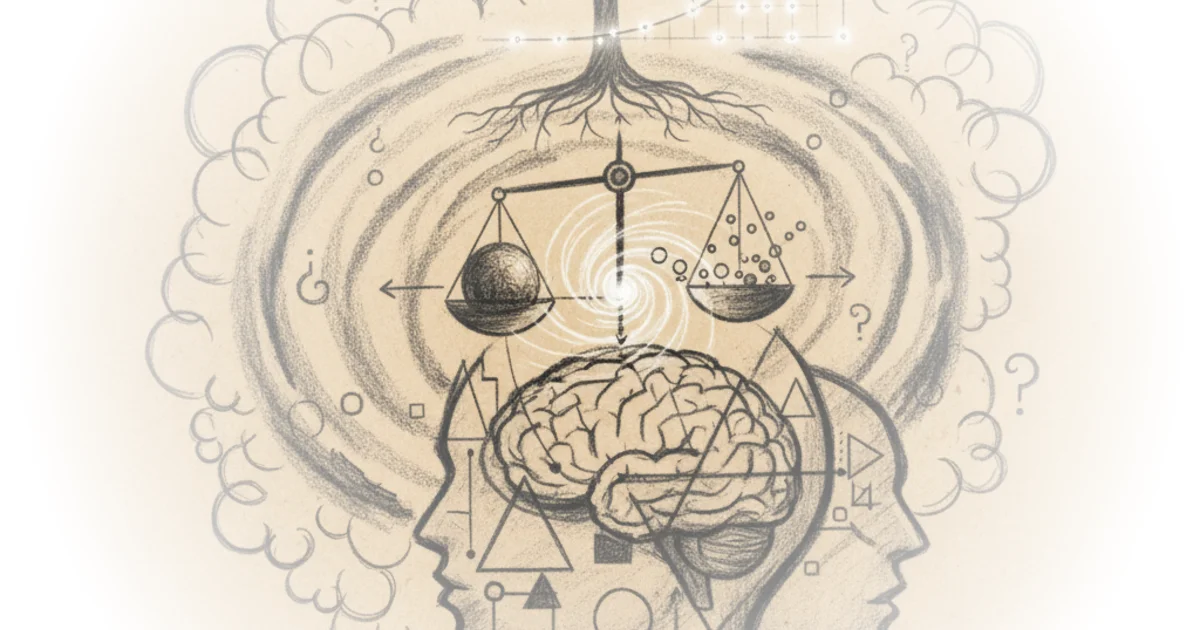
However, the author is careful to distinguish this from pure subjectivity. He notes that while the starting point might vary, the rules for updating those beliefs are rigid. "Bayesians agree about how you should change these probabilities when you gather evidence," Easwaran explains, highlighting that the mathematics of belief revision remains constant even if the initial assumptions differ. This is a crucial nuance often lost in popular discussions of the topic. It suggests that while we may start with different priors, the evidence forces us toward a shared convergence, provided we follow the logic.
Critics might note that the reliance on a "prior probability"—the initial belief before seeing evidence—can be a weak point if that starting point is arbitrary or biased. Easwaran acknowledges this tension, admitting that philosophers disagree on whether there are objectively correct priors to have. Yet, he maintains that the mechanism of updating remains the most robust tool we have for navigating an uncertain world.
The Architecture of Rationality
The commentary then shifts to the structural requirements of being rational. Easwaran posits that for an agent to be perfectly rational, their beliefs must align with the strict axioms of probability theory. He writes, "For an agent to be perfectly rational her degrees of belief must obey the axioms of probability theory." This claim is bold, suggesting that incoherence in belief is not just a philosophical error but a mathematical impossibility for a rational mind. The author leans on the work of Andrey Kolmogorov, describing probability as an "abstract mathematical structure" that applies to our internal states just as it does to external events.
The core innovation is that just as we can calculate the probability of an outcome, we can calculate the probability that a hypothesis is true.
Easwaran illustrates this with the classic coin flip example. If a coin lands heads three times in a row, the probability of it being double-headed increases significantly compared to it being fair. He explains, "The Bayesian probability of the coin being double-sided is going to go up by a factor of 8 compared to the Bayesian probability of the coin being fair." This specific ratio demonstrates the power of the framework: it quantifies exactly how much a single piece of evidence should shift our worldview. It moves belief from a binary state of "I think" or "I don't think" to a spectrum of confidence that updates with every new data point.
Yet, the application of this math to real-world complexity raises questions. Easwaran admits that while the theory works elegantly for coin flips, extending it to "hypotheses that don't give mathematically precise chances"—like the probability of a war resolving this year—is where the debate intensifies. The framework demands precision where the world often offers only ambiguity. This is the friction point where the elegance of the math meets the messiness of human affairs.
The Divide Between Synchronic and Diachronic
A significant portion of Easwaran's analysis focuses on the temporal nature of belief. He distinguishes between "synchronic" conditions—how beliefs must relate to each other at a single moment—and "diachronic" conditions—how they must evolve over time. He writes, "The second claim about probability is just saying what they have to be like... omitting this third claim about how beliefs are updated is a weaker position called probabilism." This distinction is vital for understanding the full scope of Bayesianism. It is not enough to simply hold coherent beliefs; one must also have a rule for how those beliefs change when confronted with new information.
The author suggests that this updating rule, often called conditionalization, is the "standard way the beliefs change over time." This implies that rationality is not a static state but a continuous process of adjustment. Easwaran frames this as a response to the skepticism of philosophers like David Hume, who argued that we can never justify beliefs about the future based on past observations. Easwaran counters this by showing that while we cannot prove the future will look like the past, we can mathematically justify increasing our confidence in a hypothesis as evidence accumulates.
Bayesian probability reflects your uncertainty about the hypothesis while the probabilities of the coin flips are supposed to reflect some sort of objective chance or randomness in the world.
This separation of internal uncertainty from external chance is the piece's most enduring insight. It validates the feeling of not knowing while providing a rigorous method to manage that ignorance. Easwaran's approach effectively bridges the gap between abstract philosophy and practical decision-making, offering a toolkit for anyone trying to make sense of a noisy world.
Bottom Line
Easwaran's commentary succeeds in demystifying Bayesianism, presenting it not as a rigid mathematical dogma but as a flexible framework for rational thought. Its greatest strength lies in its ability to quantify the unquantifiable, turning vague confidence into actionable data. However, its biggest vulnerability remains the subjective nature of the initial "prior" belief, which can skew results if not carefully scrutinized. For the busy reader, the takeaway is clear: while we cannot eliminate uncertainty, we can master the art of updating our beliefs in the face of it.