Hochuli and Hoare deliver a startling diagnosis: the current surge in American aggression isn't a return to isolationism or traditional realism, but a dangerous new fusion they call 'civilisationalism.' This framework explains why the executive branch can simultaneously claim to respect sovereignty while actively undermining it through direct interference in foreign elections and military strikes. For busy observers trying to make sense of contradictory foreign policy moves, this piece offers a crucial lens that moves beyond personality cults to examine the structural logic of modern power.
The Third Way Between Isolation and Internationalism
The authors challenge the standard binary that pits globalist intervention against nationalist withdrawal. They argue that the administration has settled on a third option that defies traditional categorization. As Hochuli and Hoare write, "Between internationalism and isolationism, there is a third option: civilisationalism." This distinction is vital because it explains why the White House can act with such unpredictability; it is not bound by the old rules of the post-Cold War order.
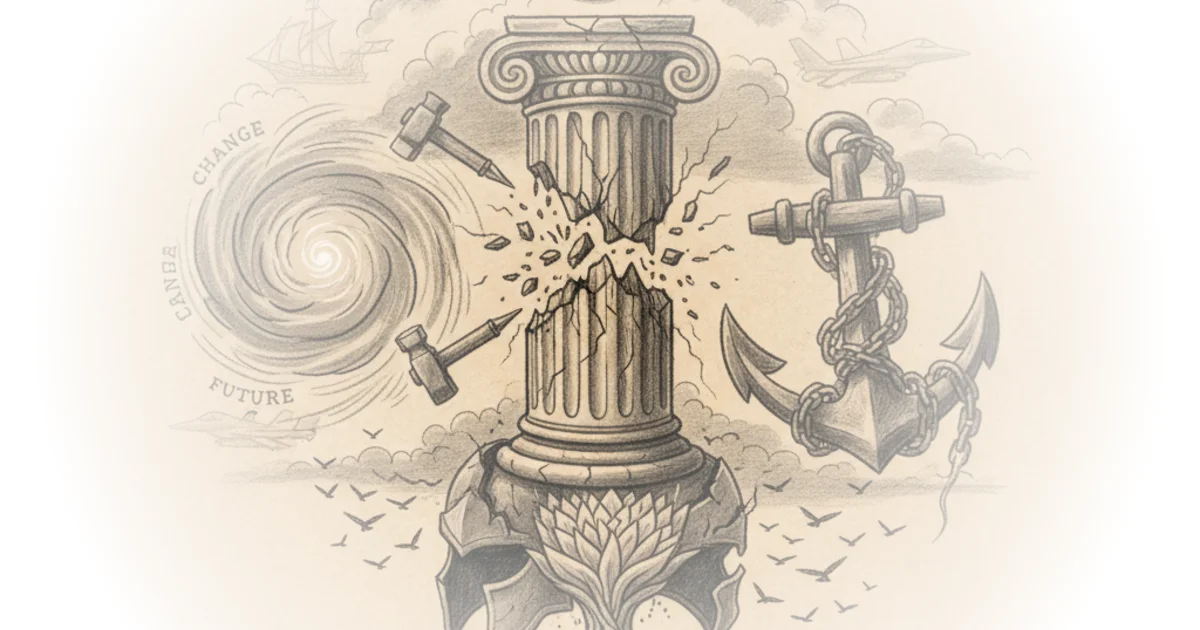
The commentary suggests that this approach is not a rejection of power, but a rebranding of it. The authors note that the administration's strategy "opens up new tactics unconstrained by norms of sovereign noninterference, such as overt support for, or contact with, civil society actors and political parties ideologically aligned with the current administration." This observation is particularly sharp, as it highlights how the executive branch is bypassing diplomatic protocols to pursue ideological goals directly. Critics might argue that this is simply neoconservatism in disguise, but Hochuli and Hoare contend that the fusion of populist rhetoric with interventionist tactics creates something distinct from the 2000s era of nation-building.
"The entire civilisational paradigm is well-suited to papering over the rupture within the Atlanticist framework."
This insight connects the current US posture to a broader European anxiety. The authors suggest that this narrative allows European elites to accept demands for greater subservience to Washington by framing it as a defense of a shared heritage against external threats. It is a compelling argument that reframes the transatlantic relationship not as a partnership of equals, but as a civilizational hierarchy.
The Mirage of the Past
A central theme of the piece is the idea that the right's appeal to tradition is actually a product of modernity's failures, not a return to a pre-modern state. The authors argue that attempts to reject modernity often result in "pathological products of modernity itself, often expressing its most violent or irrational tendencies." This is a sophisticated critique that avoids the trap of simply dismissing the movement as irrational; instead, it treats the movement as a logical, albeit destructive, response to the disintegration of social cohesion.
The text points out that this vision of "re-civilization" often excludes the very Enlightenment values that made the West powerful. Hochuli and Hoare observe, "when figures like Meloni identify the European legacy with Greek philosophy, Roman law and Christian ethics, what is flagrant in its absence is the Enlightenment." This omission is strategic, allowing the movement to claim cultural depth while rejecting the universalist principles of human rights and reason. The authors draw a parallel to the 2006 discourse on the "Clash of Civilizations," noting how the rhetoric has shifted from a war on terror to a war on "narco-terrorism," effectively combining old enemies into a new mega-enemy to justify continued aggression.
"Civilisation is only meaningful today, in modernity, under total capitalism, as a normative notion — the social conditions for human flourishing."
This is the piece's most profound claim. It suggests that the only way to salvage the concept of civilization is to strip it of its racial or religious exclusivity and redefine it as a project of social well-being. The authors argue that the current political discourse uses the language of civilization to avoid reckoning with the unique crises of modern capitalism, such as the erosion of family structures and the drive for sterile consumption.
The Limits of the Argument
While the analysis of the ideological shift is robust, the piece acknowledges that this vision lacks a concrete political-economic program for the masses. The authors admit, "this vision is not able to offer the masses anything in political-economic terms. What it does have... is ideological gruel." This is a significant vulnerability; without a material solution to the economic anxieties driving the populist surge, the civilizational narrative may remain a tool for elite consolidation rather than a genuine path to stability.
Furthermore, the argument that the Enlightenment cannot be defended but only advanced as a critical project is a high bar for political action. Critics might note that in a polarized environment, the abstract defense of critical projects often fails to mobilize the broad coalitions necessary to counter authoritarian trends. The authors seem to recognize this, noting that the "civilisation" to which the radical right refers is ultimately a "mirage" used to manipulate political identity.
Bottom Line
Hochuli and Hoare provide a necessary corrective to the view that current US foreign policy is merely a chaotic departure from norms; instead, they reveal a coherent, albeit dangerous, logic of civilizational dominance. The piece's greatest strength is its ability to link domestic cultural anxieties with international aggression, showing how the two reinforce each other. However, its reliance on a normative redefinition of civilization leaves it without a clear roadmap for political resistance, making it a powerful diagnosis but an incomplete prescription.