Then & Now delivers a searing diagnosis of modern exhaustion, arguing that burnout is not merely a personal failure of resilience but a structural flaw in how we organize work and value human life. By weaving together global statistics, historical deep dives into the Industrial Revolution, and the surprising story of workers who voluntarily chose longer hours, the author challenges the simplistic narrative that we just need to "work less." This is essential listening for anyone who feels the weight of the grind, offering a framework that connects the personal ache of fatigue to the political machinery of productivity.
The Anatomy of a Modern Epidemic
The piece opens with a stark, undeniable reality: burnout is ubiquitous. Then & Now writes, "66% of Americans are burnt out at work this year," before pivoting to the grim reality in China, where over half a million people die annually from overwork, a phenomenon they term karoshi. This global perspective immediately elevates the conversation from a personal complaint to a systemic crisis. The author effectively uses the origin story of the term itself to ground the discussion. They recount how psychiatrist Herbert Freudenberger coined "burnout" in 1974 after observing that the staff at his drug clinic were often in a worse state than the addicts they were treating.
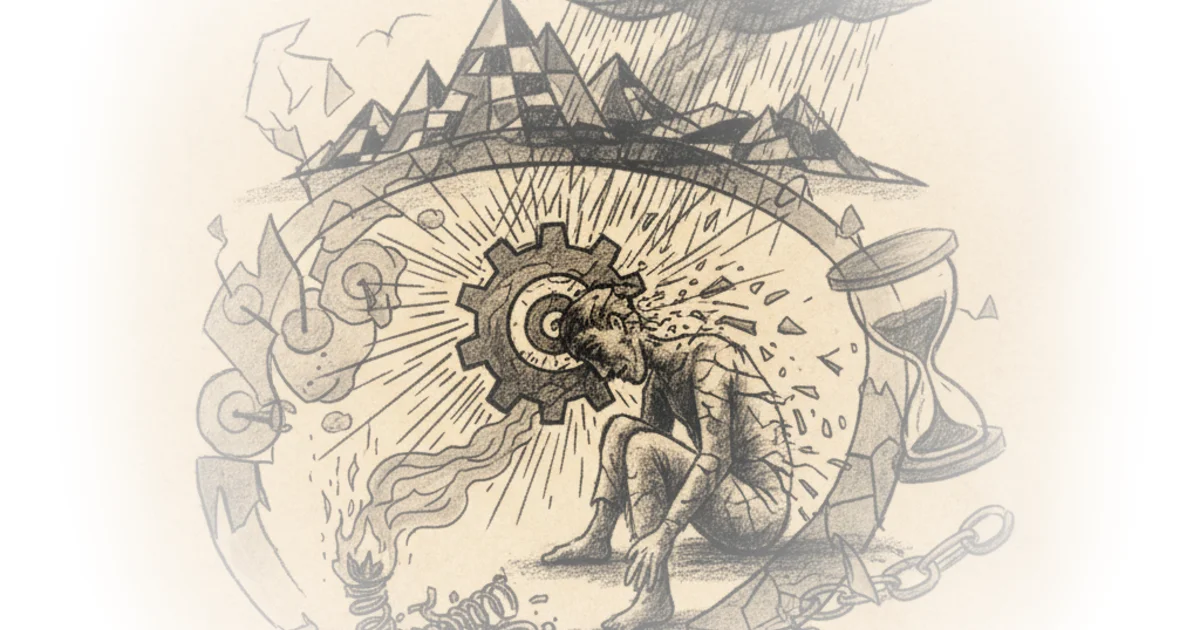
Freudenberger's insight was profound. Then & Now quotes him directly: "People as well as buildings sometimes burn out under the strain of living in our complex world. Their inner resources are consumed as if by fire leaving a great emptiness inside although their outer shells may be more or less unchanged." This metaphor of the hollowed-out shell is particularly potent for the busy professional listening in; it explains why one can appear functional while internally collapsing. The author notes that Freudenberger viewed this state as structurally similar to drug addiction, driven by an idealistic goal and a "do anything" attitude that ultimately consumes the self.
The commentary then shifts to the symptoms, moving beyond simple tiredness to a paralysis of decision-making. A medical doctor interviewed in the piece describes the cycle: "It doesn't matter what you do in your free time. It means you start making mistakes... It just like snowballs into this really really deep bad place that it's really hard to get out of." This description of the "snowball" effect is crucial. It highlights that burnout is not a static state but a degenerative process where exhaustion leads to errors, which lead to anxiety, which leads to more exhaustion. Critics might note that focusing heavily on individual anecdotes risks underplaying the role of specific corporate policies in different sectors, but the author balances this by bringing in Mark Roland, CEO of the Mental Health Foundation UK.
Burnout gives expression to the anxieties of our age.
The Illusion of the Grindset
Where the piece truly distinguishes itself is in its historical analysis of why we work the way we do. Then & Now challenges the reader to look past the quantity of hours and examine the structure of work. They introduce John Lubbock, a 19th-century British MP who fought for bank holidays and argued that "rest is not idleness because to lie sometimes under the grass... is by no means a waste of time." Lubbock serves as a counter-narrative to the modern "hustle" mentality, proving that high achievement and rest are not mutually exclusive.
The author then takes a sharp turn into the history of productivity, tracing the shift from the "original affluent society" of hunter-gatherers to the relentless efficiency of the Industrial Revolution. They describe how Josiah Wedgwood and later Frederick Taylor used stopwatches and bells to break human movement into micro-units, prioritizing efficiency over humanity. Then & Now writes, "Taylor was the father of the efficiency movement, a scientific approach to work... shaving off seconds here and there... to contribute to the most efficient factory system." This historical context is vital; it reframes our current exhaustion not as a new phenomenon, but as the culmination of centuries of optimizing humans for output.
However, the author introduces a fascinating twist that complicates the standard "capitalism is the enemy" narrative. They recount the story of Will Kellogg, who instituted a 30-hour work week during the Great Depression. Surprisingly, the workers eventually voted to return to a 40-hour week. Then & Now explains this paradox: "Most workers were clear. They wanted to work longer hours to take home more money to purchase more or better versions of the endless procession of constantly upgraded consumer products." This admission is brave. It suggests that the drive for overwork is not just imposed from above but is also internalized by us as a desire for more consumption. A counterargument worth considering is that this "choice" was made in a context of economic scarcity and limited options, which may not apply to the modern era of abundance.
The Path Forward
The piece concludes by synthesizing these threads: burnout is a gateway to serious mental illness, yet the solution is not simply working less, but making work more meaningful. Then & Now writes, "It's also about how to make work and by extension life more meaningful to get more out of ourselves. Not more productivity, but more life." This distinction is the piece's strongest takeaway. It moves the reader from a defensive posture (how do I survive?) to a constructive one (how do I live?).
The author emphasizes that the risk of burnout is severe, comparing it to physical burns that can cause "lifelong scarring impacts if you're seriously at third-degree burns where you're not able to escape from that kind of exposure." This medical analogy reinforces the urgency of the issue. By connecting the personal experience of fatigue to the political history of labor and the philosophical question of what constitutes a good life, Then & Now provides a comprehensive map for understanding our current exhaustion.
Bottom Line
Then & Now's most compelling argument is that burnout is a structural failure of meaning, not just a failure of time management, a point powerfully illustrated by the historical shift from necessary labor to the internalized drive for consumption. The piece's greatest vulnerability is its reliance on the assumption that workers can easily reclaim autonomy in rigid corporate structures, but its call to prioritize "more life" over "more productivity" remains a vital and necessary corrective to the current culture. This is a story that demands we stop asking how to be more efficient and start asking what we are actually working for.