In 1936, T.S. Eliot published a poem that would become one of the most significant long-form poems in English literature. What makes "Burnt Norton" extraordinary is its radical claim about what poetry can do — and what it cannot. Eliot wasn't just writing verse; he was attempting something Beethoven achieved with music: to push beyond the medium itself, toward something that points silently toward transcendence.
The World That Shaped Burnt Norton
The spring of 1936 was tumultuous. Across America, millions suffered during the Great Depression. Dust storms swept across the Great Plains. Record-breaking Atlantic hurricanes struck the South. In Europe, fascism rose and nations militarized. Hitler violated the Treaty of Versailles by moving troops into the Rhineland. The Nuremberg Laws stripped German Jews of citizenship.
Everyone knew war was coming. This was Eliot's moment to ask: what does it mean to write poetry when the world is collapsing?
"Burnt Norton" was first published not as part of Four Quartets, but as the final poem in a small collection called The Poetry of T.S. Eliot. It stood alone — a solitary experiment. The concept of four connected poems didn't emerge until Eliot was writing "East Coker," between October 1939 and March 1940.
A Transformation in Style
Eliot's style changed dramatically between "The Waste Land" (1922) and "Burnt Norton" (1936). Critics point to his conversion to Anglo-Catholicism as a factor, but the shift is more than religious. It's linguistic.
In "The Waste Land," meaning emerged through abrupt confluences of voices — fragments of literature, everyday conversation, private thoughts, all jarringly juxtaposed. In Four Quartets, meaning lives in what language cannot capture: its failure to communicate, but also what it can suggest and impress.
This is the heart of "Burnt Norton":
Words move. Music moves only in time. But that which is only living can only die. Words after speech reach into the silence. Only by the form, the pattern can words or music reach the stillness.
The Failure of Language
Eliot's central insight is that language strains, cracks, and sometimes breaks under burden. It slips, perishes, decays with imprecision. It will not stay in place or stay still.
"Words strain, crack, and sometimes break," he writes — acknowledging the insufficiency of words themselves. This isn't a flaw; it's the point. The poem cannot say what it tries to say, yet that very inability points toward something beyond language.
The fifth section of "Burnt Norton" enacts this fragility through form:
Words after speech reach into the silence.
Notice the enjambment — the line ends without punctuation, forcing meaning to carry over. The word "reach" reaches into the white space that follows. We must hold that reaching in our minds as we enter the next line: "or music reach" — and it points toward stillness (silence).
A Chinese Jar in Stillness
Eliot plays with double meanings beautifully:
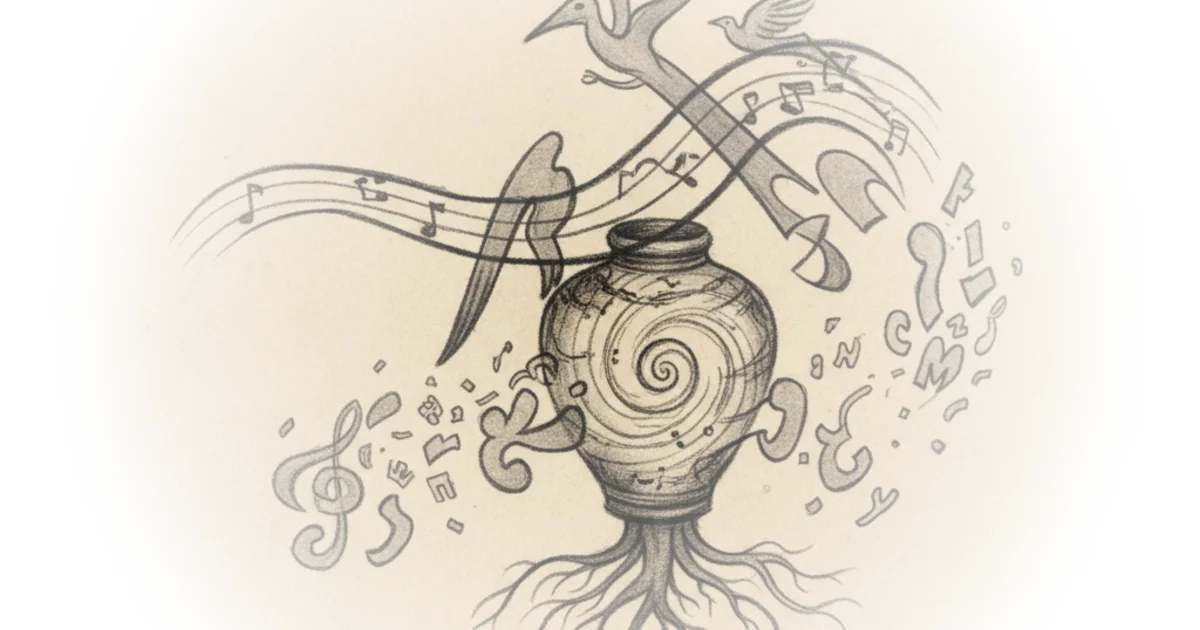
As a Chinese jar still moves perpetually in its stillness.
The word "still" means both tranquility and continuity. The jar is motionless, yet also enduring. It's as if the object tells a story that never ends — like viewing a three-dimensional painting that contains infinite narrative.
This is why language fails. Under the burden of capturing moments of perpetual stillness, words become imprecise because they point toward something beyond themselves rather than documenting it with precision.
The Musical Analogy
Eliot was reading D.H. Lawrence's letters in 1916. Lawrence wrote: "The essence of poetry with us in this age of stark and unloly actualities is stark directness without a shadow of a lie or a shadow of deflection anywhere."
This spoke to Eliot powerfully. In a 1923 letter to Ford Maddox Ford, Eliot described his goal: write poetry so transparent that we shouldn't see the poetry but what we're meant to see through it — "poetry standing naked in its bare bones" or "poetry so transparent that in reading it we are intent on what the poem points at and not on the poetry."
He added: "This seems to me the thing to try for to get beyond music as Beethoven in his later works strove to get beyond music."
The German Romantic poet Novalis regarded music as the highest form of poetry because it has that transparency — the immediacy of effect. The still surface of the mind meets the wrinkling winds of music, and one experiences impressions rather than messages: sensations and suggestions of beauty and truth, not direct statements.
Form as Meaning
Eliot's biographer Gordon Lindly observed that repetition is the very sermon of Four Quartets. Repetition composes the pattern and form — and this enacts the fragility and insufficiency of language itself.
The repetition of "the end precedes the beginning / and the end and the beginning were always there / before the beginning and after the end" creates a sense of time that doesn't flow linearly but exists in perpetual present. "All is always now" — not just the turning world, but every moment simultaneously.
Critics might note that this approach risks obscuring meaning entirely, leaving readers confused rather than enlightened. But that's precisely Eliot's point: clarity was never the goal.
Why Readers Loved Burnt Norton
When "Burnt Norton" was published, it stirred immediate acclaim. Critics and readers were moved by its portrait of inner life — it seemed to speak directly to their moment. "East Coker" would sell by the hundreds when published during the war, speaking to that wartime mindset.
D.H. Hardy, an early reviewer, described "Burnt Norton" as a newly created concept: equally abstract but vastly more exact and rich in meaning. "It makes no statement," he wrote. "It is not about anything than an abstract term like love is about anything."
Hardy identified two ways the poem approaches meaning. First, it presents concrete images — rose petals, the pool, the thrush, the trees — but we don't stay with them. They're introduced and then we're quickly ushered along before meaning roots in these images. Second, it works through abstract language: "Not the stillness of a violin while the note lasts" — not that only, but the coexistence.
The end precedes the beginning, and the end and the beginning were always there before the beginning and after the end.
This is getting at "that still point of the turning world" by introducing ready-made concepts and then rejecting them. That leads to the idea of music — which brings us back to why this poem matters.
Bottom Line
Eliot's achievement in "Burnt Norton" was revolutionary: creating poetry that points beyond itself, like music without lyrics, where form becomes transparent to what it represents. His biggest vulnerability is unresolved — whether readers can access this transparency or simply find the language too difficult to penetrate. But that's exactly the point. The poem doesn't aim for comprehension; it aims for apprehension.
The strongest part of the argument is that Eliot found a way to make form itself convey meaning — repetition creating pattern, enjambment enacting fragility, and silence becoming the ultimate destination. What readers should watch for: how these techniques evolved across all four quartets, each building on "Burnt Norton's" initial breakthrough.