The piece delivers a striking reframing of the current tech boom: it argues that the massive capital expenditure by the "Four Horsemen" of tech is not just a race for artificial intelligence, but a fundamental shift in how these companies view their own supply chains. Chipstrat posits that we are witnessing a transition from moving physical goods to minting digital tokens, where the margin lies not in the output, but in the efficiency of the machinery used to create it. This is a crucial distinction for busy investors who need to understand that the real battle is no longer just about who has the best model, but who owns the most efficient "tractors" for the new economy.
The Economics of the Tractor
Chipstrat begins by dismantling the assumption that these companies are merely buying servers; they are vertically integrating their entire production line. The article highlights that Alphabet Google has raised its 2025 capital expenditure forecast to a staggering $91 billion to $93 billion range. As the piece notes, "We're continuing to invest aggressively due to the demand we're experiencing from Cloud customers as well as the growth opportunities we see across the company." This isn't just spending; it's a strategic pivot. The editors point out that while this number sounds abstract, it represents a seismic shift: "While that might sound like chump change these days, it wasn't that long ago that the total quarterly CapEx was $6-8B!"
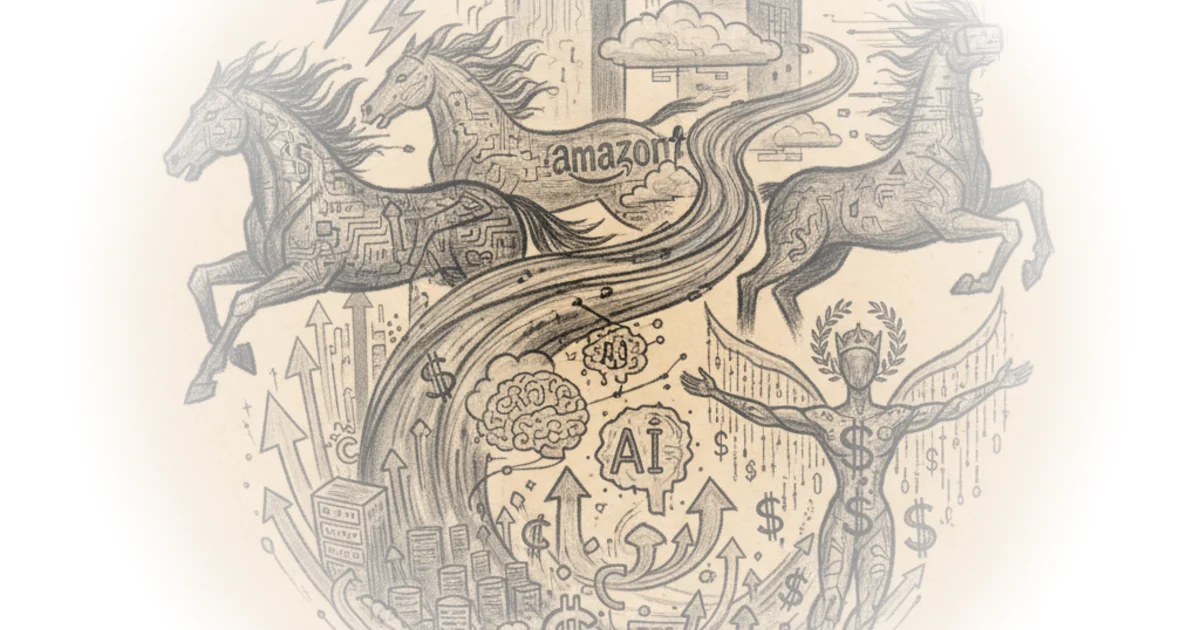
The commentary draws a sharp parallel to the agricultural sector to explain this behavior. Just as John Deere and Case IH compete on the margins of the equipment makers rather than the farmers producing the corn, these tech giants are betting that the highest returns will come from owning the infrastructure that generates the AI tokens. Chipstrat argues, "If you're going to be one of the world's largest token farmers, then it makes a ton of sense to design and build your own tractors." This analogy holds significant weight because it moves the conversation away from the hype of "intelligence" to the cold, hard math of cost structures.
"If AWS mints tokens more efficiently, the real question in the fullness of time: what kind of margin can you earn on a commodity? ... if you're going to be one of the world's largest token farmers, then it makes a ton of sense to design and build your own tractors."
Critics might note that this analogy oversimplifies the software ecosystem, where network effects and data moats often matter more than raw compute efficiency. However, the piece effectively uses the historical example of US Sugar, which built its own rail system to transport sugarcane efficiently, to illustrate why a hyperscaler might build its own networking layers. The editors suggest that just as US Sugar needed to control its logistics to lower production costs, Amazon's investment in custom silicon like Trainium is a direct response to the need to control the "rail system" for digital tokens.
The Cloud Wars and the AGI Wildcard
The narrative shifts to Microsoft, where the stakes involve not just infrastructure, but the very definition of the future. The piece scrutinizes the partnership between Microsoft and OpenAI, noting that investors are increasingly anxious about the "AGI wildcard." The editors highlight a moment of tension on the earnings call where CEO Satya Nadella was pressed on the timeline for Artificial General Intelligence. Nadella's response, as quoted by Chipstrat, was cautious: "I don't think AGI as defined at least by us in our contract is ever going to be achieved anytime soon."
This hesitation is framed as a necessary reassurance to shareholders, yet the article points out the fragility of this arrangement. The piece notes that while Nadella downplayed the timeline, OpenAI CEO Sam Altman offered a different perspective, stating, "I expect that the technology will take several surprising twists and turns and we will continue to be good partners to each other." The editors interpret this divergence as a sign that the partnership is not as ironclad as it appears, especially given the recent announcement of a $38 billion deal between OpenAI and Amazon's AWS.
"Oh, we just broke up and you already have a new girlfriend? That was fast… like you were already talking before we even broke up…"
Chipstrat argues that this pivot by OpenAI to AWS signals a broader market reality: the demand for compute is so vast that no single provider can meet it alone. The article points out a specific detail in the OpenAI announcement that is often overlooked: the mention of "tens of millions of CPUs" needed to scale agentic workloads. This suggests a massive expansion in the total addressable market for traditional processors, not just AI accelerators. The editors write, "This implies CPU server TAM will increase," a point that challenges the prevailing narrative that GPUs will eat the world.
The Meta Exception
Finally, the piece addresses the outlier: Meta. Unlike its peers, Meta does not have a cloud business to rent out its excess capacity. Chipstrat notes, "This horsemen isn't like the others. No cloud. Just Coors, personality, and flair." The editors argue that this structural difference creates a unique risk profile for Meta's massive capital outlays. While Microsoft and Amazon can sell their compute services, Meta must convert its infrastructure into advertising revenue.
The article quotes Meta CFO Susan Li, who stated, "We are still working through our capacity plans for next year, but we expect to invest aggressively to meet these needs, both by building our own infrastructure and contracting with third-party cloud providers." The editors interpret this as a high-stakes gamble. If Meta cannot monetize this compute through its ad business, the return on investment will lag behind its competitors. However, the piece offers a bullish counter-argument, suggesting that Meta's 3.5 billion daily active users provide a unique revenue model. "Businesses worldwide will bid to show their wares to each and every one of these users," the editors argue, implying that the sheer scale of the audience justifies the infrastructure spend even without a cloud division.
"3.5B people on the planet are NOT going to pay $60/year on average on ChatGPT. But you are dang right that businesses worldwide will bid to show their wares to each and every one of these users."
Bottom Line
Chipstrat's most compelling insight is the redefinition of these tech giants not as software companies, but as industrial manufacturers of intelligence, where the margin lies in the efficiency of the "tractor" rather than the crop. The piece's greatest vulnerability is its reliance on the assumption that the "commodity" of AI tokens will remain a viable long-term business model, a premise that could shift rapidly as the technology matures. Readers should watch closely for how the "agentic" era impacts CPU demand, as this could be the next major driver of infrastructure spending that the market has yet to fully price in.