Michael Huemer dismantles a centuries-old philosophical assumption with surgical precision: the idea that we never truly see the world, but only our own mental representations of it. In a field often bogged down by abstract skepticism, Huemer offers a startlingly clear path back to the reality right in front of our eyes, arguing that our senses connect us directly to the external world without a veil of ideas standing in between. This isn't just a technical debate for specialists; it is a fundamental reorientation of how we understand our own existence and the reliability of our daily experiences.
The Architecture of Awareness
Huemer begins by stripping away the complexity of traditional epistemology to define the core relationship between a conscious being and an object. He posits that for awareness to occur, three conditions must be met: an assertive mental representation, a rough satisfaction of that representation by an object, and a non-accidental causal link. "For S to be aware of x, three things must happen," Huemer writes, "(i) S must have an assertive mental representation... (ii) x must (exist and) at least roughly satisfy the content of that representation... And (iii) It must be non-accidental... that the content of the representation is satisfied." This tripartite definition is the engine of his entire argument, providing a rigorous standard that separates genuine perception from mere hallucination or lucky guessing.
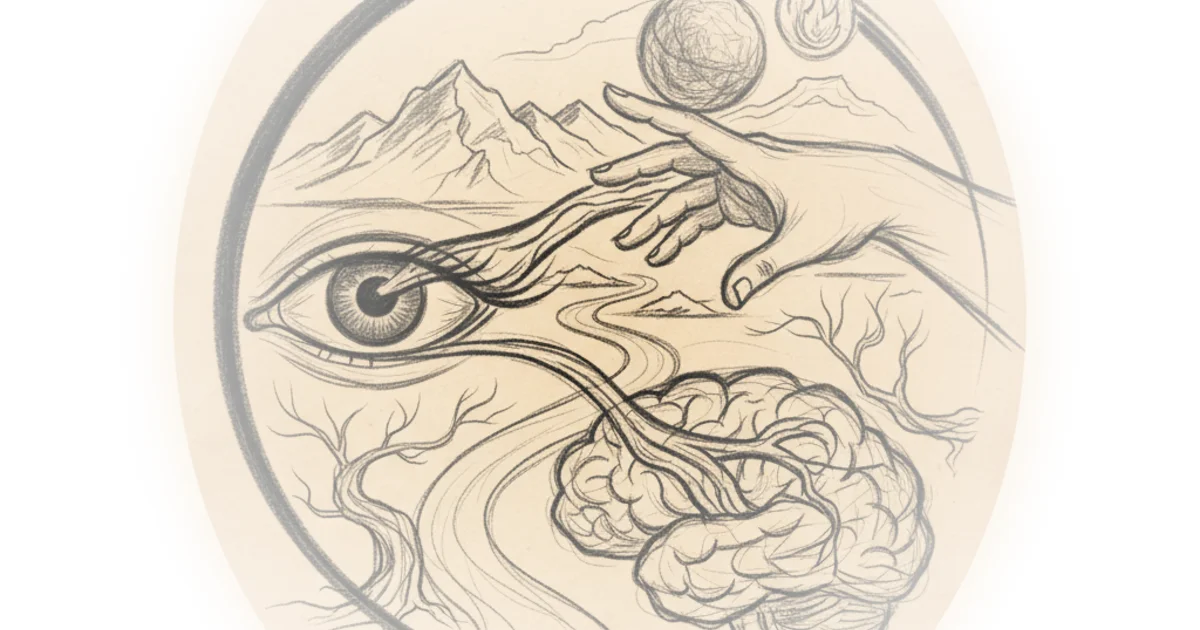
The distinction he draws between direct and indirect awareness is where the piece gains its critical momentum. He argues that indirect awareness relies on inference—knowing B because you know A—whereas direct awareness requires no such intermediate step. "You are 'indirectly aware' of x when your awareness of x is based on your awareness of something else," he explains. By framing the debate this way, Huemer shifts the burden of proof onto the indirect realist to demonstrate that we are indeed inferring the world from our minds, rather than simply experiencing it. Critics might note that this definition of "directness" is somewhat narrow, potentially sidestepping the complex neural processing that happens between stimulus and conscious experience, but Huemer's focus remains on the phenomenological reality of the conscious agent.
The central error of indirect realists has always been to confuse a vehicle of awareness with an object of awareness.
The Hallucination Trap and the Nature of Experience
One of the most compelling sections addresses the existence of perceptual experience itself, a point often denied by those who argue that perception and hallucination are entirely different categories. Huemer leverages the classic "brain-in-a-vat" thought experiment—a concept explored in depth in related philosophical deep dives—to argue that the internal mental state must be identical in both scenarios. "It is possible to have a hallucination caused by a brain state qualitatively identical to the brain state that would occur during normal perception," he notes. This forces the conclusion that a purely internal mental state exists even during normal perception, a realization that indirect realists often seize upon to claim we only ever see our own minds.
However, Huemer refuses to let this internal state become a barrier. He distinguishes between the vehicle of awareness (the experience) and the object of awareness (the external thing). He argues that while we have internal experiences, the content of those experiences points outward. "When you have a perceptual experience, the object of awareness... is the thing that satisfies the content of the experience, which is an external thing, not a mental state." This is a crucial pivot. It acknowledges the reality of our internal mental life without surrendering the external world to skepticism. The argument holds up well against the charge of naivety because it admits the possibility of illusion while maintaining that the default state is a direct connection to reality.
Qualia and the Forcefulness of Perception
Huemer then tackles the subjective quality of experience, known as qualia, using the "inverted color spectrum" argument to prove that experience is more than just data processing. He suggests that two people could see grass and tomatoes with swapped color experiences yet both be perceiving correctly, implying that the "what it is like" of the experience is distinct from the representational content. "Perhaps the best argument that qualia are something more than just representational content is the inverted color spectrum argument," he writes. This move is vital because it prevents the reduction of perception to a cold, mechanical mapping of the world, preserving the richness of human experience.
Furthermore, he introduces the concept of "forcefulness" to distinguish perception from imagination. "Perceptual experiences have an attribute I call their 'forcefulness'—the characteristic that, when you have one of these experiences, it seems as though you are actually, presently confronted with the object of the experience." This quality of immediacy is what convinces us we are in the real world. It is a phenomenological fact that imagination lacks; you can imagine a pink squirrel, but you do not feel confronted by it. This distinction provides a robust defense against the idea that we are merely trapped in a simulation of our own making.
The Fatal Flaw of Indirect Realism
In his conclusion, Huemer identifies the root cause of the indirect realist's error: a category mistake. He cites Mortimer Adler to illustrate that we confuse the means of seeing with the thing seen. "We are aware of external objects, and the way in which we are aware of them is by having perceptual experiences," Huemer states. "Those experiences are what make us count as being aware of the external things; they are not themselves the things we are normally aware of." This is the piece's strongest rhetorical move, effectively collapsing the "veil of perception" that has haunted philosophy since John Locke. By reframing the experience as the method of access rather than the object of access, Huemer restores the external world to its proper place as the primary object of our attention.
A counterargument worth considering is whether this view fully accounts for the role of cognitive interpretation. While Huemer distinguishes between conceptual and non-conceptual content, some might argue that our "direct" awareness is always already filtered through layers of prior belief and cultural conditioning. Yet, Huemer's framework is resilient enough to accommodate this; he allows for distortion and illusion without conceding that the entire process is indirect.
Once you grant that the things we are aware of are always 'ideas', it's hard to resist Berkeleyan arguments that maybe the ideas are all that there is.
Bottom Line
Huemer's defense of direct realism is a masterclass in clarity, successfully arguing that our senses are windows, not mirrors. The strongest part of this argument is its elegant redefinition of the relationship between internal experience and external objects, which neutralizes the skeptical threat of the "brain-in-a-vat" scenario. Its biggest vulnerability lies in the assumption that the "forcefulness" of an experience is a reliable guide to truth, a point that remains contested in cognitive science. For the busy reader, the takeaway is clear: we are not trapped in our heads; we are in direct contact with the world, provided we understand the mechanism of our own awareness.