Most longevity research chases the dream of turning back the clock, but this piece from Join Longevity argues we should first focus on fortifying the blueprint itself. By analyzing the genomes of 400-year-old sharks and supercentenarians, the emerging company Matter Bio is proposing a radical shift: aging isn't a programmed sequence to be reversed, but a slow accumulation of random information loss that can be stopped. For busy readers tracking the next frontier of medicine, this distinction is critical—it moves the goalpost from sci-fi rejuvenation to a tractable, near-term strategy of genomic defense.
The Blueprint vs. The Clock
The core of the argument rests on a first-principles view of biology that treats the cell's DNA as a ship constantly battered by entropy. Join Longevity reports that CEO Christopher Bradley sees aging not as a timer ticking down, but as "the blueprint… gets scratched, aged, changed, broken, rearranged." This framing is powerful because it isolates the root cause: damage. While many competitors focus on epigenetic reprogramming—essentially trying to reset the software—the piece suggests that without fixing the hardware, a reset is futile.
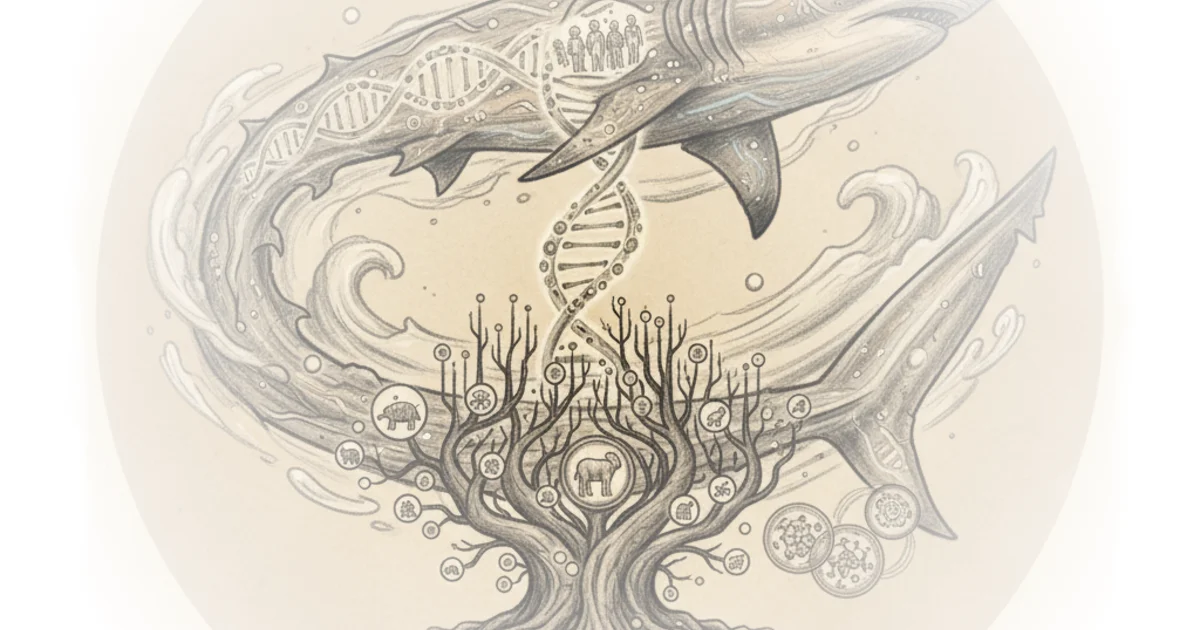
Bradley's logic is that while we can't stop the universe from creating disorder, we can engineer better defenses against it. "Life, humans and cells and all life on Earth is busy maintaining order despite the universe wanting to create disorder and destroy the order that exists," the article notes. This perspective reframes the entire longevity field. Instead of asking "how do we reverse time?", the question becomes "how do we stop the scratches?"
"I believe that time is kept in the DNA of the cell, the blueprint of the ship, of Theseus' ship. The blueprint… gets scratched, aged, changed, broken, rearranged. Then things start to go wrong. And that is not programmed. I think it's random."
This approach has a distinct advantage: it avoids the philosophical minefield of erasing human identity. If we reset the epigenetic clock, we risk wiping out the marks of experience and development that make us who we are. Bradley acknowledges this risk, noting that while reprogramming might be possible, "Your brain, you don't want to reset that completely, right? The structure there is important, epigenetically as well as larger scale." By prioritizing protection over erasure, the strategy offers a more conservative, perhaps more ethical, path to extending healthspan.
Learning from the Deep
The most distinctive element of this coverage is the scale of the proposed study. Join Longevity highlights a plan to compare long-lived species against their short-lived counterparts within the same family, rather than just comparing humans to animals. "We are not comparing sharks to people. We're comparing sharks that live 400 years to sharks that live 20," the piece quotes Bradley as saying. This design is scientifically elegant because it controls for species-specific variables, isolating the exact genetic differences that allow a Greenland shark to survive four centuries while a mako shark lives only two decades.
Critics might note that evolutionary biology is messy; a gene that protects a shark in the deep ocean might not function the same way in a human cell. However, the article addresses this by emphasizing that Matter Bio tests all candidates directly in human cells immediately. "Everything we're doing is in human cells right away. So if it doesn't work in a human cell, it's probably not relevant for this," the editors report. This pragmatic filter mitigates the risk of dead ends, ensuring that the "longevity genes" discovered are actually translatable.
The data suggests that nature has already solved the problem of DNA stability, just not in a way we've fully decoded yet. Bradley points out that across species, the total mutation burden at the end of life is surprisingly similar, even if the rate of accumulation differs. "A mouse will get hundreds of mutations a year, and a human will get dozens… at the end of life, they'll both have 2,000 to 5,000 mutations per cell," the article explains. This implies a universal threshold of damage that kills the cell, and the goal is to push that threshold further out.
"Antibiotics added 20 to 40 years of healthy life. I believe therapies that fortify DNA and enhance genomic stability could drastically extend human healthspan and help us reach the upper limits of our natural lifespan."
The Combinatorial Challenge
The piece is refreshingly honest about the complexity of the solution. It is not a matter of finding a single "magic bullet" gene. Bradley argues that if a single gene could stop aging, we would see people living indefinitely, yet "nobody has lived past 120." Instead, the solution lies in a "cocktail" of genes working in concert. The combinatorics are staggering, with "trillions and trillions of different combination potentials" to test.
This is where the science moves from theory to engineering. The article describes early screens where specific combinations of genes reduced DNA damage by 87% in human cells. "The best one reduced DNA breaks by about 87%, leaving cells nearly as undamaged as the control cells that were never exposed to stress," Join Longevity reports. This is a massive signal. It suggests that while no single gene is the answer, the right combination can act as a molecular armor.
However, there is a significant hurdle: context. Simply increasing DNA repair proteins can backfire, potentially stopping cell division or disrupting development. "If you just take the actual proteins of DNA repair... and you just jack those up… it's not great for the cell," Bradley warns. This nuance is vital. It means the therapy isn't just about adding more of a good thing; it's about precise, balanced regulation.
Bottom Line
The strongest part of this argument is its shift from the elusive goal of "reversing" aging to the achievable target of "slowing" it through genomic stability. By anchoring the strategy in the biology of the longest-lived creatures on Earth and validating it in human cells, Matter Bio offers a pragmatic roadmap that avoids the hype of total rejuvenation. The biggest vulnerability remains the sheer complexity of the genetic "cocktails" required; translating trillions of potential combinations into a safe, effective human therapy is a monumental engineering challenge that may take decades. For now, the vision of a 150-year healthspan is no longer just a dream, but a hypothesis worth testing.
"If our average lifespan is 150, I don't think a lot of people would complain."