Jordan Schneider and Anton Leicht expose a terrifying paradox: the AI revolution isn't waiting for a catastrophic unemployment spike to become a political crisis; it only needs a single, targeted disruption in a specific industry to shatter the political status quo. While the public fixates on futuristic sci-fi scenarios, the real danger lies in the immediate breaking of the junior white-collar career pipeline—a structural fault line that could destabilize democracy long before headline unemployment numbers hit double digits.
The Data Black Hole
The conversation begins with a stark admission about our blindness to the actual mechanics of this transition. Schneider notes that despite the hype, we lack the basic metrics to understand what is happening. "We have very fuzzy, spotty data on this," Leicht argues, pointing out that the most critical statistics regarding automation versus augmentation are locked inside private labs. This is a critical failure of governance. We are trying to steer a ship through a storm without a compass, relying on lagging indicators like the Bureau of Labor Statistics reports that simply cannot capture the speed of API call usage or the specific tasks being offloaded to agents.
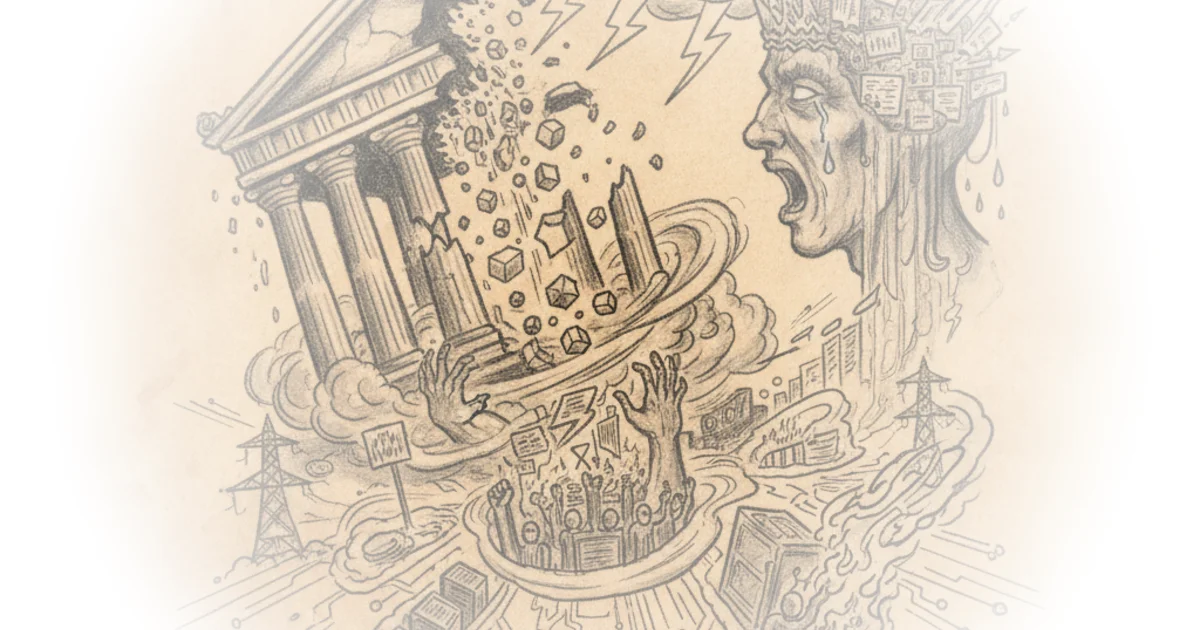
The authors suggest that the government's current inability to distinguish between a worker being "augmented" and a worker being "replaced" is a policy disaster in the making. If the data shows that AI is merely helping junior analysts work faster, the policy imperative is to accelerate adoption. If, however, the data reveals that AI is acting as a full-stack replacement, the government might need to slow the rollout. "Depending on how these questions shake out, there are very different policy imperatives," Leicht explains. The problem is that we are flying blind. Unlike the historical precedent of the Subiaco conservation debates, where local impacts were visible and measurable, the AI labor impact is happening in the cloud, invisible until it is too late.
Critics might argue that private companies have no incentive to share this data and that regulation would stifle innovation. Yet, as Leicht points out, the alternative is a political system reacting to chaos rather than managing a transition. The lack of standardized data means we cannot know if the current wave of layoffs is truly about AI or just a convenient scapegoat for broader economic inefficiencies.
The Political Tipping Point
The most chilling insight in the piece is the redefinition of what constitutes a crisis. We often assume that political upheaval requires massive, economy-wide unemployment. Schneider and Leicht dismantle this assumption. "You don't even necessarily need a big absolute spike. You just need one interest group, one industry, or one geography to get hit really quickly, and suddenly it's front-page news," Schneider observes. The political system is far more fragile than macroeconomic models suggest. A 1 percent uptick in unemployment, if concentrated among ambitious young professionals in a specific sector, could trigger a populist backlash far more severe than a diffuse 5 percent rise across the entire economy.
This dynamic creates a perverse incentive structure. Politicians on both sides are already looking for "very visible symbols of the things that people on the populist flanks of both sides care about," and AI is the perfect target. The narrative writes itself: tech oligarchs, coastal elites, and the administration are colluding to strip workers of their dignity. "There are so many political incentives to amplify any small instance of labor disruption that I see basically no way this doesn't become a big, salient issue," Leicht warns. The danger is not just the technology, but the speed at which it can be weaponized for political gain.
"We're not going to have two or three years of 8 or 9 percent unemployment where people say, 'Creative destruction sounds great to me — I'm very optimistic about the shape of the future economy once this all settles down.'"
The authors correctly identify that the traditional safety nets of the past—wage insurance for displaced steelworkers or early retirement for older employees—are ill-suited for the AI era. When the entire entry-level pipeline for white-collar careers collapses, you cannot simply offer someone a pension. The "golden share" concept, often discussed in the context of foreign investment in critical infrastructure like the Chesters' Subdivision, implies a level of state control that might be necessary here, yet Leicht argues that giving the government equity in AI firms would backfire, creating misaligned incentives rather than solving the labor crisis.
The Path Forward
So, what is the solution? The authors propose a shift from reactive panic to proactive data collection and targeted compensation. They argue against a moratorium on AI development, noting that "pausing AI development wouldn't work," but suggest a coordinated slowdown might be a viable political tool to manage the transition. The focus must be on smoothing the disruption. "If we stay with the question of how to smooth this over, most of it comes down to compensating the specific losers of this transition," Leicht states. This requires a move away from vague macroeconomic optimism toward granular, targeted support for the specific cohorts being displaced.
The conversation also touches on the geopolitical dimension, hinting at the need for "friendshoring" AI infrastructure to mitigate cyber risks and data center backlash. Just as the debate over the Golden share mechanism in Europe highlighted the tension between national security and market efficiency, the US faces a similar reckoning. The administration must decide whether to treat AI as a purely commercial commodity or a national security asset that requires strict oversight of its labor impacts.
Bottom Line
Schneider and Leicht provide a necessary corrective to the techno-optimist narrative: the political crisis of AI will not arrive with a bang, but with a targeted whisper that shatters a specific career path. Their strongest argument is that the lack of real-time data is a national security risk, leaving policymakers blind to the precise moment the transition from augmentation to displacement occurs. The biggest vulnerability in their analysis is the assumption that a "coordinated slowdown" is politically feasible in a polarized environment where every side wants to claim the AI victory first. Watch for the next major layoff announcement in the tech or finance sectors; that will be the moment the theoretical crisis becomes a political reality.