Jordan Schneider's travelogue from Shanxi strips away the glossy veneer of China's modernization to reveal a gritty, transactional underbelly where ancient social rituals and systemic corruption remain the primary engines of commerce. While Western media often fixates on the high-tech surveillance state or the coastal megacities, Schneider argues that the true pulse of the Chinese economy in its interior provinces beats to the rhythm of "wine and dine" culture and the lingering shadow of the coal barons. This is not a story of a monolithic state, but of a fractured reality where the rules of the law are secondary to the rules of the relationship.
The Architecture of Intoxication
Schneider opens with a visceral encounter that serves as a microcosm for the broader economic culture. He describes a dinner with X, a Huawei executive, where the primary business activity was not negotiation, but forced intoxication. "He was so used to this way of socialization, coaxing new friends and acquaintances to drink, that it was hard to make friends in a different manner," Schneider writes, noting that this behavior is "probably more important than any other aspect of his job requirements." The author frames this not merely as a cultural quirk, but as a functional necessity in a system where formal contracts are secondary to personal trust forged in alcohol. The executive's insistence that the narrator was not "giving him face" by refusing a drink highlights a social currency that transcends legal frameworks.
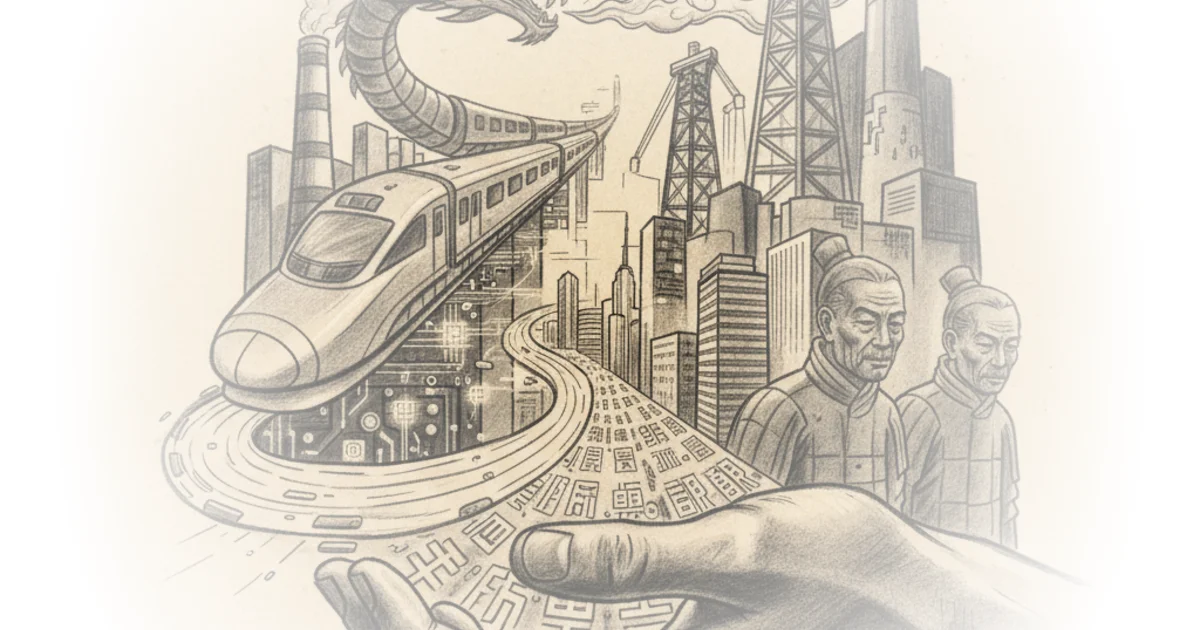
This framing is effective because it grounds abstract concepts of "guanxi" (relationships) in a tangible, uncomfortable human experience. It forces the reader to confront the reality that in many sectors of the Chinese economy, the ability to endure physical discomfort is a prerequisite for professional success. However, one might argue that Schneider risks overgeneralizing a specific, perhaps outdated, regional practice as the universal key to Chinese business, potentially overlooking the rapid professionalization occurring in the tech and export sectors.
Wealth and power go hand in hand everywhere but nowhere is it more literally true than in China.
The Coal Barons and the Rise of a New Aristocracy
The piece then pivots to the historical roots of this culture, tracing the explosion of wealth in Shanxi back to the policy shifts of the late 1970s. Schneider explains how Deng Xiaoping's reforms, intended to solve starvation, inadvertently unleashed a "flood" of private enterprise. In Shanxi, this manifested as a partnership between local party cadres and businessmen who exploited the region's massive coal reserves. "These mines operated as corporations controlled by individuals and protected by local governments, with plenty of cash flooding everyone's pockets to keep them quiet when necessary," Schneider observes.
The author's analysis of this era is particularly sharp in its description of the resulting social stratification. He notes that while the mines have since been consolidated into state-owned enterprises, the "generational wealth" generated created a "de facto nobility" whose children now flaunt their fortunes abroad. This historical context is crucial; it suggests that the current corruption is not a bug of the system, but a feature of its original design. The "7 person rule" mentioned by Schneider—a theoretical limit on private employment that was quickly ignored—serves as a perfect metaphor for the gap between ideological theory and economic reality.
Critics might note that the narrative of a "lawless wild west" in the 80s and 90s sometimes glosses over the immense state violence and coercion used to enforce these transitions, focusing too much on the beneficiaries rather than the displaced workers or the environmental devastation left in the wake of the coal boom.
The Police Officer's Ledger
Perhaps the most startling section of the commentary is the interview with "Brother D," a former police officer turned tour guide who details the mechanics of the bribe economy. Schneider does not shy away from the brutality of the stories D recounts, from the murder of a family of six to the casual disposal of a child hit by a car. "The driver will keep his license. He will probably have to pay a significant fee to the family. Life will continue as normal," D explains, a statement that underscores a chilling societal nonchalance toward death.
But it is D's description of the corruption that truly unsettles. He reveals that the "surveillance state" is porous, accessible to those with the right connections and funds. "Anyone can be bought for the right price depending on the favour," D says, detailing how he once pocketed 1.7 million rmb to help a wanted criminal erase their identity from national databases. Schneider uses this to challenge the Western narrative of an omnipotent digital panopticon. "Perhaps the deep surveillance is completely hidden from the rank and file," he muses, suggesting that the system's greatest vulnerability is not technology, but the human element within it.
The author's choice to let D speak in such graphic detail about the sale of identities and the provision of prostitutes to officials is bold. It humanizes the corruption, moving it from a statistical abstract to a series of specific, transactional choices. Yet, the reliance on a single source for such explosive claims regarding the national database's integrity is a potential weakness; while D's testimony is compelling, it remains anecdotal evidence of a systemic failure that is difficult to verify independently.
Maybe only people with high clearance level can access them. If you pay them to change your identity, can you really can get past every level of security in the country, even the national border?
The Human Cost of the Transaction
Beyond the mechanics of bribery, Schneider captures the profound moral exhaustion of the individuals navigating this system. D's confession that he quit the police force because he had seen "too much death" and his subsequent indulgence in expensive massages and aimless drives reveal a man seeking escape from the horror of his own complicity. "Sometimes when I can't sleep, I'll hire a driver and just tell him to drive without a destination," D says, a poignant image of a man trying to outrun his own conscience.
This section serves as a necessary counterweight to the cynicism of the business anecdotes. It reminds the reader that behind the "great game" of flattery and betrayal are real human beings suffering from the psychological toll of a system that demands their moral compromise. The author's decision to focus on D's personal luxuries—the 500 rmb massages, the 60 rmb cigarettes—grounds the abstract concept of corruption in the mundane reality of a man trying to feel something other than numbness.
Bottom Line
Schneider's piece is a powerful, if unsettling, reminder that the "China model" is not a monolith but a complex, often contradictory ecosystem where ancient social codes and modern corruption coexist. The strongest part of the argument is its refusal to romanticize the rise of China, instead focusing on the human cost and the moral compromises required to thrive within it. Its biggest vulnerability lies in its reliance on anecdotal evidence to make broad claims about the integrity of the national security apparatus, a claim that warrants further investigation. Readers should watch for how the central government's recent anti-corruption drives interact with these deeply entrenched local networks of power and trust.