In a legal landscape where celebrities increasingly seek to silence critics through the courts, a federal judge in Florida has drawn a hard line: the First Amendment does not bow to the desire for civility, even when the target is a Grammy-winning artist. This piece from Reason dissects a pivotal moment where the machinery of the law was asked to create a permanent gag order on an online personality, only to be rebuffed on the grounds that such an order would constitute an unconstitutional prior restraint on speech. For busy readers navigating a world of deepfakes and digital harassment, the ruling offers a sobering reminder that the remedy for past lies is often limited to damages, not the erasure of future voice.
The Constitutional Wall Against Prior Restraint
The core of the article's analysis rests on the judge's rejection of Megan Thee Stallion's request for a sweeping injunction. The plaintiff had asked the court to bar the defendant, an online personality known as Milagro Gramz, from making any further defamatory statements, posting deepfakes, or even discussing the jury's verdict. Reason reports that the court found this request "impermissible" because it would function as a "prior restraint on speech that triggers First Amendment concerns."
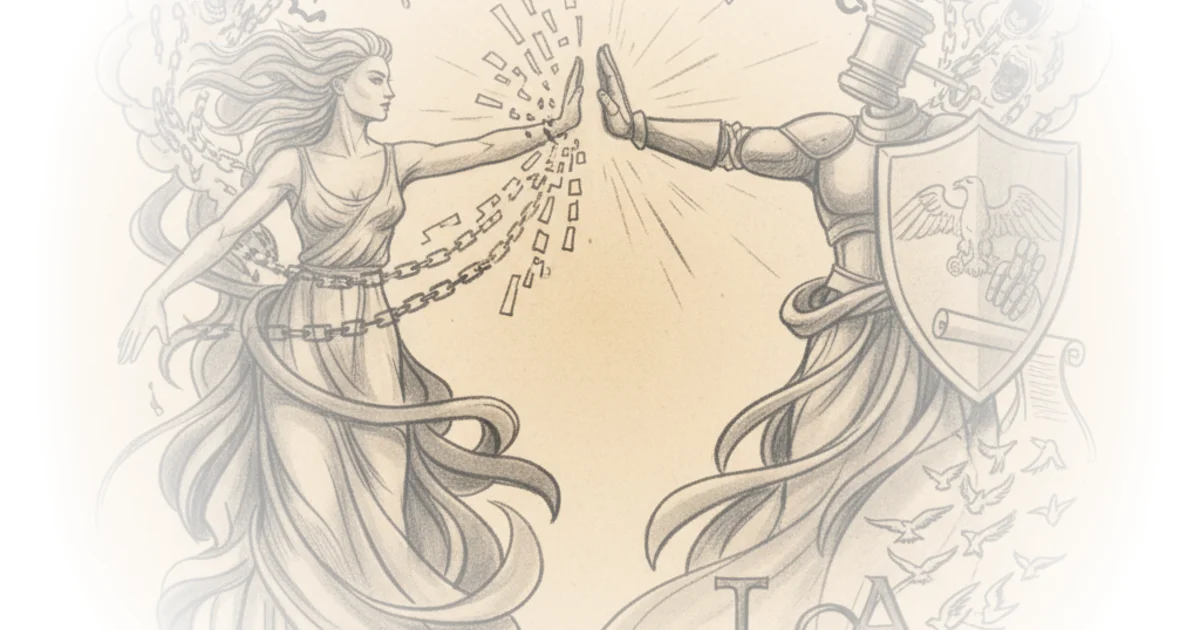
The piece argues that while courts are divided on whether injunctions against defamation are ever allowed, the prevailing view requires extreme caution. The article notes that even in jurisdictions that allow such injunctions, they "must not through careless drafting forbid statements not yet determined to be defamatory." This distinction is crucial. The judge in this case, Cecilia Altonaga, refused to grant a blanket ban on future speech because the plaintiff could not prove that every potential future statement would be false or harmful. As the piece highlights, the request was not tied to specific, proven lies but rather sought to forbid a broad category of speech about the artist's mental state, family, and testimony.
"As tempting as it might be to force some civility into the matter by staunching [Defendant's] speech against [Plaintiff], doing so would ignore the protections of the First Amendment."
This reasoning aligns with a long history of legal skepticism toward prior restraints. The article briefly contextualizes this by noting that the legal system has historically been wary of government or judicial orders that prevent speech before it happens, a principle rooted in the fear that such power could be abused to suppress legitimate criticism. Critics might argue that in the age of viral deepfakes, the traditional legal tools are too slow to prevent irreparable harm, but the court's decision suggests that the risk of over-censorship outweighs the benefit of a preemptive ban.
The Narrow Definition of Cyberstalking
Beyond the free speech arguments, the piece delves into the specific statutory requirements for a cyberstalking injunction under Florida law. The court found that the plaintiff failed to demonstrate that the defendant's conduct met the strict legal definition of cyberstalking. The article explains that to win such a claim, a plaintiff must prove the defendant acted "willfully, maliciously, and repeatedly" and that the communications served "no legitimate purpose."
Reason points out a critical flaw in the plaintiff's case: the jury had found the defendant acted "intentionally or recklessly," but the statute requires a higher bar of "willful" and "malicious" intent. Furthermore, the court noted that the defendant's online persona operated similarly to traditional news media, disseminating information on matters of public concern. The piece argues that this "legitimate purpose" defense is broad, citing examples where courts have found legitimate purposes in everything from threatening emails about settling lawsuits to hostile calls from parents to coaches.
The article also highlights the disconnect between the plaintiff's fears and the defendant's actual actions. The plaintiff requested a 500-foot distance order and a ban on disclosing personal information, yet the court found "no evidence that Defendant has ever attended Plaintiff's performances or attempted to contact or seek out Plaintiff." The only personal information at issue was a residential address obtained from public voter records. The court reasoned that the requested injunctions were "far removed from any redress for the claimed harassment."
"The Verdict represents an adequate remedy at law for Defendant's past conduct."
This conclusion underscores a fundamental tension in modern defamation law: the jury can award money for past harms, but the court is reluctant to police future speech. The piece suggests that the plaintiff's strategy of seeking an injunction was a misstep, as it invited the court to weigh the value of free expression against the desire for total silence from a critic. The court's refusal to expand the definition of cyberstalking to include mere insults or posts about a verdict reinforces the idea that the legal system is not designed to curate online discourse.
The Limits of Legal Remedies in the Digital Age
The article concludes by examining the post-verdict conduct of the defendant, which the plaintiff claimed constituted continuing harassment. The court, however, found that the defendant's posts—ranging from promotional photos to accusations of perjury—did not meet the legal threshold for cyberstalking. The piece notes that the court applied a "reasonable person standard" to determine if the posts caused "substantial emotional distress," and found that the plaintiff had not met this burden.
Reason argues that this ruling serves as a check on the expansion of legal liability for online speech. By refusing to grant the injunction, the court affirmed that the remedy for defamation is damages, not a permanent ban on speech. The article suggests that this outcome, while frustrating for the plaintiff, is essential for maintaining a robust public discourse where even offensive or false statements can be challenged in the court of public opinion rather than silenced by a judicial order.
"Whether a communication causes substantial emotional distress should be narrowly construed and is governed by the reasonable person standard."
This narrow construction is a vital safeguard. If courts were to grant injunctions based on subjective feelings of distress, the result could be a chilling effect on legitimate criticism and commentary. The piece implies that the legal system must remain a place for adjudicating specific harms, not a tool for managing the emotional landscape of public figures.
Bottom Line
The strongest part of this argument is its unwavering commitment to the principle that the First Amendment protects speech even when it is offensive, false, or deeply hurtful, provided it does not cross into specific, provable threats or harassment. The piece effectively demonstrates that the legal system's tools for stopping speech are far narrower than many public figures assume. The biggest vulnerability in the plaintiff's case was the attempt to conflate past defamation with future speech, a strategy the court rightly rejected. Readers should watch for how this ruling influences future attempts to use injunctions as a shield against online critics, as it sets a high bar for what constitutes a legitimate reason to silence someone before they speak.