In a war often defined by muddy trenches and static front lines, Good Times Bad Times makes a startling claim: the true battlefield has shifted from the Donbas to the balance sheet of the Russian state. The author argues that Ukraine's precision strikes on energy infrastructure, combined with aggressive new US sanctions, are not merely tactical annoyances but a coordinated campaign to induce a 'stockflation'—a deadly mix of stagnation and hyperinflation—that could collapse the Kremlin's war machine from within. For the busy observer, this piece offers a crucial pivot away from the daily grind of territorial loss to the structural rot that may ultimately decide the conflict's outcome.
The Economic Frontline
The author's most compelling insight is the sheer velocity of the escalation in Ukraine's long-range campaign. Good Times Bad Times writes, "Since the start of August, that number [of refinery strikes] has jumped to 47," contrasting this sharply with the mere three strikes recorded in the preceding four months. This isn't just noise; it is a deliberate strategy to export the war directly into Russian territory. The commentary suggests this is Zelenskyy's most significant strategic card, executed without the need for third-party permission, leveraging US intelligence to degrade an economic pillar that Moscow believed was untouchable.
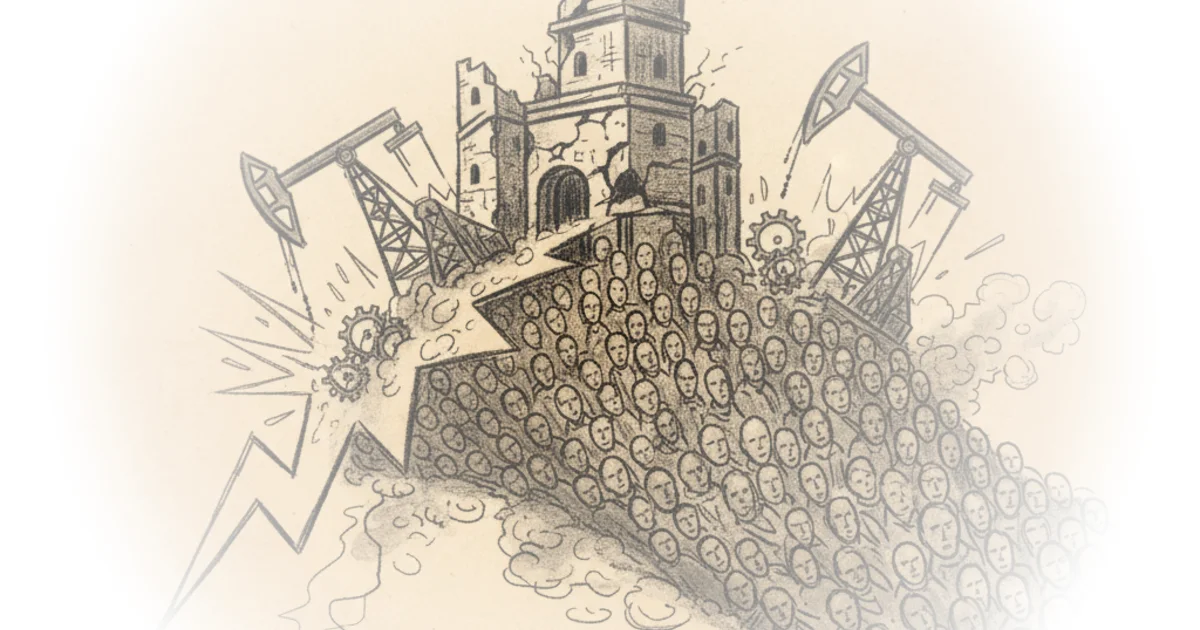
The impact is already visible in the domestic sphere. As the author notes, "Fuel prices in some regions have risen 30 to 50% over recent months," a tangible pain point for ordinary citizens that propaganda cannot easily mask. While the piece acknowledges that the energy system is not yet in a "catastrophic" state, it warns that the current pace of degradation is unsustainable. Critics might argue that Russia has a vast capacity to reroute fuel and that the economy has shown surprising resilience in the past, but the author effectively counters this by highlighting the rising cost of logistics and the inability of aging infrastructure to adapt quickly enough to the drone tempo.
The Sanctions Hammer
The coverage then pivots to the financial chokehold tightening around Russia's oil giants, Rosneft and Lukoil. Good Times Bad Times puts it bluntly: "This is no symbolic move. Moscow genuinely fears these measures." The author details how Donald Trump's administration has issued a one-month ultimatum for foreign entities to terminate contracts, effectively freezing accounts and cutting off payment channels before the sanctions even formally take effect. The stakes are massive, with the author noting that "both firms are already cut off from payments as their accounts have been frozen."
The ripple effects are global. The piece highlights a critical vulnerability in Russia's relationship with India, its largest buyer of discounted crude. Citing Reuters, the author reports that "privately-owned Reliance Industries will stop importing oil under its long-term deal to buy nearly 500,000 barrels per day of crude from Russian oil major Rosneft." This is a significant blow, as New Delhi accounts for roughly 40% of Russia's discounted exports. The author's analysis of the "shadow fleet" is particularly illuminating, explaining how Russia attempts to bypass these restrictions through a web of shell companies in Dubai and aging tankers. However, the commentary rightly points out that "the problem isn't the barrels. It is the people and institutions that let them move," and the new sanctions are specifically targeting those intermediaries.
The sector's total losses since 2022 are estimated at over $100 billion. Altogether, the refinery strikes and sanctions are casting a long shadow over Russia's federal economy.
The Illusion of Resilience
Perhaps the most damning section of the article is its dissection of Russia's hidden debt and the true cost of the war. Good Times Bad Times argues that the Kremlin's economic resilience is "an illusion built on concealed wartime financing." The author cites estimates that nearly 30% of the federal budget is classified, with total spending rising to roughly 14% of GDP, far exceeding the official 7% figure. This hidden spending is propping up the defense industry with cheap loans while choking the civilian economy.
The consequences are already manifesting in the real economy, with factories switching to shorter workweeks and enlistment bonuses being slashed by as much as 80% in some regions. The author quotes the Bank of Russia's own warning of a "risky scenario" where GDP could fall by 3.5% next year and inflation could hit 20%. Even in a more optimistic baseline, the author describes a future of "high inflation coupled with minimal growth and restricted credit," driven largely by "unproductive arms production." This framing is powerful because it uses the Kremlin's own institutions to predict its downfall, rather than relying solely on Western analysis.
The Battlefield Reality
The piece concludes by connecting these economic pressures back to the grim reality on the ground, specifically the impending fall of Pokrovsk. Good Times Bad Times writes, "The city's fall now appears inevitable," citing a Russian advantage of 8-to-1 in manpower and 10-to-1 in drones in the sector. The author paints a desperate picture of a Ukrainian retreat, noting that "a well-ordered retreat is now highly unlikely" and that forces may be forced to flee in panic. The situation is described as reminiscent of Russia's own position in Kerch, with destroyed bridges and relentless drone strikes hampering medical evacuations.
This creates a tragic irony: the economic strangulation of Russia is happening simultaneously with its most successful military offensive in years. The author suggests that the Kremlin is in "no hurry to end the war" because the military contracts are the only thing keeping the banking sector from collapse. As the piece concludes, "once the war ends, this system will collapse," forcing a bailout at the expense of taxpayers. This creates a perverse incentive for the war to continue indefinitely, regardless of the human cost.
Bottom Line
Good Times Bad Times delivers a sobering verdict: the war is shifting from a contest of territorial control to a race against Russia's internal economic decay. The strongest part of the argument is the synthesis of battlefield attrition with financial strangulation, revealing how Ukraine's drone campaign and Western sanctions are working in tandem to erode the foundations of the Russian state. The biggest vulnerability, however, remains the timeline; as the author admits, the economic collapse requires months of sustained pressure, while the fall of Pokrovsk could happen in days. The reader must watch whether the economic pain becomes severe enough to fracture the regime before the front lines break completely.