We are living in a dark age. Not the darkness of ignorance, but the darkness of enclosure — what one commentator calls "the closed circle." Throughout history, civilizations have trapped their populations within narrowly defined conceptions of politics, religious fundamentalism, and above all, the shrinking circuits of consumerism and mindless entertainment. These circles are not accidental; they are engineered by algorithms, by artificial intelligence, by markets that profit from keeping human spirits orbiting fixed points until they expire.
Henry David Thoreau called this "desperation" — a quiet surrender to society's duties and entertainment. In Walden, he wrote that some people lead lives of quiet desperation. The word desperation shares a root with despair; it is the resignation to an unconscious cycle, comfortable in its predictability but deadly in its sameness.
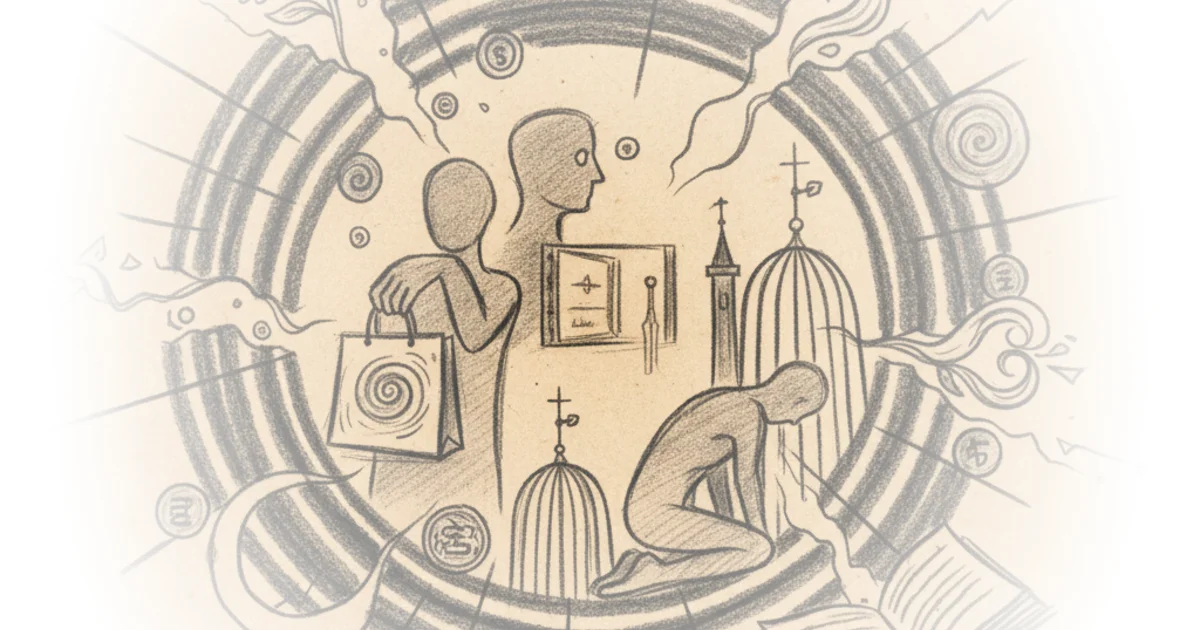
But Thoreau's life was a series of experiments in breaking free. His two years at Walden Pond were not isolation — they were liberation from the closed circles of Concord, New England society, his abolitionism, his education theory, his explorations into Maine and Cape Cod. He knew that within closed circles, life runs its unconscious course around a fixed point until it expires.
The Myth of the Closed Circle
The image of the closed circle does not originate with Thoreau. The author borrows it from Valentine Tombberg, an Estonian Catholic mystic who described the circle as a kind of prison. In his parabolic retelling of the cosmic myth of creation and the fall, Tombberg offers a striking vision: in the six days of creation there was a circle, but the Sabbath — the seventh day — was the opening of the circle into the spiral.
The serpent biting its own tail closes the circle eternally. Now the world is perpetually at odds between closed circles and open spirals of freedom. This framework can be applied to many things: your spirit runs along an orbit around daily life, but the world constantly tries to narrow that orbit.
"The world" here refers not to nature, but to forces of materialism, ideology, consumerism, individualism, and mindless entertainment. It is a catch-all for any force that wants to narrow your orbit and enslave your spirit to its own interests. The lie of this world is that your spiritual desires can be satisfied by more purchases, by media, by entertainment, by AI friendship.
The lie of the world is that your spiritual desires can be satisfied by more purchases, by media, by entertainment.
It is bleak and dystopian where we're headed. We see closed circles being exploited as a way of harvesting information, intent, and attention.
The Panther in the Cage
The author references Rilke's panther — an animal trapped in a cage at the zoo in the Paris gardens. There is inside all of us a powerful intuition that recognizes the confines of the cage. Every now and then we encounter something that widens our radius, breaks open the circle, transforms it from two-dimensional enclosure to three-dimensional ascending spiral.
When we are acted upon by something higher, something outside ourselves, our spirits are lifted out by another gravitational field. We become aware of forces greater than those seeking to control us, and for a brief moment we break free from the endless closed circle.
This is what theologians call conversion — moments when we become ourselves or draw nearer to ourselves. Our transformation begins to widen according to our own spirits. It is the swinging open of a prison door. It is the moment when a seedling breaks free from the shell of an acorn that begins to grow according to its true self, moving ever closer to the oak tree it will one day become and already contains within.
What is a renaissance other than a moment when a culture's two-dimensional circle violently breaks open into a three-dimensional ascending spiral? When the enslaving forces of the world are overpowered by a vitality that is creative, spiritual, and has a gravitational field greater than those of the world.
The Porous Self
The author draws on Charles Taylor's philosophical framework: the buffered self versus the porous self. The buffered self is closed, armored, protected. The porous self is open — its pores are open to receive what the world offers.
Emily Dickinson captured this in a beautiful poem about keeping the door open:
"The soul should always stand a jar That if heaven inquire, He will not be obliged to wait Or shy of troubling her. Depart before the host have slid The bolt unto the door To search for the accomplished guest, Her visitor no more."
It is partly inspired by the Song of Songs. It is about keeping the door open — and how inconvenient that is. Heaven will not honor the clock, much less your schedule. You must be willing to entertain angels at all times, often at the most convenient times.
Breaking the closed circle involves breaking your routine to place yourself within the presence of beauty and art. It requires effort. The one who would live the life of the ascending spiral must maintain careful receptivity and openness.
We must have what Wordsworth called a heart that watches and receives.
When your days fill with emails, phone calls, paperwork, meetings — or worse, TikTok and Reels — stop and make sure your door is ajar. Do not give heaven any reason to depart before it blesses us.
The Life of the Spiral
The life of the spiral acknowledges that daily life is intimately bound up with spiritual life. Speaking to a monk, the author learned that the two are inseparable. You should not think of the spiritual life because spiritual life is simply life — and once you see that, you begin to see how insidious the forces of the world are.
Buying things on Amazon, filling waking hours with podcasts or video content — human life should be more porous. There is nothing wrong with content that inspires you to move away from closed circles; often these are moments where you're opening yourself up to new possibilities, becoming more porous.
You must maintain a healthy sovereignty over your own intellectual domain in which you allow certain moments to consume. Sometimes to passively consume if needed, but you need to be in control of those moments. Be porous to the common graces of nature, not so much porous to the forces of the world.
The life of the ascending spiral is so countercultural to our moment that it makes it all the more important — and more dangerous. Imagine what will happen in the next ten years if too many people break the closed circles. The market will have to adapt or find new ways of enslavement.
What the Next Renaissance Requires
If the next renaissance is going to happen, our lives must move according to the ascending spiral. It will require a spiritual vitality powerful enough to combat the opioids of entertainment and the ills of consumerism and philosophical materialism.
It will require artists and readers to imagine a new orientation to the traditions of literature.
The author has been academic, treating literature like a university classroom where we study the fossils of poetry. But this relationship to the canon which is purely studious is not sufficient to bring about the renaissance. We need permission to drive one's plow over the bones of the dead, as William Blake once wrote.
There is a certain reverence one must have — and a certain studiousness in reading the classics and great works of literature because they will teach us how to write. Every good work of literature came at the right moment in relation to the past and its literature. We must do the same thing.
We need to rediscover the inheritance of the romantic movements, specifically the power of the imagination, which we have lost. The romantic imagination has been treated very academically as though it were a theory fossilized in literary history. But this is actually a way of life; this is something that feeds us spiritually.
There is a difference between studying fossils and studying actual flowers and plants. We need to see art and literature as icons, as thresholds, as windows into other worlds. It will require more than just an academic understanding of culture, but rather a new form of study that makes new creation permissible.
The Course Ahead
In 2026, the author's courses on verse and content on YouTube and Substack will center around the literature of Renaissance movements — moments in history where circles break open. This includes not just the European or Italian renaissance, but other movements:
The Romantic revival of the 18th century that broke open a very materialistic understanding of the world.
The American Renaissance started by Emerson and Margaret Fuller.
The Modernist movement which was a revival of spirit in revolt against form — properly understood with some qualification — before sinking back into a period of closed circles.
The schedule is loose, allowing freedom to change and adapt to student interests. They will study literature from great cultural revivals: philosophy and poetry, Plotinus and John Donne's love poetry, the Corpus Hermeticum and its influence on Henry Vaughan's poetry, the Cambridge Platonists and Thomas Traherve.
They'll study William Blake, Samuel Taylor Coleridge's theory of imagination, Wordsworth's poetry, Byron's Child Harold. They'll read Shelley, Emerson's 1836 essay Nature that set in motion the American transcendentalist movement and the American Renaissance. Virginia Woolf and James Joyce to understand how modernism is partly a revival of spirit against form.
These courses will help readers get nearer to great works of literature themselves and give permission to break their own closed circles.
Counterpoints
Critics might note that framing all consumerist entertainment as "enslavement" risks conflating serious philosophical critique with hyperbole. Not all content is harmful, and not everyone who consumes entertainment does so mindlessly. Some find genuine meaning in media that others consider trivial.
A counterargument worth considering: the framework of "closed circles" versus "ascending spirals" may itself be too binary. Human experience rarely moves between extremes; most lives contain both enclosure and openness simultaneously, and perhaps the goal is not to escape circles entirely but to find spirals within them.
Bottom Line
The strongest part of this argument is its articulation of how culture truly functions as either prison or doorway — and how literature and art offer genuine liberation from what the author calls "the lie of the world," where spiritual satisfaction is promised through purchases rather than presence. The weakest vulnerability: the vision remains largely aspirational. The author describes what renaissance requires but does not explain how, leaving readers with metaphor rather than method. The call to rediscover the romantic imagination as a way of life rather than academic study is compelling, but without concrete practices or examples, it risks sounding like aspiration rather than action.
What should readers watch for next: the author's upcoming course material in 2026 may finally bridge this gap between concept and practice.