Heather Cox Richardson doesn't just report the news—she dissects the accelerating collapse of presidential norms with surgical precision. Her most chilling revelation? That Donald Trump’s erratic behavior isn’t a tactic but a symptom of dangerous incompetence, documented through his own words and the stunned reactions of allies he humiliates. This isn’t partisan commentary; it’s a contemporaneous autopsy of a presidency unraveling in real time.
The Iran Debacle: From Pearl Harbor to $14 Billion
Richardson opens with Trump’s jaw-dropping Pearl Harbor gaffe—a moment where historical ignorance metastasized into diplomatic sabotage. “President Donald J. Trump’s behavior is increasingly erratic as he lashes out at those he perceives to be enemies,” she writes, framing the Japanese prime minister’s “taken aback” reaction as Exhibit A. The core of her argument lands because it connects Trump’s childish defensiveness (“Who knows better about surprise than Japan?”) to catastrophic real-world consequences: the closure of the Strait of Hormuz, which carries 20% of global oil. Former defense secretary Leon Panetta’s assessment—cited by Richardson as “he tends to be naive about how things can happen”—exposes Trump’s delusion that declaring victory solves anything. This isn’t just poor strategy; it’s a president operating like “kids” do, while holding the world economy hostage.
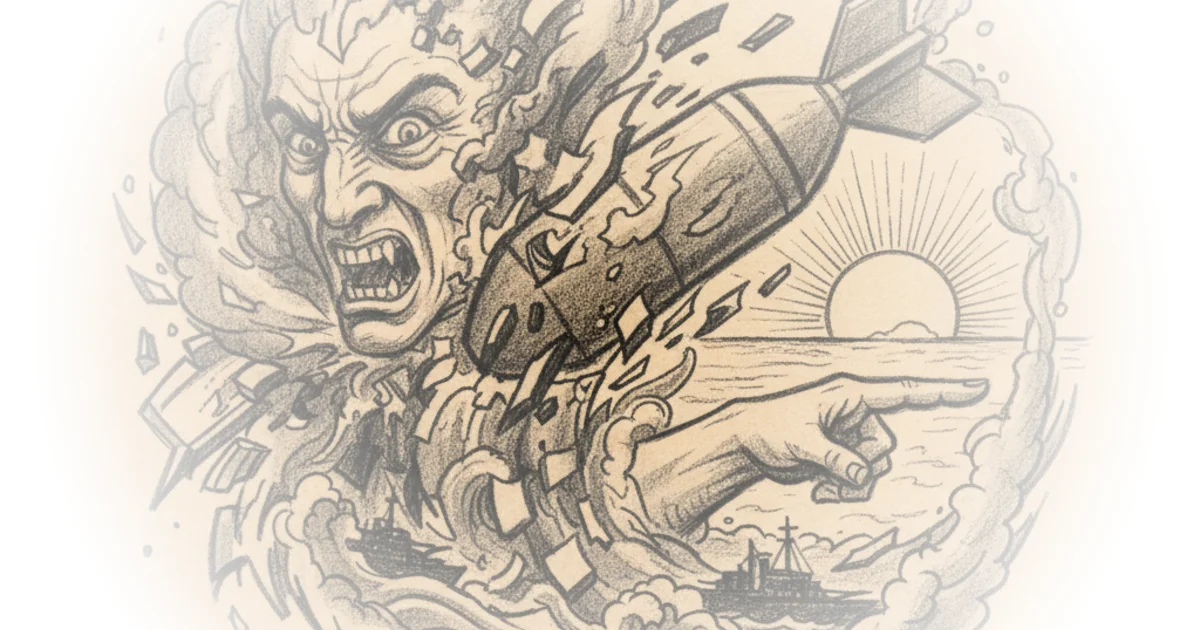
Richardson then pivots to Trump’s “frantic attempt” to reverse sanctions on Iranian oil—a move that hands Tehran $14 billion. She doesn’t just state the facts; she weaponizes contrast. Phil Gordon’s critique, which she quotes at length, highlights the staggering hypocrisy: Trump mocked Obama’s $1.7 billion payment to Iran as “insane,” yet now gives ten times that amount “without any concessions from Tehran.” Richardson’s reporting here is devastating because it shows desperation masquerading as strength—a pattern critics might dismiss as political theater, but her sourcing (Gordon, Panetta, Murphy) proves it’s systemic failure.
“We’re literally putting money into the pockets of the very nations that we are fighting right now. We’ve never seen this level of incompetence in war-making in this country’s history.”
DHS: Corruption and the Private Army
Richardson shifts focus to the Department of Homeland Security, where she reveals how Corey Lewandowski operated as a shadow secretary. “Trump is also under pressure over the Department of Homeland Security (DHS), which has been mired in news stories about corruption since former secretary Kristi Noem stepped down,” she states—then meticulously unpacks the rot. Her reporting on Lewandowski “sidestepping” his 130-day limit by “going into the building accompanying Noem” transforms abstract “cronyism” into visceral betrayal. The most damning detail? Lewandowski demanding “success fees” from prison contractors—a revelation that lands because Richardson cites six journalists across three outlets (NBC, NYT, ProPublica), making denial impossible.
This section’s power comes from Richardson’s refusal to let Trump deflect. When he threatens to deploy ICE agents to airports as “his own private army,” she dissects the mechanics: Democrats offered funding excluding ICE due to “abuses under Noem, Lewandowski, and Bovino,” but Trump insists on the anti-voting SAVE America Act. Her phrase “whom Trump appears to see as his own private army” crystallizes the danger—not hyperbole, but documented fact. Counterarguments about “political gridlock” crumble when Richardson notes ICE’s budget now dwarfs all other federal law enforcement agencies combined.
Mueller’s Ghost and the Erosion of Norms
Richardson saves her most emotionally resonant critique for Trump’s reaction to Robert Mueller’s death. “Not only is Robert Mueller getting under Trump’s skin, so, clearly, is his own failure to reopen the Strait of Hormuz,” she writes—a line that reframes Trump’s “Good, I’m glad he’s dead” tweet as symptomatic of his broader unraveling. Her tribute to Mueller’s career (“a lifelong public servant” who “refused to say his report ‘exonerated’ Trump”) isn’t nostalgia; it’s a benchmark for the norms Trump is torching. The contrast between Mueller’s integrity and Trump’s glee at his death lands because Richardson grounds it in Mueller’s own words: “I have always felt compelled to contribute.”
This section’s vulnerability? It assumes readers grasp why Mueller mattered—a risk for text-to-speech audiences. But Richardson mitigates it by summarizing his findings (“indicted thirty-four people, including six of Trump’s former advisors”) with prosecutorial clarity. Her inclusion of the Epstein document-shredding reports—though seemingly tangential—proves a pattern: Trump’s circle destroys evidence while he tweets “PEACE THROUGH STRENGTH.”
Bottom Line
Richardson’s strongest contribution is documenting how Trump’s incompetence and corruption aren’t isolated incidents but mutually reinforcing pathologies. Her biggest vulnerability is the sheer volume of scandals, which risks normalizing the unthinkable. Watch for whether Panetta’s warning—that declaring victory won’t fix what Trump broke—proves tragically prescient.