Dan Perry confronts a jarring contradiction at America's 250th anniversary: how can the world's most powerful nation be so deeply fractured? Rather than offering a patriotic puff piece, this collection argues that the very turbulence threatening to tear the country apart is actually its mechanism for survival. Perry posits that while the current leadership has embraced isolationism and eroded norms, the American experiment possesses a unique, albeit painful, capacity for self-correction.
The Paradox of Power and Anxiety
The collection opens by dismantling the myth of inevitable decline. Perry writes, "America's 250th birthday exposes a paradox: the US remains unmatched in wealth, military power, innovation, universities and culture, yet is deeply anxious, unequal and politically broken." This framing is crucial because it refuses to let readers off the hook with simple nostalgia; instead, it forces a confrontation with the gap between American potential and current reality. The argument suggests that this anxiety isn't a sign of death, but a symptom of a system struggling to adapt its 18th-century structures to 21st-century complexities.
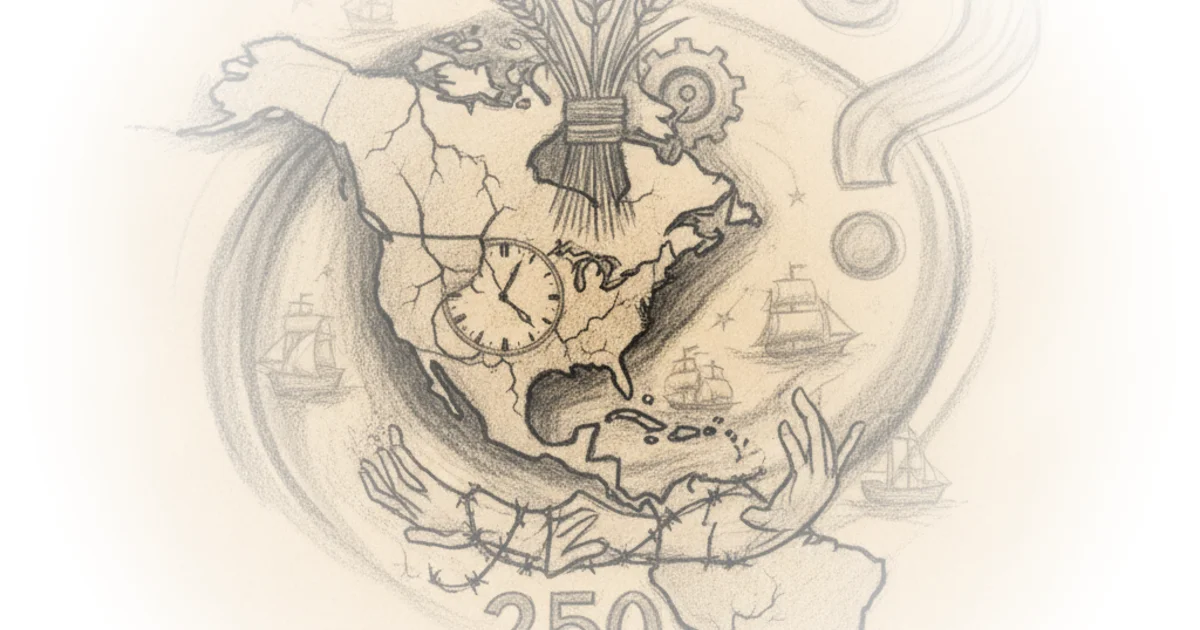
Perry is particularly sharp when diagnosing the political dysfunction. He notes that "the US is currently saddled with a leadership that is hostile to the ideals upon which the country was established," a sentiment that reframes the crisis not as a personality quirk, but as an institutional threat. The collection draws a direct line from this leadership style to the erosion of checks and balances, arguing that Congress and the courts have increasingly "enabled the concentration of authority in the White House." This is a stark warning about the drift toward one-man rule, echoing historical moments like Shays's Rebellion where the fragility of governance was first tested. The stakes are clear: without restoring constitutional constraints, personalized rule could become the accepted norm.
Journalism has an obligation to describe reality as it is... We remain fundamentally optimistic about the American experiment.
Critics might argue that this optimism feels unearned given the severity of the described failures, particularly regarding the judiciary. Perry acknowledges the damage done by recent rulings but insists on the resilience of the system, a balance that some may find too charitable to institutions that have recently upheld presidential immunity and struck down only the most egregious overreach.
Structural Flaws and the Path Forward
The commentary moves beyond diagnosis to prescription, tackling the structural rot in America's political machinery. Perry argues that "neither Republicans nor Democrats adequately represent the broad political middle," making a case for a viable centrist third party built from the top down rather than through grassroots chaos. This is a bold departure from standard reform talk; it suggests that the current two-party duopoly is so calcified that only a coordinated defection of moderate officials can break the cycle.
The collection does not shy away from the most toxic elements of American life, specifically gun violence and the death penalty. Perry states bluntly, "The country's exceptionally high rate of firearm deaths stems primarily from the widespread availability of guns rather than from distinctive mental health problems." This cuts through the usual noise about culture wars to focus on the tangible cause-and-effect relationship between policy and mortality. Similarly, regarding capital punishment, he contends that "irreversible punishment cannot be justified in a fallible legal system," using the execution of Cameron Todd Willingham as a grim case study of procedural failure.
On foreign policy, Perry describes a fundamental break from the post-World War II consensus, noting that the administration's "America First" approach risks weakening alliances and emboldening authoritarian powers. He warns that the US is drifting away from the liberal international order that secured global stability for decades. This echoes the lessons of Pearl Harbor, reminding readers that isolationism often invites greater conflict rather than preventing it. The collection argues that abandoning strategic cooperation in favor of transactional nationalism is a dangerous gamble.
Laws and codes are useless when leaders lack courage to denounce obvious bigotry.
The analysis also touches on the cultural fragmentation threatening national cohesion. Perry observes an "age of shamelessness" where conflicts of interest are conducted openly, eroding public trust. He critiques the political strategy of both sides: Democrats for appearing soft on border security and embracing divisive cultural issues that alienate moderate voters, and Republicans for exploiting gerrymandering to entrench power. The argument here is pragmatic: "Controlling illegal immigration is compatible with humanitarian values," yet the political discourse has failed to find a middle ground.
The Role of Truth and Institutions
Perhaps the most urgent theme in Perry's collection is the assault on objective reality. He details how modern authoritarians wage a "war on truth" by weaponizing misinformation, attacking expertise, and vilifying independent media. This isn't just about fake news; it's about a systematic effort to "erode objective reality and democratic accountability." The piece suggests that without a shared commitment to truth, the other reforms—on healthcare, education, or justice—are impossible.
Perry also highlights the crisis in higher education, where soaring costs have turned universities into engines of debt rather than opportunity. He argues that "it should not be the domain of the rich," pointing out that elite institutions are failing their moral mandate when they refuse to condemn bigotry while claiming to uphold free speech. The collection suggests that the health of American democracy is inextricably linked to the integrity of its knowledge-producing institutions.
Bottom Line
Dan Perry's collection succeeds by refusing to look away from America's darkest moments, arguing instead that this brutal honesty is the only path to renewal. Its greatest strength lies in connecting specific policy failures—from the Electoral College to presidential immunity—to a broader narrative of institutional decay and potential rebirth. The biggest vulnerability remains the assumption that the "broad, pragmatic center" will reassert itself; history shows that polarization often deepens before it breaks, and the window for correction may be closing faster than this optimistic view allows.