Matt Stoller delivers a startling historical twist: the very anti-monopoly tools the U.S. once dismantled are now being resurrected not by progressives, but by the current administration to counter Chinese state power. The piece's most provocative claim is that the West's decades-long embrace of deregulation and financialization has left it defenseless against a rival that mastered the art of predatory pricing and strategic monopoly control. For busy listeners, this reframes the current trade war not as a political squabble, but as a structural collapse of American industrial strategy that is finally hitting a wall.
The Premature Anti-Monopolist
Stoller opens by drawing a sharp parallel between the "premature anti-fascist" label of the 1930s and today's anti-monopoly advocates. He argues that just as those who opposed Hitler early were persecuted, those who warned against the dangers of concentrated corporate power are only now being vindicated by geopolitical necessity. "Today, we are in a similar moment with anti-monopoly arguments," Stoller writes, noting that Treasury Secretary Scott Bessent is now embracing tactics that were once considered radical.
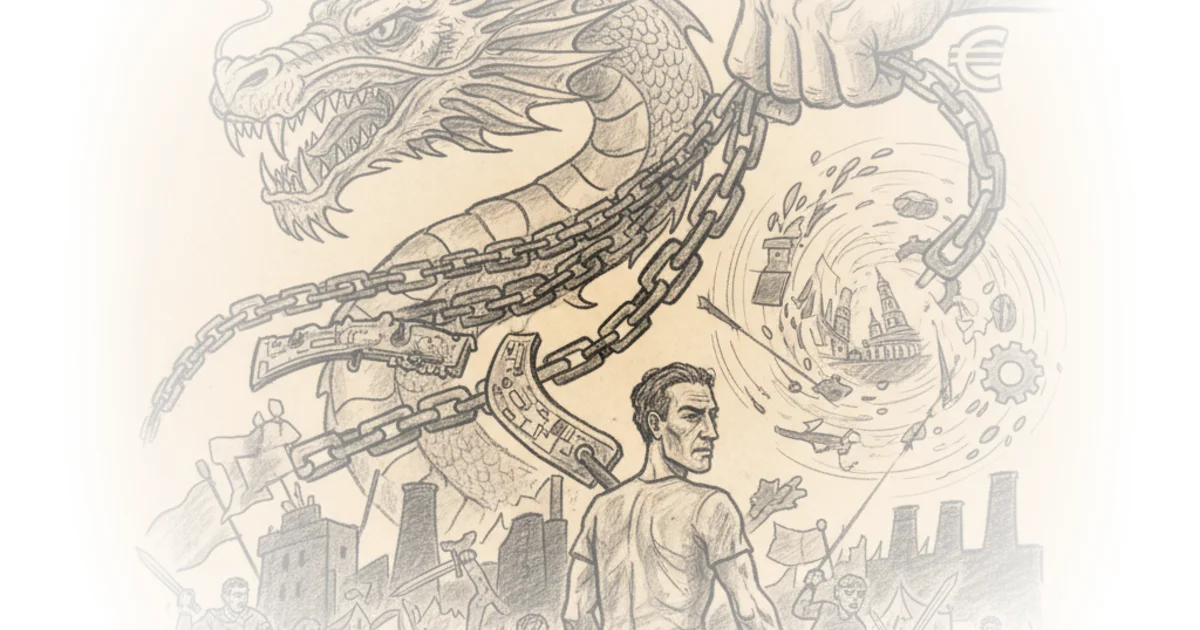
The core of Stoller's argument is that China has weaponized the rules the West wrote for itself. He details how Beijing uses state subsidies to drive prices below cost, a strategy known as predatory pricing, to capture global markets in critical sectors like electric vehicles and rare earth processing. "China has a smart industrial policy, the government subsidizes its industries so that they can charge below-cost rates, driving everyone else out of business," he explains. This isn't just economic competition; it's a geopolitical lever. Stoller points out that China now controls the "tap" for essential materials, with the ability to cut off access to foreign militaries and industries at will.
"They're installing what you might call a tap system, where they can turn that tap on and off."
Critics might argue that Stoller downplays the West's own history of using economic coercion, such as vaccine patent restrictions or financial sanctions. He acknowledges this, noting that "all countries engage in these kinds of games," but insists the current dynamic is unique because the U.S. voluntarily disarmed its own defenses. The author's framing is effective because it shifts the blame from foreign aggression to domestic policy failure.
The Betrayal of Domestic Industry
Stoller traces the roots of this vulnerability to a specific era of American policy: the 1980s and 1990s, when antitrust enforcement was gutted and intellectual property laws were rewritten to favor financial engineers over manufacturers. He highlights the case of Archibald Cox, whose company sold rare earth technology to the Chinese government, illustrating the "failure of modern liberalism and Wall Street." "Archie Cox and his company are committing a criminal act," Stoller quotes UAW organizer Mike O'Brien, calling him a "traitor to his country."
The piece argues that the Supreme Court's 1986 decision legalizing predatory pricing created a vacuum that foreign actors happily filled. Stoller writes, "There is a consensus among commentators that predatory pricing schemes are rarely tried, and even more rarely successful," a quote the court used to justify deregulation, which Stoller argues proved disastrously wrong in the global arena. By allowing domestic firms to be rolled up and sold off, the U.S. lost its ability to produce critical inputs independently.
"The son of a famous Watergate prosecutor lauded for his political courage, Cox sold out his country for money, and got a bonus for his troubles."
This historical analysis is the piece's strongest asset, connecting abstract economic theory to tangible national security risks. However, it glosses over the complexity of global supply chains; completely decoupling from Chinese processing is not merely a matter of changing laws but of rebuilding entire industrial ecosystems, a process that takes decades.
The Forced Reckoning
The most surprising element of Stoller's commentary is his observation that the current administration is being forced to adopt the very industrial policies it once mocked. He notes that the Pentagon has already implemented a minimum price guarantee for neodymium-praseodymium oxide to counter Chinese dumping. "Now, the two tactics used by the Chinese state to seize market power are also well-understood," Stoller notes, listing underpricing and strict intellectual property controls as the tools the U.S. must now counter.
Stoller suggests this creates a "dual economy" in America: one for non-essential goods that remains bloated and consolidated, and another for critical materials where the government actively intervenes. He draws a parallel between the administration's actions and the pilot programs proposed by Zohran Mamdani for government-run grocery stores, arguing that the logic is the same even if the sectors differ. "It would be better if we just reimplemented anti-monopoly rules across society, rather than picking some sectors where the government will structure healthier markets," Stoller argues.
"Scott Bessent and Trump are acting in ways that suggest they are being forced to reckon with foreign monopolies threatening America."
A counterargument worth considering is whether this "dual economy" approach is sustainable. If the government intervenes only in sectors deemed critical, it may inadvertently reinforce monopolies in non-critical sectors, leaving consumers vulnerable to price gouging in everyday goods. Stoller admits this is a flaw in the current approach but suggests the geopolitical threat is too immediate to wait for a comprehensive overhaul.
Bottom Line
Stoller's most compelling insight is that the U.S. is not fighting a new war, but fighting the consequences of its own deregulation, with China as the beneficiary. The piece's greatest vulnerability is its optimism that the administration can successfully pivot to an anti-monopoly stance without the ideological consistency to apply it universally. Readers should watch to see if these emergency measures become permanent structural reforms or temporary stopgaps that vanish once the immediate crisis passes.