Dan Williams delivers a counterintuitive diagnosis for the current political malaise: the solution to the rise of populism isn't more censorship, but less elite control over the conversation. While conventional wisdom blames algorithms for radicalizing the masses, Williams argues that the real catalyst was the destruction of the "informational monopoly" once held by establishment institutions. For listeners navigating a fractured media landscape, this piece offers a necessary reframing of why the liberal order is struggling and why the instinct to re-impose gatekeeping is not only futile but dangerous.
The Death of the Gatekeeper
The essay begins by dismantling the popular theory that engagement-maximizing algorithms are the primary architects of political polarization. Williams writes, "The popular image of wholly passive exposure to recommended content, or of vast numbers of users being sucked into radicalising rabbit holes, is not well supported by evidence." Instead, he points to the work of Martin Gurri, suggesting the true shift was the collapse of the elite ability to curate reality. In a world where establishment institutions once managed media to protect their interests, social media made that narrative control impossible.
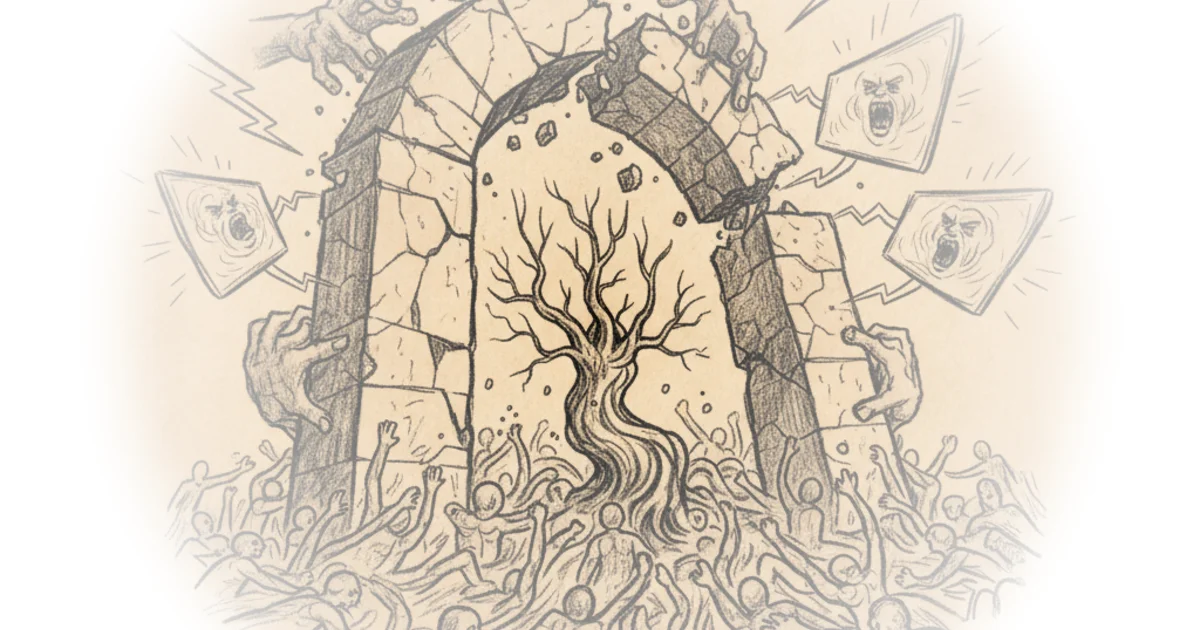
This is a crucial distinction. Williams argues that social media doesn't just amplify anger; it provides a platform for ideas that were previously stigmatized and marginalized. He notes that "'popular ideas historically stigmatised by elites' is a pretty good definition of populism." By letting these views reach a mass audience, the platforms have triggered a psychological shift known as the "spiral of silence" breaking. When individuals realize their controversial views are shared by many, they become emboldened. This dynamic mirrors the historical context of the "End of History" narrative, where the assumption that liberal democracy had triumphed left institutions unprepared for a public that no longer accepted their curated truths.
"Once established institutions lost the privilege to control the public conversation, they acquired an obligation to participate within it, which, so far, they have mostly failed to do."
Williams is sharp here. He identifies that the problem isn't just the existence of populist elites, but the failure of establishment elites to adapt to a world where they can no longer dictate the terms of debate. The argument holds weight because it moves beyond blaming technology and focuses on institutional inertia.
The Trap of Restoring Control
The piece then pivots to a provocative question: if gatekeeping helped maintain order, why not bring it back? Williams is unequivocal. He argues that a return to top-down censorship or aggressive de-amplification is both unfeasible and undesirable. He writes, "The effort to avoid platforming and normalising illiberal, misinformed, or hateful ideas doesn't make much sense in a world in which they are already popular and widely discussed."
The historical evidence he cites is damning. He points to the post-2016 anti-misinformation industry, noting that "in the well-funded, top-down war against misinformation, misinformation won." Attempts to censor disfavoured views often bred the very resentment they sought to quell, fueling the perception of an unaccountable "censorship industrial complex." This backlash, Williams suggests, is a primary driver behind the political trajectories of figures who rose by opposing these very efforts.
Critics might note that Williams risks underestimating the tangible harms of unchecked hate speech and disinformation, particularly when it incites real-world violence. However, his core point remains robust: policies that rely on people not being misinformed to work are doomed in an era where information flows freely. He argues that the liberal establishment's tendency to scapegoat social media for all societal ills is a "self-serving fantasy" that ignores deeper structural failures.
The Obligation to Persuade
The final section of the essay delivers the most stinging critique of the current liberal establishment. Williams argues that institutions have failed to adapt their norms to the new media reality. They cling to an "aversion to engaging with illiberal ideas" to avoid "platforming" them, a strategy that worked when they controlled the airwaves but fails now. He writes, "We now have the worst of both worlds: a reluctance to engage with many illiberal, populist ideas that are becoming increasingly mainstream."
He illustrates this with the "Great Awokening," describing it as an approach that emphasized ideological purity and shaming over persuasion. "The distinctive feature of wokeism is not really the use of such tactics against perceived heresies, but the heroic attempt to expand the category of heresy to include attitudes held by around 90% of the population," Williams writes. This refusal to engage, he argues, has left the establishment unable to defend its values when challenged. He points to the 2024 election, noting that even in what Democrats claimed was a critical moment for democracy, the candidate did not appear on the world's most popular podcast to make her case.
"The liberal establishment's frequent scapegoating of social media-based 'misinformation' for all the world's problems is no more defensible than simplistic populist narratives blaming immigrants or billionaires for them."
This is the essay's strongest insight. It challenges the reader to accept that the only way to defeat illiberalism is to engage with it, not to hide from it. The argument suggests that the establishment's retreat from the marketplace of ideas has ceded the ground to those who are willing to fight for it.
Bottom Line
Dan Williams makes a compelling case that the liberal order's decline is not a result of social media's inherent evil, but of the establishment's refusal to compete in the new information ecosystem. The argument's greatest strength is its rejection of the "censorship solution," but its vulnerability lies in whether it offers a practical roadmap for how institutions can engage with hate speech without legitimizing it. The reader should watch for how major institutions attempt to bridge this gap in the coming election cycle, as the cost of inaction continues to mount.