In a final episode that feels less like a lecture and more like a toast among colleagues, Yale University and historian Bethany Moreton (referred to as Bev Gage in the transcript) dismantle the myth of Ronald Reagan as a simple ideologue. Rather than accepting the standard narrative of the "Age of Reagan," the speakers argue that the 1980s were defined by a profound contradiction: a president who campaigned to shrink government while presiding over its expansion, and a man who claimed to restore a past that never existed. For listeners navigating today's polarized political landscape, this historical excavation offers a crucial lens on how performative charisma can mask policy failures and how reactionary politics can accidentally spark forward-looking movements.
The Actor in the Oval Office
Yale University frames the discussion around the unique moment when Reagan transitions from "memory to history," noting that "there are obviously lots and lots of people who have living memories of the Reagan years... but we're also beginning to get enough historical distance that all of these new archives are opening." This timing is critical; it allows scholars to move beyond the polarized literature of "people who either really love him or really hate him" and examine the man behind the myth. The authors suggest that Reagan's significance lies not just in his policies, but in his role as the "first show business president," a figure who understood that the modern presidency had become a performative enterprise.
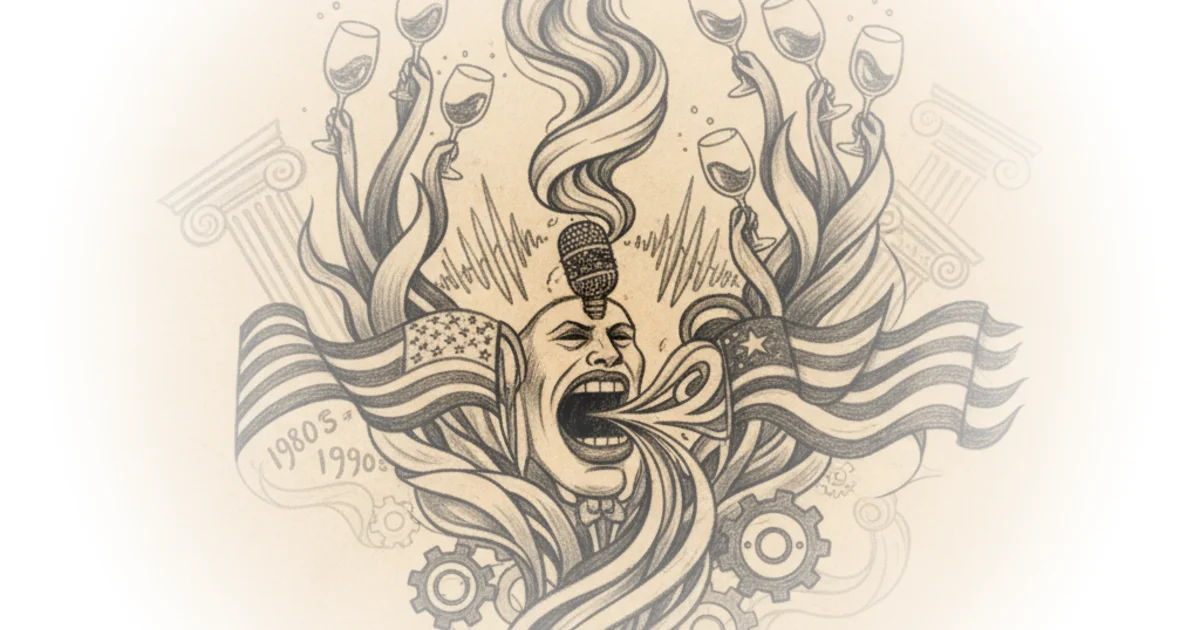
The commentary highlights a striking paradox: Reagan was an actor who admitted he didn't know how to be president unless he was acting. As Yale University puts it, "I don't know how you could be president if you weren't an actor." This performative nature allowed him to represent ideological ideals without necessarily delivering on the gritty details of governance. The speakers argue that this disconnect explains why the religious right grew frustrated with him; he could say the right things to rally the base while failing to deliver on specific promises like overturning abortion rights. This is a compelling reframing of presidential power, suggesting that in the television age, the ability to appear to lead is often more politically potent than the act of leading itself.
Critics might note that attributing Reagan's success primarily to his acting skills risks underestimating the genuine structural shifts in the conservative movement that he rode to power. However, the speakers effectively balance this by acknowledging that his "sunny optimism" was a deliberate political tool designed to counter the "malaise" of the Carter era.
The Paradox of Reactionary Progress
The most provocative section of the podcast tackles the idea that Reaganism was a mix of looking backward and moving forward. Yale University observes that Reagan was the "original let's make America great again," a slogan that is inherently "backward looking," yet his 1984 campaign slogan, "Morning in America," signaled a "beginning of something." This duality is the core of the authors' argument: Reagan's reactionary politics against the 1960s and 70s social changes inadvertently forced a reorganization of the political landscape that energized opposition and redefined the future.
The speakers point out that while Reagan claimed to reverse the gains of the civil rights and feminist movements, his aggressive stance actually "awakened something" in those who felt excluded by his vision. As Yale University notes, "if you're not included in the... sunny morning we... right then all your hackles are going to go up." This suggests that the polarization we see today is not a new phenomenon but a direct result of the 1980s, where the assertion of a singular national identity created a counter-movement that reshaped American politics. The argument is strengthened by the admission that Reagan was "the most racially divisive president modern president ever," a claim that contextualizes the current racial tensions as a continuation of the strategies deployed in the 1980s.
He is the original let's make America great again, which is a backward looking slogan, but morning is the beginning of something.
While the speakers focus heavily on domestic reaction, they briefly touch on foreign policy, noting the irony that the Cold War ended "just after his watch." This raises a counterpoint: does the "Reagan Doctrine" truly deserve credit for the Soviet collapse, or was it merely a matter of timing? The authors seem to lean toward the latter, suggesting that the anti-communist framework was a category through which history was interpreted rather than the sole cause of the outcome.
The Unwritten History
The episode concludes by emphasizing that the history of the 1980s and 90s is still being written. Yale University states, "once you start getting into the 80s and 90s and early 21st century, even the first draft of that history really hasn't been written, at least not in a comprehensive way." This is a vital reminder for the busy listener; the narratives we hold about this era are fluid and subject to revision as new archives open and new perspectives emerge. The speakers celebrate this uncertainty, viewing it as an opportunity for scholars to challenge the "assumptions that historians made" about the dominance of the New Deal coalition and the subsequent "Age of Reagan."
By treating the 1980s as a period of "reinvention" rather than a settled chapter, the authors invite listeners to question the inevitability of current political structures. They argue that the "isms" of the era were not just slogans but active forces that continue to shape our reality. The discussion of how Reagan's coalition was frustrated by his inability to govern as he campaigned serves as a timeless lesson in the gap between political rhetoric and administrative reality.
Bottom Line
Yale University and Bethany Moreton provide a sophisticated, nuanced portrait of Ronald Reagan that moves beyond the binary of hero or villain to reveal a complex figure of performance and contradiction. The strongest part of their argument is the insight that Reagan's performative charisma allowed him to maintain power despite policy failures, a dynamic that remains highly relevant in today's media-saturated politics. The biggest vulnerability in the coverage is the brief treatment of foreign policy, which leaves the question of Reagan's actual impact on the Cold War somewhat unresolved. Listeners should watch for how these historical debates evolve as more archives open, particularly regarding the racial and social fractures that Reagan's presidency both exposed and exacerbated.