The modernist movement wasn't just an artistic revolution — it was a spiritual reckoning. When Ezra Pound declared "Make it new," he was speaking to a generation that had watched traditional faith crumble under the weight of Darwin's evolution theory, higher criticism of scripture, and the trauma of World War I. The modernists tried to rebuild meaning from the wreckage.
The Crisis That Spawned Modernism
The modernist movement emerged precisely at the turn of the 20th century, roughly forty years after Darwin's Origin of Species shattered the old religious order. Higher criticism had already dismantled traditional views of biblical authorship. Among these ruins, poets like T.S. Eliot, Virginia Woolf, James Joyce, and W.B. Yeats attempted to reconstruct meaning through radical innovation.
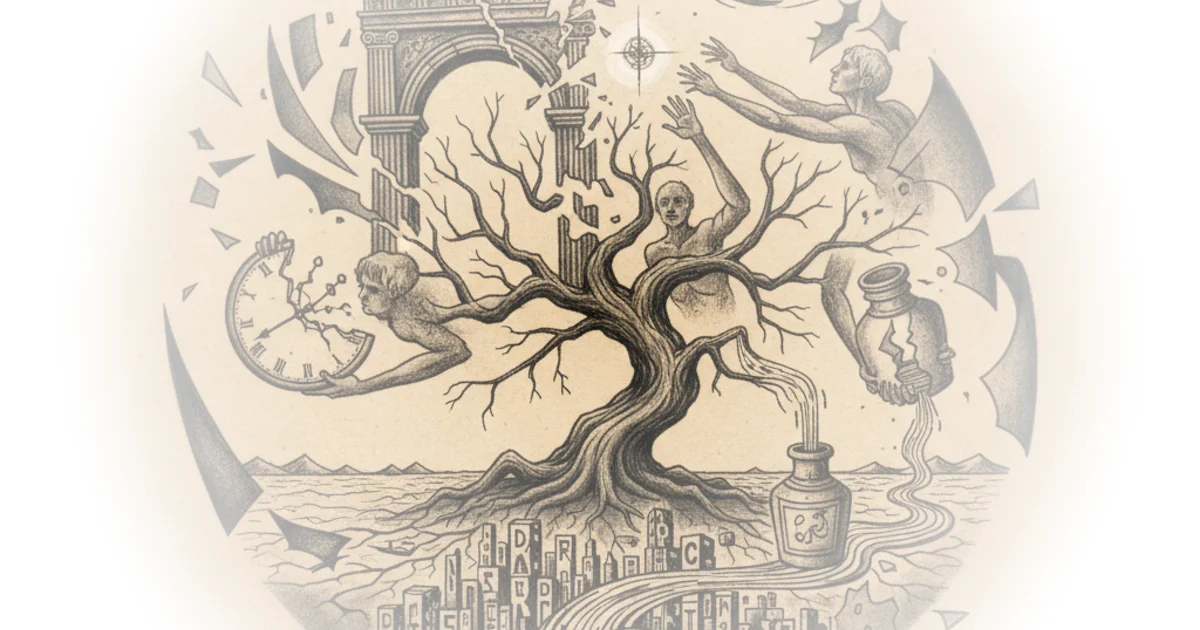
Their work wasn't simply a return to what was before. It was reinvesting the world with new meaning — finding something authentic in the debris of old faith.
The Diagnostic Power of "The Waste Land"
Eliot's The Waste Land, published in 1922, imagined Europe's psychological landscape after World War I. Critics often misread it as nihilistic. George Orwell complained that the poem lacked moral commitment. But reading it closely reveals something different: the poem diagnoses the spiritual impoverishment of its era and turns toward restoration.
Eliot invoked fertility myths and seasonal renewal — cyclical patterns containing seeds of regeneration. The final section, "What the Thunder Said," includes the line "These fragments I have shored against my ruins." This isn't despair. It's a motion toward spiritual renewal, seeking echoes of transcendent order in the fragmented past.
The poem names the spiritual sickness of its time without prescribing a cure — it simply points to what has been lost.
The Turn Toward Traditional Structures
Shortly after The Waste Land, Eliot began reconsidering religious practice. In 1923 or 1924, he wrote on an envelope: "There are only two things, Puritanism and Catholicism. You are one or the other." He was drawn to Anglicanism's Catholic elements — what became Anglo-Catholicism.
By 1927, Eliot fully converted to Anglo Catholicism. His friend Virginia Woolf complained in a letter to her sister: "I have had a most shameful and distressing interview with poor dear Tom Eliot... I was really shocked. A corpse would seem to me more credible than he does."
This commitment deepened. By the late 1930s and 1940s, Eliot was what he called "a person of prayer" — someone seeking contemplative life within traditional church walls.
The same pattern appeared in other modernists. James Joyce attended Eastern Orthodox services toward the end of his life, drawn to what he saw as ancient patterns of human ritual encoded in liturgical worship. W.B. Yeats moved from Irish folklore and theosophy toward systematic occultism and a personalized view of cyclical history. Hilda Doulton turned toward Gnosticism and esoteric knowledge.
Critics might note that framing this as purely "spiritual" risks overlooking how much these poets were also navigating personal crises — Eliot's documented psychological collapse preceding The Waste Land, Joyce's ongoing battles with faith and aesthetics. The spiritual turn wasn't always pure devotion; it was sometimes a strategy for order in fragmented times.
Why This Matters Now
Art and poetry become conduits for spiritual power in times of crisis. Today's cultural landscape shows similar patterns: the rise of esotericism, conversions to Eastern Orthodoxy and Roman Catholicism, interest in alternative spiritualities — even conspiracy theories channel a spiritual impulse that mainstream culture no longer satisfies.
Every Renaissance moment has resisted both religious fundamentalism and complete abandonment of spirituality. Modernist poetry was never just about breaking from tradition; it was about making meaning when traditional meaning had been rendered meaningless by time, criticism, and science.
Bottom Line
The strongest thread running through this argument is the connection between artistic production and spiritual life — how poets like Eliot diagnosed cultural despair while simultaneously searching for something solid to believe in. The vulnerability is that the piece sometimes overstates what these poets actually found: their returns were often messy, uncertain, and as much about aesthetics as theology. But that's precisely why it resonates. We're all searching for fragments to shore against our ruins.