Most baseball coverage treats a five-game losing streak as a narrative of collapse, but The Baseball Nerd argues this recent Cubs skid is actually a story of statistical noise masking a healthy roster. By deploying proprietary metrics like Bases Gained and FADE Hit, the author separates the panic-inducing scoreboard from the underlying reality of player performance, offering a rare, data-driven antidote to the knee-jerk reaction of 'the team is broken.' This is essential reading for anyone trying to distinguish between a structural failure and a temporary cold streak in a division race that is tighter than the headlines suggest.
The Illusion of Collapse
The piece opens by dismantling the emotional weight of the standings. The Baseball Nerd writes, "The five-game losing streak is the visible part. The slide started earlier." This framing is crucial because it shifts the reader's focus from the dramatic result to the gradual erosion of a lead. The author notes that while the Cubs dropped from a 2.5-game lead to being 1.5 games behind, the Milwaukee Brewers simultaneously went 8-2, meaning the lead evaporated from both ends. The argument here is that the division race is a zero-sum game where the opponent's surge is as significant as the Cubs' stumble.
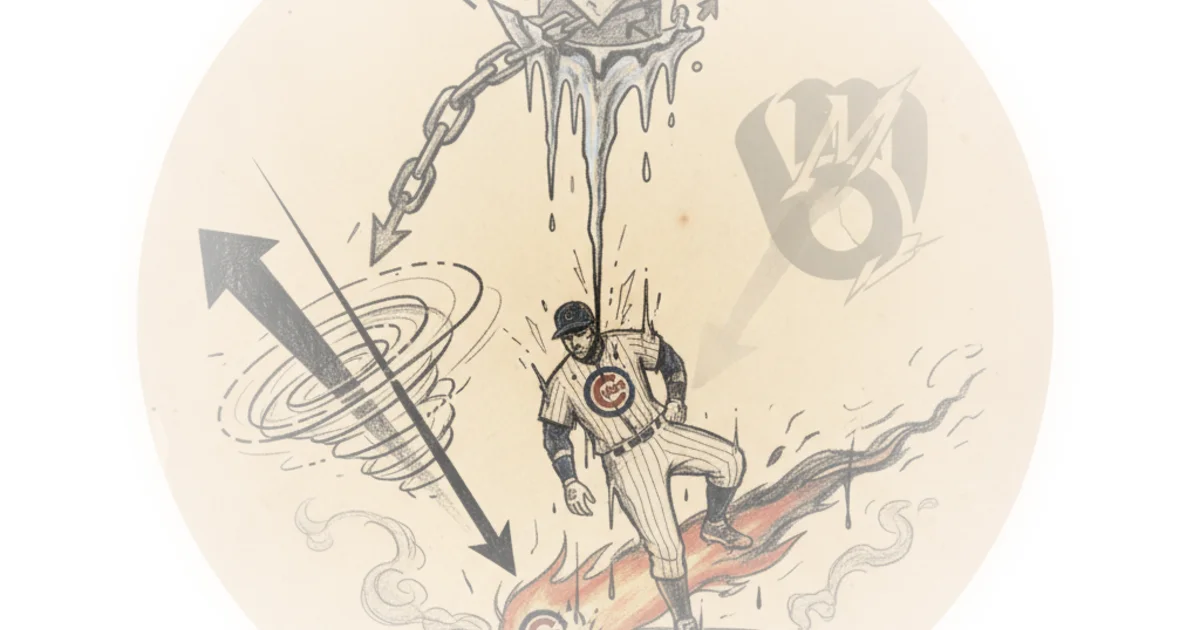
This contextualization is effective because it prevents the reader from over-indexing on the Cubs' 2-8 record in their last ten games. The Baseball Nerd points out that the preceding winning streak was built on beating .500-or-worse teams, while the losing streak came against division leaders. "The competition stepped up at the exact moment the pitching cracked and the bats went cold," the author observes. This is a fair assessment of variance, though critics might argue that a first-place team should be better equipped to handle a gauntlet of division rivals without such a precipitous drop in run differential.
The Bases Gained Breakdown
Where the coverage truly shines is in its granular offensive analysis. Instead of relying on batting average, the author introduces Bases Gained, a metric that accounts for total bases, walks, situational production, and the cost of double plays. The Baseball Nerd writes, "A league-average offense generates roughly 115-125 BG over five games. The Cubs produced 81." This stark contrast immediately quantifies the offensive failure without resorting to vague descriptions of 'slumps.'
The analysis isolates specific players rather than blaming the entire lineup. The author highlights Ian Happ's -7.05 Bases Gained score, driven by 12 strikeouts and two double plays. "He did not just fail to contribute. He came up in situations that mattered and delivered nothing, repeatedly," The Baseball Nerd writes. This is a powerful indictment of a key player's week, yet the author immediately pivots to a deeper layer of analysis using the FADE Hit model. The piece argues that despite the poor output, Happ's underlying metrics—exit velocity and barrel rate—remain stable. "This is not a player breaking down. This is a productive hitter in a cold week," the author asserts.
The BG says he was brutal this week. Both are correct at the same time. That is exactly what the crossover tells you that either model alone cannot.
This synthesis of surface-level failure and underlying stability is the article's strongest intellectual move. It challenges the reader to trust the data over the box score. Similarly, the author uses this framework to defend Pete Crow-Armstrong, whose .118 batting average hid a +10.34 Bases Gained score. "His RE24 of nearly zero means he was not a situational disaster despite the low average," The Baseball Nerd explains, noting that his value came from baserunning and positional defense. This nuance is often lost in traditional coverage, which would likely have buried a player with such a low average.
The Pitching and the Future
The commentary also addresses the pitching collapse, noting that no starter lasted more than five innings in the Milwaukee series. However, the author contextualizes this by pointing to the opponent's strength, specifically Jacob Misiorowski. "That is not a Cubs failure. That is one of the best young pitchers in baseball doing exactly what the model projected," the author writes regarding Misiorowski's dominant performance. This reframes the pitching struggles as a matchup issue rather than a systemic rot.
The piece concludes by reinforcing the stability of the veteran core. The Baseball Nerd writes, "All four are Stable. All four are in what could be the back end of a career. All four, according to FADE, are holding up physically and statistically." This is a reassuring conclusion for a fanbase prone to anxiety, suggesting that the roster is structurally sound. However, one counterargument worth considering is that 'stable' underlying metrics do not guarantee future results if the team's pitching rotation cannot find consistency against elite competition. The article acknowledges the rotation's failure but places less weight on it than the offensive variance.
Bottom Line
The Baseball Nerd successfully argues that the Cubs' recent slide is a statistical outlier rather than a career-ending decline, using proprietary models to separate noise from signal. The strongest part of this argument is the dual analysis of Ian Happ and Pete Crow-Armstrong, which proves that surface-level stats can be deeply misleading. The biggest vulnerability is the reliance on models that may not fully capture the psychological toll of a losing streak on a team's momentum. Readers should watch whether the 'stable' underlying metrics hold up over the next month or if the cold streak finally reveals a structural crack.