Peter Gelderloos delivers a jarring corrective to the political lexicon, arguing that the very words we use to describe our struggles—liberal, progressive, radical—have been hollowed out by a century of state-centric thinking. This is not a standard political analysis; it is a linguistic excavation designed to reveal that the entire spectrum of mainstream politics, from the self-styled left to the right, operates within a framework that Gelderloos contends is inherently destructive to human life.
The Architecture of Language
Gelderloos begins by challenging the modern tendency to let political terms drift into meaningless synonyms. He posits that language evolves through the friction of lived experience, particularly among oppressed groups, but warns against the flattening of nuance that leads to "an Orwellian hellscape in which we have a thousand ways to say nothing other than 'good' or 'bad'." This insistence on precision is the piece's foundation. By refusing to accept the corrupted definitions of the late 20th century, where conservatives successfully rebranded "liberal" as unpatriotic, Gelderloos forces a return to the historical roots of these concepts.
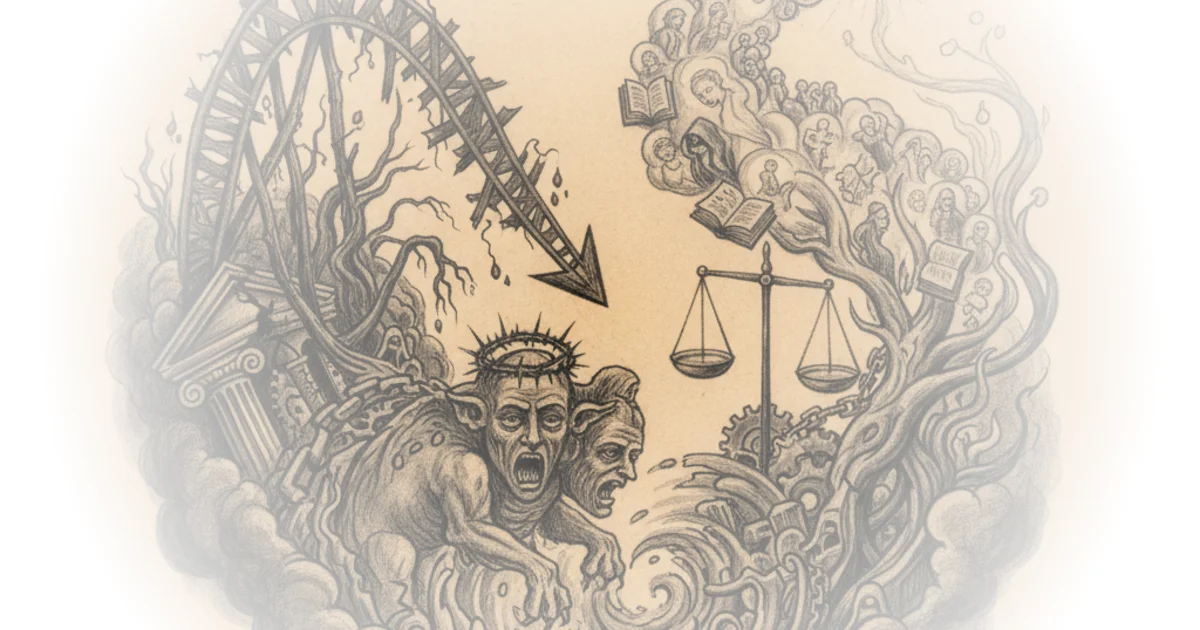
The author argues that for most of the last two centuries, both the mainstream Right and Left have been "liberals" in the truest sense: they all believe that rights inhere to individuals, that private property is the foremost right, and that the state is the only legitimate form of social organization. "In other words, until very recently, nearly everyone in the mainstream Right and Left have been liberals, operating within a liberal paradigm," Gelderloos writes. This reframing is striking because it dissolves the illusion of a fundamental divide between parties like the Democrats and Republicans, suggesting they are merely different managers of the same system.
"The legitimacy of the state rests on the consent of the governed, ipso facto some form of elections are necessary."
Critics might argue that this historical definition ignores the genuine policy differences that affect people's daily lives, such as access to healthcare or environmental regulations. However, Gelderloos's point is structural: he contends that these debates occur entirely within the bounds of a system that prioritizes capital accumulation over human needs.
Defining the Spectrum of State Power
Moving beyond the broad category of liberalism, Gelderloos dissects the specific flavors of state-supporting ideologies. He defines "neoliberals" not just as free-market enthusiasts, but as the architects of a regime where "corporations should legally be considered people with the rights of people but none of the responsibilities." This is a potent critique of the era spanning the 1980s to the 2000s, a period he associates with leaders who removed barriers to capital accumulation regardless of human rights or environmental costs.
He then contrasts this with "progressives," who he describes as believing in the "moral arc of the universe bends towards justice" through the institutions of democracy. While progressives seek to fix the system through active government intervention, Gelderloos suggests they remain trapped in the same paradigm as their neoliberal opponents. "They believe that injustice and oppression have been a big problem, but that things are getting better," he notes, highlighting a fundamental optimism that the author views as a blind spot.
"We don't want reforms, we don't want to stick a bandage on the problem, because by going to the roots we understand the long historical origins of these various problems."
This distinction sets the stage for his definition of "radicals." Unlike progressives who seek to improve the state, radicals seek to go to the roots of the problem, concluding that "democracy is a system developed by and for colonizers and slave owners." Gelderloos argues that true radicalism requires a total transformation of society, not merely a change in who holds power.
The Trap of Authoritarian Reform
Perhaps the most controversial section of the piece is Gelderloos's treatment of socialists and communists. He strips away the romanticism often associated with these labels in the 21st century, arguing that historical socialist and communist states were "authoritarian progressives" that ultimately betrayed the oppressed. He asserts that "every time socialists or communists took power during the 20th century... colonial relationships remained in place, radicals who prioritized revolutionary transformation over the interests of a party were imprisoned or massacred."
Gelderloos does not mince words when describing the economic reality of these regimes, stating that "all socialist and communist states maintained fundamentally capitalist economies." He points to the persistence of wage labor, extractivism, and participation in international banking as proof that these systems failed to abolish the roots of hierarchy.
"Some of these regimes became socially progressive, but many others were/are extremely conservative, homophobic, and patriarchal."
This is a harsh assessment that challenges the traditional leftist narrative of the 20th century. While some readers may find his dismissal of state socialism too sweeping, ignoring the genuine social gains made in certain areas, Gelderloos's focus remains on the structural inability of these states to end exploitation. He argues that the state itself, regardless of the ideology of its leaders, is the mechanism of oppression.
"Do we understand that the existence of the State intrinsically and inevitably constitutes an ongoing war against everyone, a war against life itself, that can only end with the destruction of the State?"
This question serves as the piece's central pivot. Gelderloos traces the origin of "Left" and "Right" back to the French Revolution, noting that while the seating arrangement in the assembly was physical, the ideological commitment to the state was shared by all. "These are usages that are true to our history and true the present," he writes, emphasizing that the distinction between the political sides is a distraction from the reality that they all serve the same master: the state apparatus.
Bottom Line
Gelderloos's most compelling argument is that the debate between the "left" and "right" is a false dichotomy that obscures the shared commitment to state power and capitalist logic. His biggest vulnerability lies in his absolute rejection of any reformist strategy, which may alienate readers looking for immediate, tangible improvements within the current system. However, the piece succeeds in forcing a necessary confrontation with the idea that the state itself may be the primary obstacle to human liberation.