Most coverage of autonomous vehicles fixates on the promise of a utopian future where traffic vanishes and safety is guaranteed. Jason Slaughter flips this script entirely, arguing that the very technology hailed as the savior of urban life is poised to complete the destruction of cities that began a century ago. This is not a Luddite rejection of progress, but a forensic examination of how capital, flawed engineering, and regulatory capture are colliding to create a new, more insidious threat to public space.
The Myth of the Perfect Driver
Slaughter immediately dismantles the binary debate surrounding self-driving cars: the view that they are a "pipe dream" versus the belief that they will "solve all of our transportation problems." He takes a hard stance: "I do believe that self-driving cars are real and they will be in every city in the near future... they will fundamentally destroy the fabric of our cities." This framing is crucial because it shifts the conversation from "if" the technology arrives to "how" it will reshape our physical environment. The author notes that while human drivers are dangerous, the alternative is not necessarily a computer-driven paradise, especially given the history of how automobiles reshaped the 20th century.
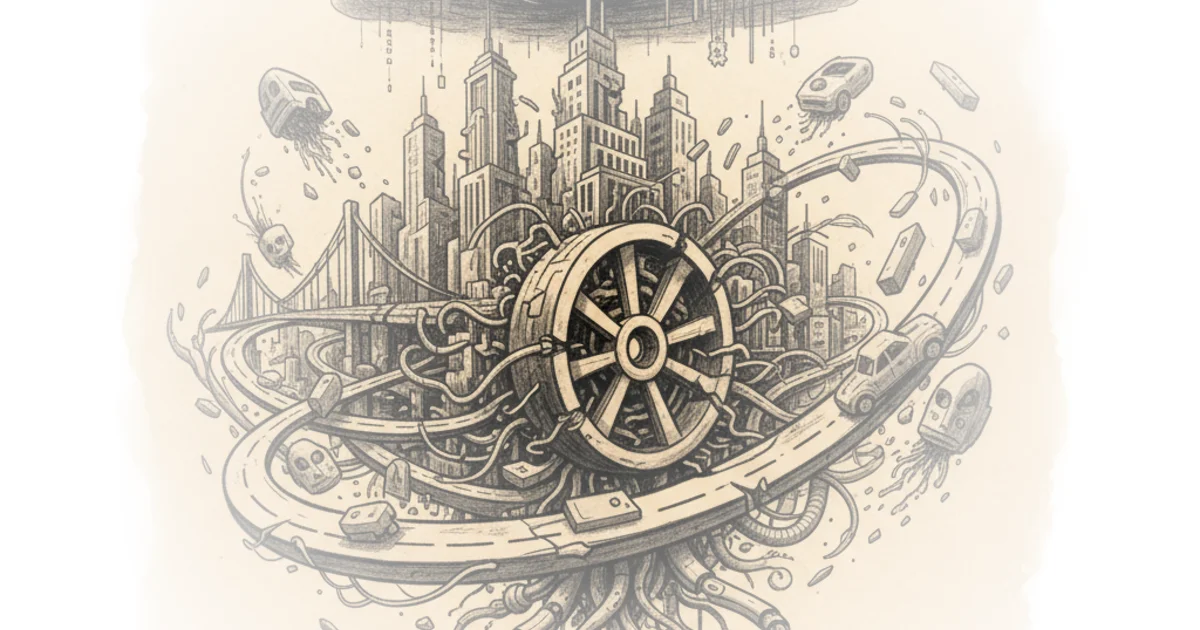
The piece exposes the gap between the marketing narrative and the operational reality. Slaughter points out that despite the hype, these vehicles often require human intervention. "Crews confirmed that their Robo taxis were required Human Assistance every 4 to 5 miles," he notes, highlighting that the "technological Miracle" is often just a remote operator taking the wheel. The argument here is that the industry is prioritizing market entry over genuine readiness. As Slaughter puts it, "nobody knows how long it will take to sort out the long tale of rare occurrences that a self-driving car will encounter in a busy City." This suggests that the public is being used as an unpaid testing ground for a product that is fundamentally "stupid" and prone to "dumb mistakes."
These cars are not intelligent; they don't even have the object permanence of a toddler, yet they are being beta tested on public roads without the consent of the citizens.
Critics might argue that human error is far more prevalent and that any reduction in accidents is a net positive, regardless of the new types of failures introduced. However, Slaughter counters this by emphasizing that the new mistakes are unpredictable and often catastrophic in ways human errors are not.
The Human Cost of "Move Fast and Break Things"
The commentary takes a darker turn when examining specific incidents where the technology failed to recognize human life. Slaughter details a harrowing case in San Francisco where a pedestrian, knocked into the path of a vehicle by another car, was then dragged by a self-driving taxi. The vehicle, having classified the victim as an object that was no longer there, "continued to drive dragging her underneath." This incident underscores a terrifying flaw: the software lacks the contextual understanding to handle complex, dynamic tragedies. "It's a first for police and fire departments involving a driver car," Slaughter writes, noting that the company initially tried to hide the severity of the event.
The root cause, Slaughter argues, is not just the software, but the environment in which it is trained. He points to the 2018 fatality in Tempe, Arizona, where a woman pushing a bicycle was struck. The system failed because it could not categorize her consistently, flipping between identifying her as a vehicle, a bicycle, or a static object. "The software didn't consider her to be an important object that was going to cross the path of the SUV until 1.2 seconds before the crash," he explains. This failure is symptomatic of a broader issue: American traffic engineering. The area was designed like a freeway, hostile to pedestrians, with infrastructure that forced people to cross in dangerous ways. Slaughter asserts that the solution was not to fix the road design, but to blame the pedestrian and the technology.
The most deadly kind of road in the US is the 'stroad'—a road designed for high-speed travel that also tries to act as a destination—and these are all over the US and Canada.
Slaughter argues that the push for self-driving cars is a distraction from the real solution: better road design. He notes that if the US adopted the "Vision Zero" method developed in Sweden, fatalities could drop by over 80% without any new technology. The industry's focus on selling new cars rather than fixing old infrastructure is a strategic choice driven by profit. "Self-driving car companies do not care about Road Safety they care about selling cars and Technology," he writes. The safety messaging is merely a tool to gain regulatory approval, after which the priority shifts to market dominance.
The Global Export of Car-Centric Chaos
The final section of the piece warns of the international implications of this technology. Because these systems are trained in the most car-dependent cities in the world, like Phoenix and San Francisco, they are learning to navigate environments that prioritize vehicles above all else. "If anthropomorphic cars could design cities they would design Phoenix," Slaughter observes, describing a landscape of wide roads and square grids that is "literally like driving on easy mode." The danger lies in exporting this logic to cities in Europe and elsewhere that have historically prioritized walking and cycling.
The author highlights the aggressive lobbying efforts by these companies to avoid accountability. They have successfully pushed for laws that allow self-certification and prevent police from ticketing autonomous vehicles for traffic violations. "It may be that eventually on average self-driving cars will be safer than human drivers in the future but it is incredibly naive to believe that they will not introduce new safety problems of their own," Slaughter concludes. The industry's mantra of "move fast and break things" is being applied to public safety, with the potential to break the very social fabric of our cities.
Bottom Line
Jason Slaughter's argument is a necessary corrective to the techno-optimism dominating the autonomous vehicle discourse, effectively linking the technology's flaws to the deeper failures of American urban planning. While the piece may understate the potential for future software improvements, its strongest point remains the undeniable reality that these systems are currently being deployed in an environment hostile to the very safety they promise. The reader should watch for how regulators respond to the growing evidence of these "new mistakes" before the technology becomes irreversible.