Mary Cadwalladr has delivered a piece that initially appears to be a surreal cautionary tale about immigration enforcement, only to pivot into a profound, revisionist history of American music. The opening anecdote—featuring ICE agents engaged in a bizarre, snow-melting contest in a Texas gas station restroom—is a deliberate, jarring narrative device used to expose the absurdity of bureaucratic overreach and the fragility of due process. Yet, the true weight of the article lies not in this satirical prologue, but in Cadwalladr's bold claim that the most significant cultural synthesis of the 20th century occurred not in the coastal capitals of New York or Los Angeles, but in the low-budget, segregated studios of 1960s Texas.
The Margins as the Center
Cadwalladr argues that commercial success often dilutes artistic genius, proposing instead that true innovation thrives in the margins. She writes, "For in postwar America, where commercial success at the highest levels has always been shaped by forces extraneous at best, and hostile at worst, to the musical art as such, marginality really is the most reliable marker of greatness." This framing challenges the standard music industry narrative that equates high production values with quality. By focusing on The !!! Beat, a hastily recorded television show from WFAA in Dallas, she uncovers a forgotten ecosystem where racial barriers were dissolved through shared vernacular traditions.
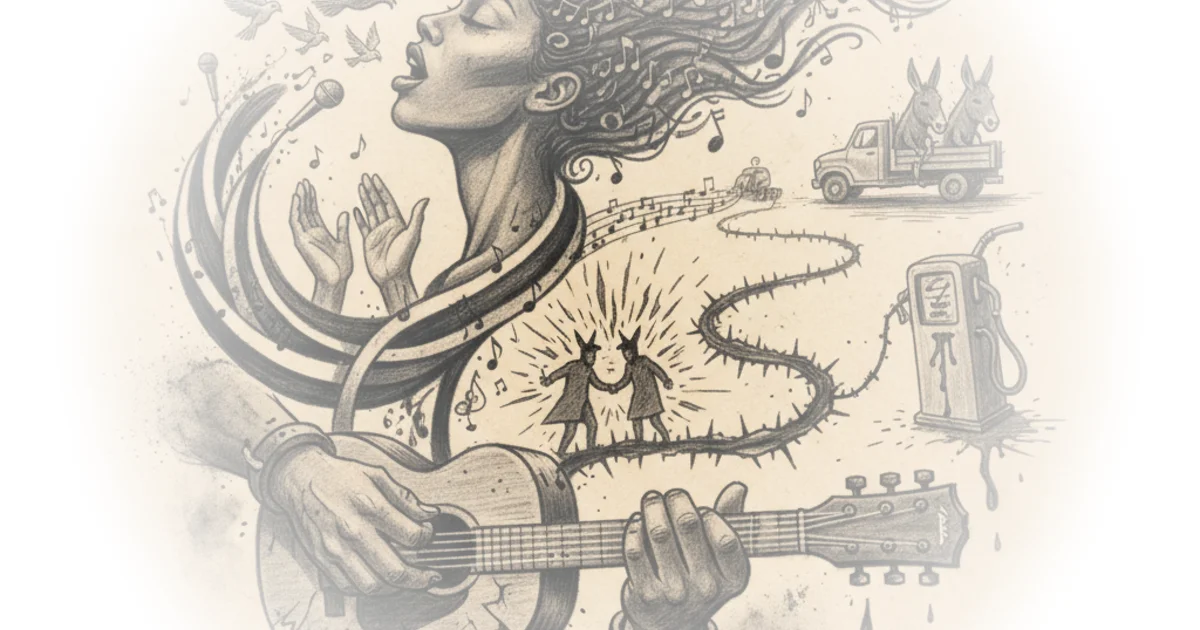
The author posits that the show's host, Bill "Hoss" Allen, was a crucial figure in this cultural alchemy. Cadwalladr describes him as a "high-wattage white transmitter of rhythm and blues" who, despite appearing perpetually hungover, managed to "center Black American genius" and "lift up Black American voices." This is a striking re-evaluation of a white DJ's role in the civil rights era, suggesting that his platform facilitated a "delicious American métissage" that the recording industry tried to suppress. Critics might note that elevating a single white host risks overshadowing the Black artists who were the actual creators of the sound, but Cadwalladr is careful to frame Allen as a conduit rather than a creator.
"It really is on the margins that we should go looking for personalities to build cults around. It really is in the lowest-budget productions that we may most hope to find true genius."
The Texas Crucible
The article's most compelling argument centers on the unique cultural geography of Texas. Cadwalladr suggests that the state's specific history—defined by an "open frontier, proximity to Mexico, and to the legacy of the Comanche Empire"—created a space where race-fluid music could flourish. She uses the career of fiddle virtuoso Clarence "Gatemouth" Brown to illustrate this point, noting that his ability to play country fiddle with the uncanny precision of a lyrebird was not an anomaly, but a product of this specific environment.
Cadwalladr draws a direct line from this Texas sound to the later "outlaw country" movement, suggesting that Willie Nelson's vocal techniques were forged in the fires of The !!! Beat. She writes, "If you really want to understand outlaw country, you have to imagine Willie in front of his TV in 1966, studying under all the masters parading across Hoss's variety stage." This historical connection is vital, as it reclaims a genre often whitewashed in popular memory and roots it firmly in a shared, multiracial heritage. The reference to Gatemouth Brown's 1973 performance of "Please Mr. Nixon" further underscores the political undercurrents of this music, celebrating a "mongrel and race-fluid soul" that defies the industry's attempts to categorize artists by race.
The Spiritual Counterpoint
Perhaps the most profound section of the piece is Cadwalladr's analysis of the role of Christianity in postwar music. She argues that the industry's eventual secularization of music stripped it of its deepest emotional resonance. "Nothing makes sense in American postwar cultural history if you do not take into account the role of religion," she asserts, tracing the lineage from gospel to the "darkness" of rock and roll.
She highlights the Staple Singers as the pinnacle of this synthesis, arguing that their music captured both the "soul's suffering" and the "golden radiance of its salvation." Cadwalladr claims their version of "Uncloudy Day" is "both the most beautiful and the most consequential recording in postwar musical history." This is a bold aesthetic judgment that challenges the secular canon. While some might argue that focusing on the spiritual roots of soul music ignores the political activism of the Civil Rights movement, Cadwalladr insists that the two are inseparable, stating that the artists' sensibility was "shaped by an awareness of the inescapable tragedy of human existence."
"The hard depths they sounded were always only the counterpoint, the soul's suffering in its early sojourn, to the golden radiance of its salvation, which, unlike Jimi, they are also capable of expressing in sound."
The Silenced Archive
The article concludes by lamenting the poor audio quality of the surviving tapes of The !!! Beat, noting that the "woefully poor audio" obscures the "exquisite work" of artists like Barbara Lynn. This technical failure serves as a metaphor for the broader erasure of this shared cultural history. Cadwalladr points out that the show's geographical scope was almost entirely contained within "flyover country," a region that shaped the musical character of America while being ignored by the coastal cultural elites. She notes that while New York and Los Angeles were important for later dialogues with Latin America, the foundational work happened in the South and Midwest. The piece serves as a reminder that the "canned history" of the music industry, with its euphemisms like "urban hits," has actively worked to forget that Black America was, until relatively recently, primarily a region of rural America.
Bottom Line
Mary Cadwalladr's piece is a masterful exercise in cultural recovery, using a surreal opening to disarm the reader before delivering a rigorous, evidence-based argument for the centrality of Texas and the rural South in the evolution of American music. The strongest element is her reframing of "marginality" as the true source of artistic genius, effectively dismantling the coastal-centric narrative of music history. However, the piece's reliance on a single, obscure television show as the primary lens for this history leaves some gaps in the broader narrative, particularly regarding the role of radio and live venues in sustaining these cross-racial dialogues. Readers should watch for how this revisionist history challenges the current industry's categorization of genres and the ongoing efforts to preserve these fragile, low-fidelity archives.