Economics Explained delivers a jarring reality check: the global economy might be losing $40 trillion annually not to war or recession, but to the quiet, collective act of staring at screens for clickbait. By converting human attention into hard currency, the author exposes a terrifying gap between what we measure as "value" and what we actually experience as a life well-lived.
The Price of a Human Hour
The piece opens with a provocative calculation that forces the reader to confront the transactional nature of modern media. Economics Explained writes, "To me, it's worth about $50,000," referring to the aggregate value of a viewer's lifetime of attention as captured by a single viral video. This stark figure serves as the entry point for a deeper critique of how economists quantify human existence. The author argues that while traditional metrics like GDP track money changing hands, they often miss the actual utility people derive from free services.
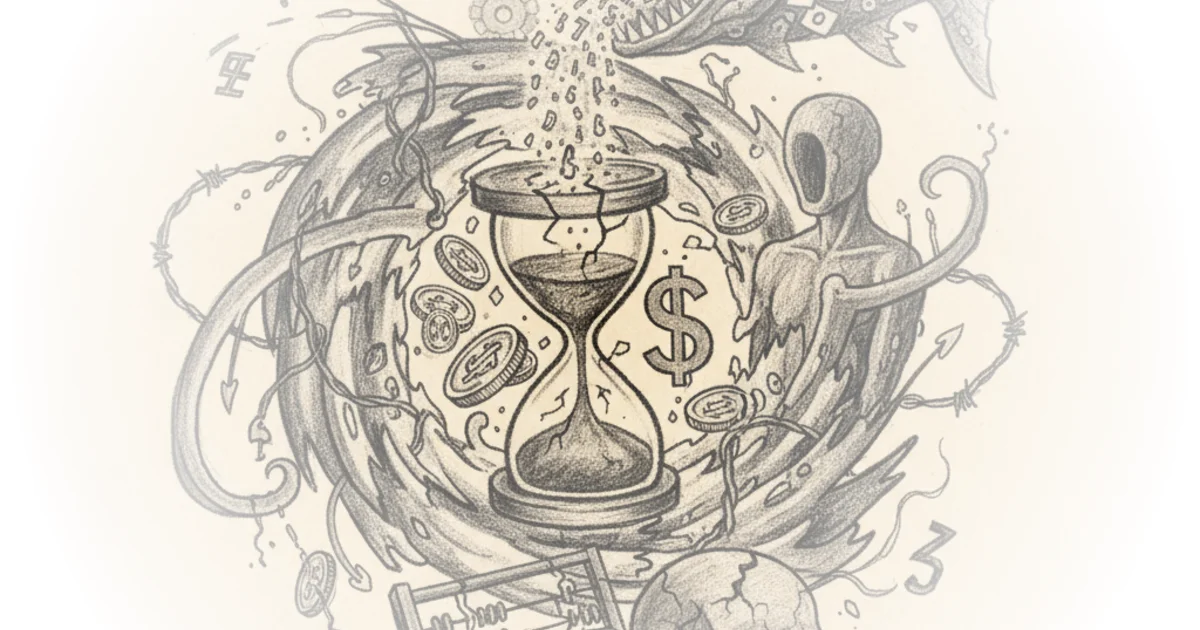
As Economics Explained puts it, "For a lot of economies, it's assumed that as long as numbers like unemployment, inflation, productivity, and incomes go in the right direction, that automatically the human experience is also improving." This assumption, the author contends, is increasingly fragile. The commentary suggests that this rigid mathematical precision often strips away the nuance of the human condition, creating a scenario where headline figures look great while the population feels they are moving backward. Critics might note that relying on self-reported "vibe" metrics can be subjective, yet the author's point stands: the disconnect between macroeconomic data and personal well-being is widening.
One human lifetime was spent watching these videos and $50,000 was paid by advertisers to feature on those videos. Seems pretty straightforward, right?
The author uses this thought experiment to highlight a fundamental flaw in how we value time. If a person spends an hour watching a video, GDP only registers the ad revenue, ignoring the entertainment or education the viewer gained. Economics Explained illustrates this with a hypothetical comparison: an economy with free, ad-supported movies would likely offer a higher quality of life than one where everything is behind a paywall, yet the latter would show a higher GDP. This inversion challenges the very definition of economic progress.
The Hidden Cost of Distraction
Moving from theory to hard data, the analysis shifts to the staggering scale of time lost to digital distractions. The author calculates that the average worker spends roughly 600 hours a year on their phone during work hours. When multiplied by the global workforce and average productivity rates, the result is a lost economic output of $40 trillion. Economics Explained notes, "That is already a huge number, bigly even," before refining the estimate to focus specifically on "rage bait" and low-quality content.
The argument here is that while some screen time offers genuine relaxation or utility, a significant portion is pure waste. The author cites a report by the Association of National Advertisers, noting that "as much as 23% of programming ad spend was effectively squandered on what they politely called low quality websites." By isolating the time spent on content that offers zero value, the author estimates that $2 trillion of productive time is wasted annually on clickbait alone. This is a compelling reframing of the problem; it's not just about individual procrastination, but a systemic leakage of global productive capacity.
However, the piece acknowledges a counterpoint: not all non-work screen time is wasted. Economics Explained writes, "relaxing, even if it is on the job, has value to the people doing it, even if that value can't be directly captured by the market." This admission is crucial. It prevents the argument from becoming a moralizing lecture on productivity and instead keeps the focus on the economic inefficiency of content that actively harms the user or the economy. The author further points out that the rise of "rage bait"—content designed to provoke anger for engagement—adds a layer of active harm beyond mere time loss.
The Paradox of Value
The commentary concludes by examining the irony of the current economic landscape. As platforms become more aggressive with ads and data tracking, the monetary value extracted from user time increases, even as the quality of that time decreases. Economics Explained observes, "Ironically, by valuing your time less, recent economic trends have made your time more valuable." This paradox highlights the tension between the creator's revenue and the consumer's well-being.
The author suggests that the solution isn't simply to demand more productivity, but to recognize the limitations of current economic metrics. "This logical failing of such an important economic metric has actually inspired some economists to propose what they call GDPB," the author explains, referring to a measure that accounts for the value of free goods. The piece argues that without adjusting how we measure value, we will continue to overlook the massive economic and social costs of the attention economy.
Throwing in the hundred billion from the advertisers, and this is taking more from global GDP than Australia is contributing.
This comparison drives home the scale of the issue. The loss isn't a rounding error; it's a continental-scale economic drain. The author's use of concrete comparisons—equating lost time to the GDP of a major nation—makes the abstract concept of "wasted attention" tangible and urgent.
Bottom Line
Economics Explained's most powerful contribution is the reframing of clickbait not as a minor annoyance, but as a macroeconomic catastrophe that dwarfs the output of entire nations. The argument's greatest vulnerability lies in its reliance on average productivity rates, which may not fully capture the nuance of creative or knowledge-based work where "downtime" can spark innovation. Nevertheless, the piece successfully forces a reckoning with the hidden costs of our digital habits, proving that what we don't measure is often what costs us the most.