In an era where digital surveillance feels omnipresent, Kings and Generals offers a startling reminder that the most effective resistance to censorship often relies on the most analog of methods: a typewriter, a stack of carbon paper, and a network of trusted friends. This piece stands out not for its novelty of topic, but for its granular reconstruction of the logistical and social machinery that kept forbidden ideas alive in the Soviet Union, revealing how the state's attempt to control information inadvertently created a more resilient, human-centric distribution network.
The Architecture of Self-Publishing
Kings and Generals begins by grounding the reader in the etymology and mechanics of the phenomenon, defining it as a "novel solution which spawned a new genre of literature." The authors explain that the term itself was a piece of linguistic rebellion, a "mockery of the verboseness of official Soviet publishing houses." By breaking down the word into "sam" (self) and "isdat" (publishing house), the commentary highlights how the very act of naming was an assertion of autonomy against a state that claimed a monopoly on truth.
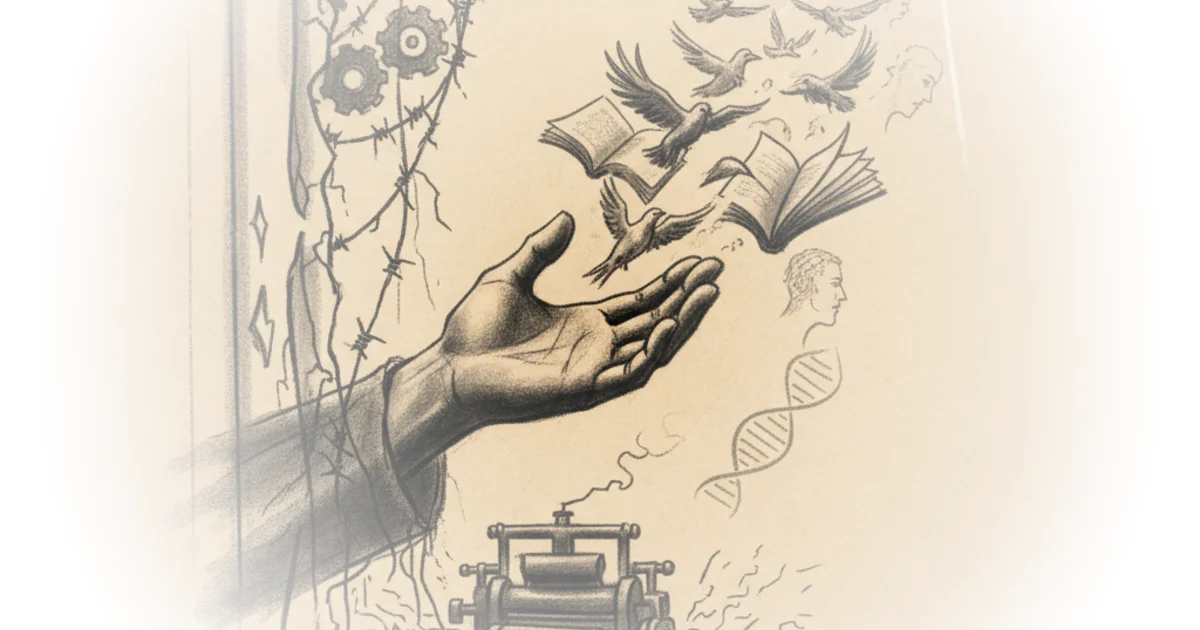
The narrative then pivots to the material reality of the resistance. The authors note that while state-owned typewriters were tracked by the secret police, "huge numbers of typewriters [were] in private hands, passed down through families." This observation is crucial; it shifts the focus from high-level ideology to the mundane tools of survival. Kings and Generals writes, "To save time and limit the likelihood of detection, the texts were often typed onto a thin carbon paper. Because of the thinness of the paper, multiple copies could be typed at once." This detail underscores the ingenuity required to operate within a totalitarian system, turning a simple office supply into a weapon of mass dissemination.
Historian Benjamin Nathans describes how summistats were produced at the kitchen table of Soviet dissident in an assemblyline fashion. People taking turns typing different texts.
The commentary effectively humanizes the process, noting that "many of the typists were women, the wives, daughters and companions of intellectuals or intellectuals in their own right." This is a vital correction to the historical record, which often centers the male authors while ignoring the logistical labor that made their work possible. The argument here is that the resistance was not just a literary movement but a communal one, sustained by domestic spaces that the state could not fully penetrate.
The Catalyst of Persecution
The piece identifies a paradoxical dynamic where state repression often fueled the very movement it sought to crush. Kings and Generals points to the case of Boris Pasternak, whose novel Doctor Zhivago was banned but whose persecution "actually galvanized" the underground press. The authors describe how the state's heavy-handed response to Pasternak, including forcing him to decline the Nobel Prize and ostracizing him, backfired spectacularly.
As Kings and Generals puts it, "The publication of Pastanak's book under his own name led to him being ostracized on Krushchev's orders and ultimately dying from cancer a few years later as a state sanctioned pariah." The irony, as the authors note, is that even the leader who ordered the persecution later admitted he found nothing anti-Soviet in the book. This section argues that the state's inability to distinguish between harmless art and genuine subversion created a credibility gap that dissidents exploited.
The distribution method evolved from simple copying to a complex social ritual. The authors explain that to read a long work, one might have to "go to one apartment having been vouched for to read part one. then you might have to go to a different apartment to read part two." This physical movement of people and paper created a social dynamic that was as important as the text itself. It turned reading into an act of trust and community building, making the ideas within the texts more potent because they were shared in a context of mutual risk.
The Failure of the Legal Theater
A significant portion of the commentary is dedicated to the legal battles that exposed the hollowness of Soviet justice. The authors detail the 1965 trial of Yuli Daniel and Andrei Sinyavsky, which was intended to be a show trial but instead became a farce that humiliated the state. Kings and Generals writes, "The trial turned into a farce charged with article 70 of the Soviet Penal Code, agitation or propaganda carried on for the purpose of subverting or weakening of the Soviet regime."
The authors argue that the state's decision to hold a public trial without the use of torture was a strategic error. "Without the use of torture, the Soviet authorities could not repeat the show trials of Stalin's time with their elaborate confessions," they note. Instead, the defense was able to read the contested texts aloud in court, effectively distributing the banned literature to the public and the world. The text was introduced as evidence, but in doing so, the prosecution gave the ideas a platform they would never have received otherwise.
The prosecution presented Daniel Insigni's text as evidence which led to the text being read out in the court.
This section highlights a critical weakness in the state's strategy: the attempt to use the rule of law to suppress dissent only highlighted the absurdity of the charges. Critics might note that while the trials were a propaganda victory for the dissidents, they did not immediately stop the repression; many were still sent to labor camps or psychiatric hospitals. However, the authors' point stands that the spectacle of the trial undermined the state's claim to legitimacy. The KGB eventually settled on a pattern of intimidation and the use of psychiatric hospitals to avoid the spectacle of trials, a move that Kings and Generals describes as an admission of defeat in the court of public opinion.
The Limits and Legacy of the Underground
The commentary concludes by addressing the scope and limitations of the movement. While the underground press was vibrant, Kings and Generals is careful not to romanticize it as a mass movement. They estimate that at its peak, the readership was "at least 200 to 250,000 people," a significant number but a fraction of the total population. The authors write, "The majority of Soviet citizens simply did not have the same luxury and the methods the KGB had at its disposal for intimidation and repression were far more impactful for ordinary citizens."
This nuance is essential. The piece acknowledges that while the intelligentsia could risk their careers and freedom, the average citizen faced a much steeper price for participation. Yet, the diversity of the content is highlighted, ranging from religious texts to ethnic nationalist writings. The authors note that "not all sistats promoted liberal values. Indeed, many of them were deeply conservative, criticizing the USSR for destroying Russia's connection with its spiritual heritage." This broadens the narrative beyond a simple liberal vs. authoritarian binary, showing the underground as a true marketplace of ideas.
One of the most tenacious was a chronicle of current events, which published from 1968 until 1983. In the course of its existence, it covered over 700 political trials from across the Soviet Union.
The authors use the Chronicle of Current Events to illustrate the endurance of the movement. By documenting human rights abuses and demanding the state uphold its own constitution, the dissidents turned the state's rhetoric against it. This strategy of holding the government to its own stated ideals proved to be a powerful tool, one that the state struggled to counter without revealing its own hypocrisy.
Bottom Line
Kings and Generals delivers a compelling analysis of how a totalitarian state's obsession with control created the very conditions for its own subversion, proving that the human drive for free expression is harder to stamp out than a typewriter. The piece's greatest strength lies in its focus on the logistical and social mechanics of resistance, moving beyond the abstract to show the tangible risks and rewards of sharing forbidden ideas. However, it occasionally underplays the sheer terror that kept the majority of the population silent, a necessary context for understanding why the movement remained the purview of the elite. For modern readers, the story serves as a potent reminder that in the face of surveillance, the most powerful technology is often the network of trust between individuals.