Andrew Henry doesn't just celebrate a million subscribers; he exposes the brutal economic reality of trying to teach nuance in an algorithm designed for rage. While most creators chase the "four dark laws" of online engagement, Henry argues that the only way to survive the coming decade of religious conflict is to refuse to play the game.
The Cost of Nuance in a Rage Economy
Henry opens with a celebration that quickly pivots to a sobering defense of slow media. He acknowledges the milestone of hitting one million subscribers but immediately reframes it: "The number itself is just symbolic. What I'm more grateful for is who makes up that 1 million person audience." This is a crucial distinction. In an era where metrics often dictate content strategy, Henry insists that the quality of the audience matters more than the raw count. He argues that his channel exists to "improve your religious literacy," not to defend or attack faith, but to provide "academically grounded answers" to basic questions.
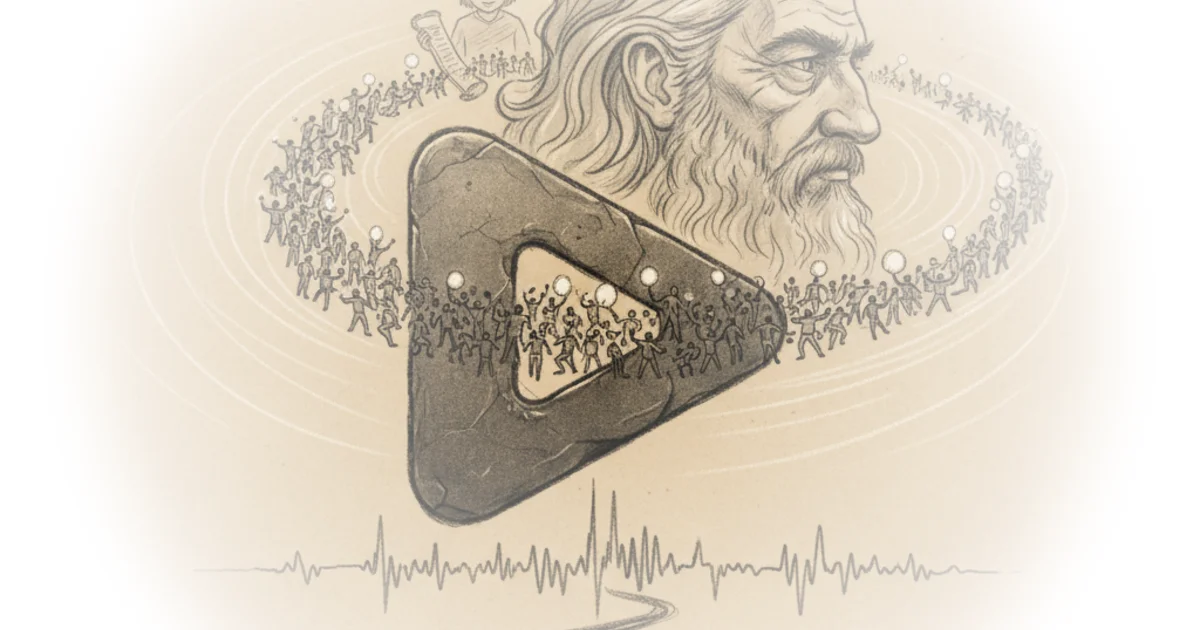
The core of his argument is that the internet is actively hostile to this kind of work. He identifies a specific set of incentives he calls the "four dark laws of online engagement," noting that "negativity increases clicks" and "attacking an out group drives engagement." He admits that the fastest way to grow is to be "angrier, louder, and more divisive," yet he explicitly refuses to do so. This is a bold stance. It suggests that the current creator economy is structurally incapable of supporting deep, educational content without external intervention.
"The fastest way to grow a channel is usually to be angrier, louder, and more divisive. And I just don't do that. Not because it wouldn't work, but because I just don't think it would be good for the mission we're doing here."
Critics might argue that this refusal to engage with the algorithm is a luxury only a creator with an established audience can afford. If Henry had started today, would the "slow" approach have allowed him to reach a critical mass at all? He doesn't fully address this counterfactual, assuming his decade-long runway insulates him from the immediate pressures that crush newer channels.
The Human Labor Behind the Screen
Henry then dismantles the myth of the "solo creator," revealing the extensive, expensive infrastructure required to maintain accuracy. He describes a "flood of AI generated slop" that mimics authoritative voices but is often factually wrong. He notes that AI channels have stolen his scripts, feeding them through large language models to create cheap ripoffs. "The cost of producing plausible sounding is now down to the price of a chat GPT subscription," he observes, highlighting how artificial intelligence threatens to drown out genuine scholarship.
To combat this, Henry details the rigorous, non-scalable process behind his videos. He explains that a single episode on Zen Buddhism required collaboration with two different scholars: one to write the script and another to fact-check it. He even went so far as to send video clips to colleagues to verify if the monks shown were actually from the Zen tradition. "On-screen accuracy is extremely important to me because we're talking about real people, real communities, real religious traditions," he writes. This level of scrutiny is antithetical to the "speed" demanded by the platform.
He illustrates this with his upcoming video on whether babies are born atheist, a project that required weeks of reading developmental psychology and cognitive science. "None of that work is flashy. None of it was easy," he admits. This transparency is powerful. It forces the audience to confront the fact that "religious literacy content is not fast" and that "scripts don't come together quickly."
"Every single video involves a lot of labor, and much of it is collaborative. I pay editors and animators. I pay researchers and writers, and I pay scholars as consultants."
This section serves as a direct rebuttal to the "sloppification" of the internet. However, it also highlights a vulnerability: if the audience is not willing to pay for this labor, the model collapses. Henry is betting that there is a "huge hunger for slow, careful, academically grounded work," but that hunger must be monetized directly, not through ad revenue which favors the "outrage" model.
The Economics of Independence
The final pivot in Henry's commentary is a call to action, but framed not as a plea for charity, but as a necessary investment in intellectual independence. He argues that YouTube ad revenue and sponsorships cannot provide the "stability and independence" needed to tackle complex topics. Instead, he points to his Patreon supporters as the engine that allows him to "plan further ahead" and "keep the focus on careful scholarship rather than chasing the latest trend."
He introduces a specific, tangible reward: a mug available only to long-term supporters. "This has been the longest running Patreon perk on the channel," he notes, emphasizing that it is not merchandise in the usual sense but a "small tangible reminder that you're part of this project." His goal is to grow his patron base from 700 to 1,000, which would allow him to "pay scholars fairly" and take on topics that "don't naturally fit on the algorithm."
"I'm not in this for a quick run or a trend cycle. I'm in this for the long haul. I want to be making these videos in 5 years and 10 years still doing this work carefully, responsibly, and with integrity."
This is the ultimate differentiator. While other creators burn out or pivot to controversy, Henry is explicitly planning for a second decade of the same rigorous work. He frames his audience not as consumers, but as co-architects of a project to "boost everyone's religious literacy."
"Religion for Breakfast is entering its second decade with more clarity, more ambition, and more responsibility than ever."
Bottom Line
Andrew Henry's argument is a compelling case for the viability of "slow media" in a fast-paced digital ecosystem, grounded in the reality that accuracy requires expensive, human labor. His strongest point is the direct link between financial independence via patronage and the ability to resist algorithmic pressure toward outrage. The biggest vulnerability remains the scalability of this model; it relies on a niche audience willing to pay a premium for nuance, a bet that may not hold if the broader internet continues to prioritize speed over substance.