Laura Rozen delivers a narrative that feels less like standard political reporting and more like an archaeological dig into a sudden, irreversible rupture in American institutional norms. The piece centers on a single, jarring image: the complete leveling of the White House East Wing, captured from the air, which contradicts months of official assurances that the structure would remain intact. This is not merely a story about construction delays; it is a stark examination of how quickly the physical embodiment of the presidency can be altered without the usual guardrails of public review or congressional oversight.
The Breakdown of Process
Rozen anchors her reporting in the visual evidence provided by Katie Harbath, noting that "The total destruction of the White House East Wing is seen in this cropped photo taken by Katie Harbath from her airplane on October 23, 2025." This visual proof serves as the article's backbone, forcing a confrontation between what was promised and what was delivered. The author highlights the sheer speed of the reversal, contrasting the initial denial of demolition with the final reality of a flattened site.
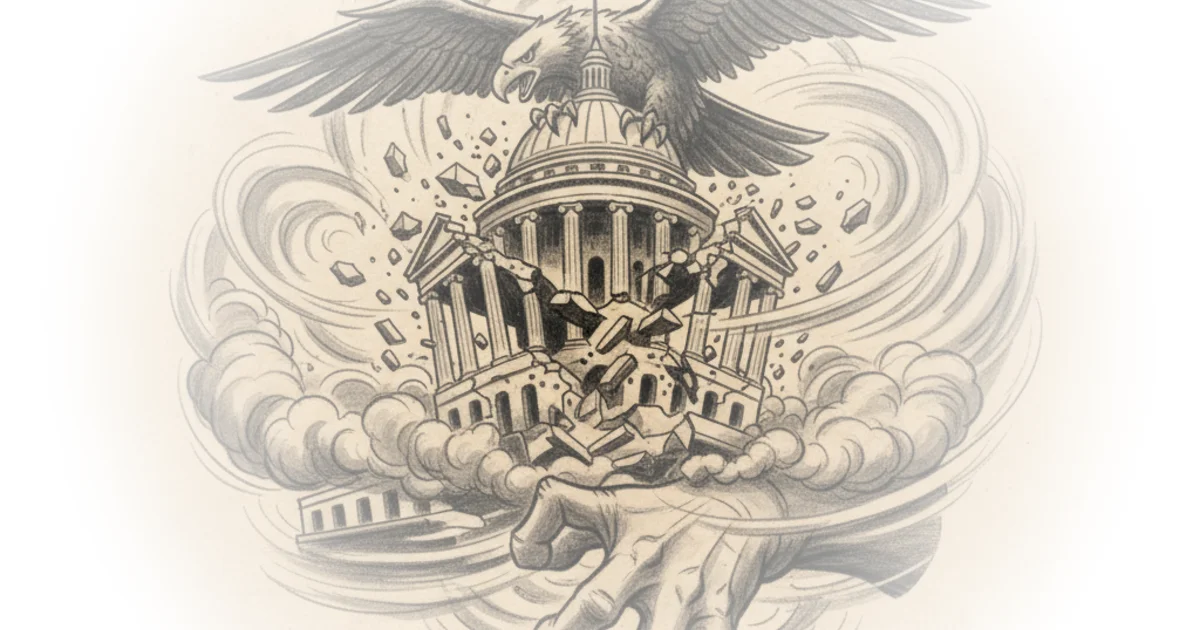
The core of Rozen's argument rests on the administration's attempt to normalize this radical change through bureaucratic vagueness. She quotes White House spokesperson Karoline Leavitt, who stated, "With any construction project, there are changes over time as you assess what the project is going to look like." Rozen frames this as a deliberate deflection, a rhetorical sleight of hand designed to mask a fundamental shift in the scope of the project. By invoking the phrase "Trust the process," the administration attempts to bypass the need for detailed justification. This framing is effective in its brevity, but it leaves the reader with a profound sense of unease about the lack of transparency.
"With any construction project, there are changes over time as you assess what the project is going to look like," White House spokesperson Karoline Leavitt said today. "Trust the process."
Critics might argue that major construction projects often evolve, and that the administration has the authority to manage the executive residence as it sees fit. However, Rozen's reporting suggests that the scale of this change—demolishing an entire historic wing—transcends typical project management. The absence of a formal review or permission process, as noted in the text, elevates this from a logistical update to a constitutional concern.
The Institutional Shock
The most compelling section of Rozen's piece is her inclusion of the reaction from within the political establishment itself. She turns to Senator Lisa Murkowski, a Republican from Alaska, to articulate the breach of trust. Rozen writes that the demolition, "with no review or permission, is 'kind of shocking,'" according to Murkowski. This attribution is crucial; it signals that the disruption is not limited to opposition parties but has rattled the governing coalition as well.
Rozen captures the emotional weight of the event through Murkowski's observation that "I think people feel very possessive about it. It's the People's House." The author uses this quote to pivot from the physical destruction to the symbolic loss. The argument here is that the White House is not just a government building but a shared national asset, and its unilateral alteration feels like a theft from the public. The piece effectively uses the Senator's voice to validate the reader's likely confusion and alarm.
The narrative takes a darker turn in Rozen's closing observation: "At least, it was." This brief, punchy sentence serves as a grim verdict on the current state of affairs. It implies that the concept of the White House as a public trust has been fundamentally compromised. The author does not need to elaborate further; the implication is that the "People's House" has ceased to be such in practice, if not in name.
"I think people feel very possessive about it. It's the People's House." At least, it was.
Bottom Line
Rozen's strongest contribution is her refusal to let the administration's vague assurances stand as the final word, instead using the visual evidence and the shock of a key ally to expose the depth of the institutional breach. The piece's greatest vulnerability is its reliance on a single, catastrophic event to illustrate a broader trend, which risks appearing hyperbolic without further context on the long-term legal challenges that may follow. Readers should watch for how the executive branch justifies the removal of historic preservation laws in the coming weeks, as that will determine whether this was a one-off anomaly or a new precedent for the presidency.