The Trap of Middle Flourishing
Brad DeLong has spent considerable time wrestling with Brink Lindsey's new book, and the struggle reveals something important about our current political moment. Lindsey's The Permanent Problem argues that wealthy liberal democracies have solved material scarcity but now fail at what Keynes called humanity's real challenge: how to use freedom and abundance to live wisely and agreeably and well. DeLong's commentary on Lindsey's work—and the harsh reviews it has received—opens a window into a fault line running through contemporary liberalism.
Brokenists Versus Anti-Brokenists
Lindsey finds himself lumped together with post-liberal critics despite vigorous objections. Brad DeLong writes, "Brokenists, like myself, regard the political upheavals of the past decade as an understandable but misguided reaction to serious underlying maladies…. Anti-brokenists… insist… [on] 'derangement syndromes' that render people unable to handle living in a fallen, messy world." This distinction matters. Lindsey sees widespread disaffection as a rational response to real structural problems, not hysteria or entitled whining.
As Brad DeLong puts it, "I'll stick to my guns…. But it is dispiriting that, after a decade of populist distempers, so many of my fellow liberals still don't understand the nature of the challenge that confronts them." The book's critics—Michael Strain and Jonathan Rauch—dismiss Lindsey as confused or post-liberal without engaging his actual arguments. Rauch writes that if he had stopped reading after Chapter 7, he would take the book for a postliberal screed that outdoes anything by Patrick Deneen. Yet Lindsey rejects post-liberalism completely and unreservedly.
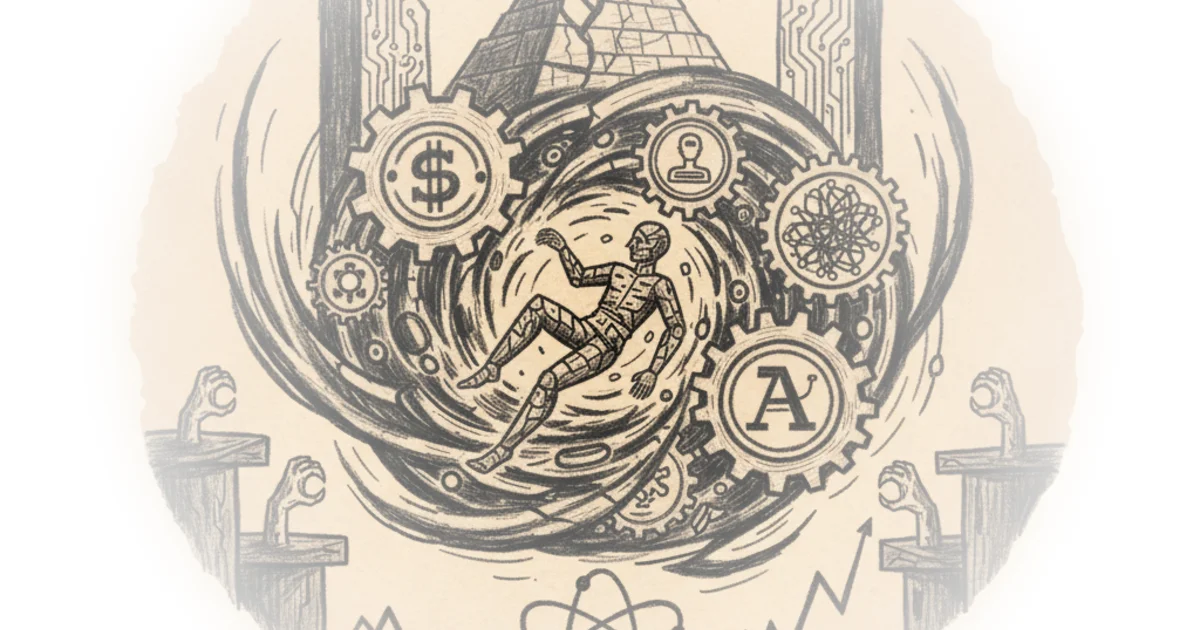
They make us their playthings, controlling us by making us offers we dare not refuse, for refusing them hobbles our very valuable extraordinary material prosperity.
The Triple Crisis
Lindsey diagnoses three interconnected failures in advanced capitalism. First, inclusion collapses as the educated meritocracy hardens into caste. Brad DeLong writes, "The old working‑class ecosystem of unions, neighborhood institutions, and religious congregations has largely disappeared, and nothing comparably binding has replaced it." Marriage, stable families, church attendance, and community life hold up among the highly educated but collapse elsewhere.
Second, dynamism slows in what Lindsey calls the "world of atoms." Productivity growth has decelerated since the 1970s, masked only by information technology's boom. A pervasive NIMBYism arises as people who feel they have more to lose become more risk-averse. Third, politics degenerates into multi-elite culture war. The Brahmin left and merchant right vie for different segments of the electorate while ordinary workers' material interests fall by the wayside.
Critics might note that Lindsey's framework risks romanticizing pre-modern social structures that were often exclusionary or oppressive. The intermediate institutions he champions—unions, congregations, neighborhood associations—sometimes enforced conformity rather than flourishing.
The Constitution of Knowledge
The attention economy corrodes what liberal democracy depends on. Brad DeLong writes, "All the intermediate social structures that grew up over centuries are dismantled, the structure of society radically simplifies: what once was a complicated, often convoluted amalgam of overlapping and competing hierarchies and authorities and loyalties resolves into an undifferentiated mass of subjects under a single rationalizing central authority." Trust in epistemic institutions decays. Politics becomes entertainment. Symbolic victories drown out actual governance.
Lindsey's answer is an abundance agenda plus a connection agenda. More growth where it matters—energy, housing, physical infrastructure, food. More human-scale power over how we live together by nurturing intermediary institutions in which people can do things and live lives that matter. As Brad DeLong puts it, "We also need: positive freedom in the sense of the ability to form groups, groups at human scale, so that we can do things that matter to us, both individually and communally."
This connects to the meritocracy deep dive. The educated elite concentrates residentially and maritally, hardening intergenerationally into quasi-caste. Ordinary people are scattered through low-status service jobs with thinning prospects and fraying social ties. The economic realignment mirrors itself in private life.
Not Post-Liberal, But Liberal
Lindsey insists he is not overthrowing capitalism. Brad DeLong writes, "I reject this post-liberal position completely and unreservedly…. There are totalitarian tendencies in modernity…. But the dominant tendencies have surely been liberating and humanitarian." The problem is not the Enlightenment. The problem is that our abilities to manipulate nature and collectively organize ourselves have become too powerful. They have given us mass society. And mass society is too massive.
Market economies, bureaucratic states, ideological systems, and now algorithmic systems seem arbitrary and alien. They liberate us from material scarcity but subject us to the dominion of extraordinary strong powers. Lindsey proposes using capitalism's extraordinary capacity for innovation and wealth creation to boost collective societal power, then distributing that power to make more people independent of the market's harshest disciplines.
Critics might argue that Lindsey's abundance agenda assumes state capacity and market competition can be directed toward human flourishing without reproducing the same alienating dynamics he diagnoses. The connection agenda requires cultural change that policy alone cannot engineer.
Bottom Line
Lindsey offers a liberal alternative to both post-liberal despair and anti-brokenist complacency. He argues that mass affluence has created a middle flourishing trap where social arrangements work against the very lives they should enable. The verdict: ambitious, imperfect, and urgently necessary.