Nate Hagens challenges the comfortable illusion that the future is a single, predictable line, arguing instead that we are navigating a shifting landscape of overlapping probability curves where a "solution" in one domain often triggers a crisis in another. This piece stands out because it refuses to treat climate models as oracles, exposing the blind spots in mainstream projections that ignore energy collapse, biomass substitution, and the catastrophic cooling of nuclear war. For anyone trying to make sense of the next fifty years, Hagens offers a necessary correction: we are not betting on a winner, but managing a system where every pull on a thread tightens the knot elsewhere.
The Illusion of Certainty
Hagens begins by dismantling our instinct to pin the future to a single number. He asks us to imagine a room of peers guessing the outcome of the 2025 Super Bowl or the global temperature in 2100. While we voice a specific prediction, Hagens notes that "in your mind, you're not picturing just a single outcome. You're likely envisioning a distribution of futures." This distinction is crucial. He uses the NFL season as a metaphor for how probability works in complex systems, explaining that while the Super Bowl eventually collapses into a single reality, the path there is defined by a "normal curve" where the most likely outcomes sit in the fat middle and long shots lurk in the thin tails.
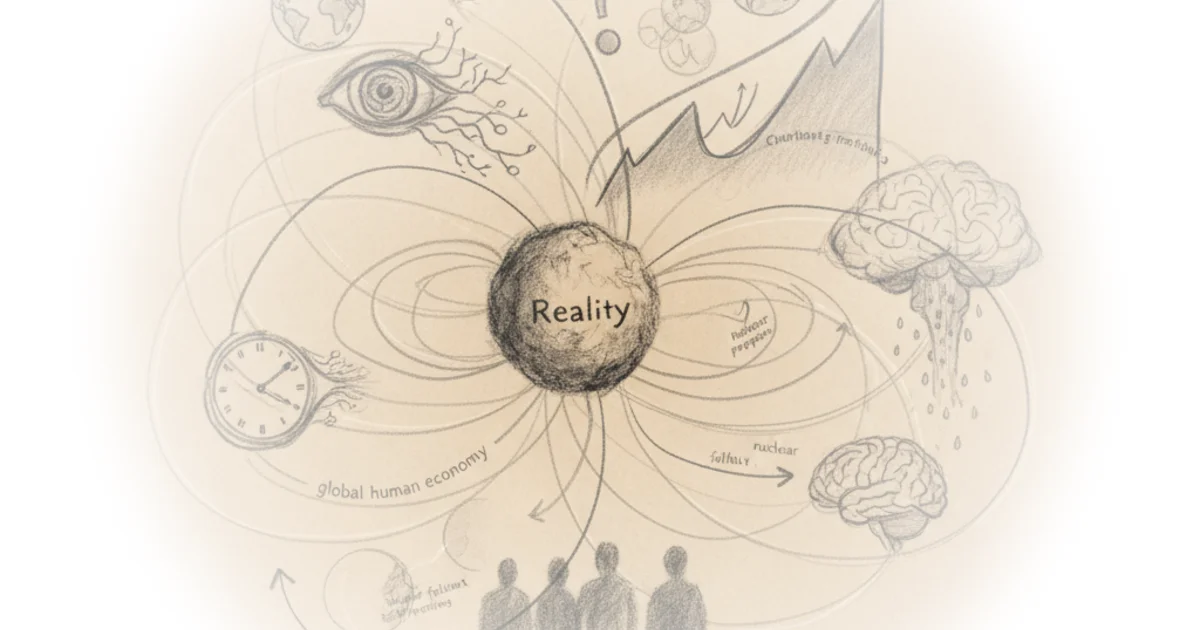
The author argues that this statistical reality applies equally to climate and economics. "The future of the global climate or projected growth in GDP are rather complex topics – so let's start with a simpler example of how probability works in the real world." By framing the future as a distribution rather than a destination, Hagens forces us to confront the fact that "reality isn't shaped by just one probability distribution. It's shaped by many – overlapping, interacting, and constantly shifting." This is where the piece gains its analytical weight; it moves beyond simple prediction to the study of systemic interdependence. Critics might argue that focusing on distributions can lead to paralysis, but Hagens suggests that acknowledging the range of possibilities is the only way to prepare for the unknown.
The Blind Spots in the Models
The commentary takes a sharp turn when Hagens scrutinizes the scientific consensus itself. He acknowledges that models from the Intergovernmental Panel on Climate Change (IPCC) are our best tools, yet he identifies three critical systemic failures that skew the data. First, he points out that society is "energy blind," noting that "there is not a single integrated assessment climate model from the IPCC that incorporates a scenario with meaningfully negative economic growth in the next few decades due to fossil fuel depletion accelerating." This omission is significant because, as Hagens explains, a decline in economic growth would reduce emissions, potentially shifting the temperature curve to a "better" outcome, but the models assume business-as-usual growth.
However, the second blind spot reveals a darker irony. When economic hardship strikes, people don't just stop consuming energy; they often revert to dirtier sources. "For individuals, reduced access to oil and natural gas, combined with tough economic times, typically forces a return to energy sources like wood and coal," Hagens writes, citing historical precedents like the 2009 crisis in Greece. This behavioral shift could lead to a "dramatic increase in the consumption of coal and biomass," effectively pushing the temperature distribution back toward catastrophic warming. The models, he argues, fail to account for this desperate substitution.
Incorporating the above three things into my personal mental distribution for future temperatures would look something like the above (theoretical) graph.
The third and most chilling oversight involves nuclear conflict. Hagens estimates a 20% chance of a strategic nuclear exchange by 2080. While such an event would technically cool the planet—potentially dropping temperatures by 15-17°C in the short term—he warns that this is a "disaster" that would trigger a "Sixth Mass Extinction." "It would reduce emissions – but at an unbearable cost," he writes. This reframing is vital: it reminds us that a "better" climate statistic can be the result of a civilization-ending event. The interplay of these factors means that "pulling on one thread will tug at the whole system," and we cannot simply optimize for temperature without considering the human and ecological toll.
The Human Perception Gap
Ultimately, Hagens returns to the individual, arguing that our personal mental models are just as flawed as the aggregate scientific ones. We tend to simplify complex distributions into a single number, ignoring the "fat middle" of likely outcomes and the "thin tails" of existential risk. "When we say: 'I think temperature in 2100 will be 3ºC warmer than today,' what most of us really mean is: '3ºC is the middle of my mental distribution,'" he explains. This cognitive shortcut prevents us from preparing for the full range of possibilities, from economic collapse to nuclear winter.
The author's framing of the future as a dynamic, shifting probability curve rather than a fixed timeline is a powerful tool for decision-making. It forces us to ask not just "what will happen?" but "what are the risks of the tails?" and "how do these systems interact?" As Hagens concludes, the real world is "complex, interconnected, and full of feedback loops," and our models must evolve to reflect that reality or risk leading us astray.
Bottom Line
Hagens's most compelling contribution is his insistence that the "solution" to climate change is not a linear path but a complex negotiation of trade-offs where economic decline, energy poverty, and geopolitical instability can all distort the climate curve in unexpected ways. The argument's greatest vulnerability lies in its reliance on hypothetical scenarios for nuclear war and energy collapse, which, while plausible, are difficult to quantify with precision. Readers should watch for how policymakers address these systemic blind spots, as ignoring the interplay of these distributions could lead to policies that solve one crisis while accelerating another.
The real world is complex, interconnected, and full of feedback loops. We cannot fully know how each of these distributions will affect the others, but we must accept that pulling on one thread will tug at the whole system.