The Line is Patrick Boyle's deep dive into one of the most ambitious urban projects ever attempted — and one of the most dramatic failures in modern engineering. Saudi Arabia's The Line was supposed to be a 170-kilometer-long city, stretching across the desert like something out of science fiction. Now it's being scaled back by roughly ninety-nine percent. This is the story of how a futuristic vision collided with financial reality — and what it tells us about ambition without anchor.
The Dream vs. The Numbers
The original plans were staggering. "9 million people will be living on a footprint of just 34 Square kilomet which is 13 square miles Manila in the Philippines has the world's highest population density with 119,600 people per square mile neom would have 686,000 people per square mile which is almost six times the population density of Manila." The math is staggering — and that's before you factor in the transportation logistics. Boyle does the math: to travel 170 kilometers in twenty minutes as the designers claimed, you'd need speeds approaching 1,700 km/h, with trains stopping every two seconds at over four hundred stations. "2 seconds to get on or off a train that would quickly accelerate up to let's say three times the speed of sound before slamming on its brakes for the next station and when you lose blood pressure to your head you could even lose Consciousness." This isn't just ambitious — it's physically impossible with current technology.
The Technology That Doesn't Exist Yet
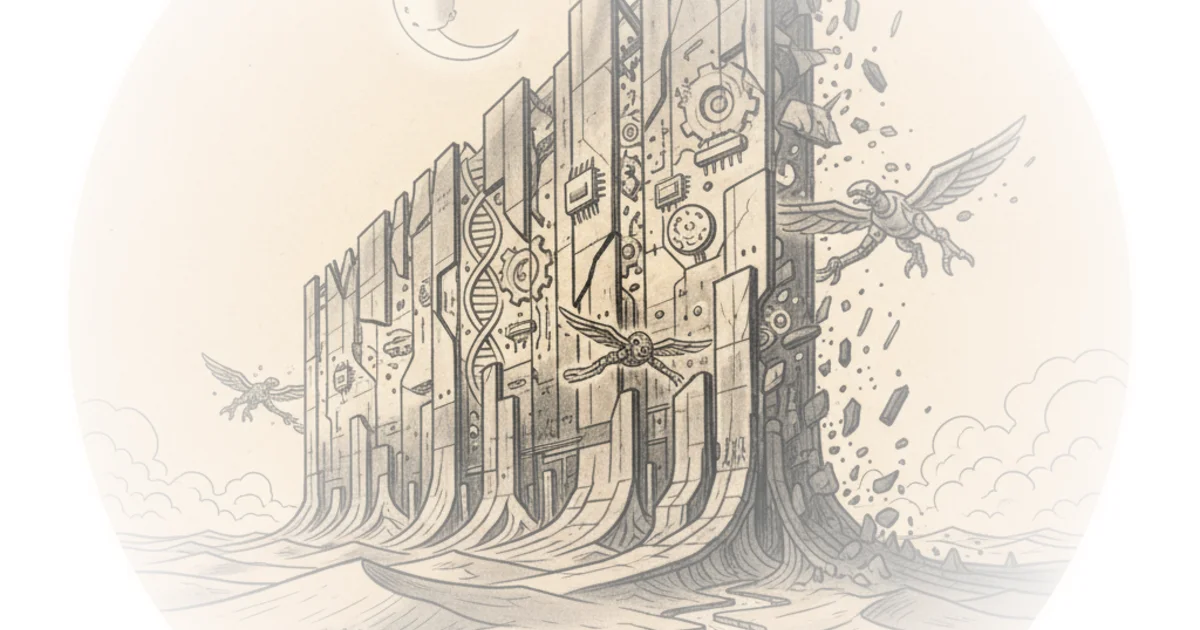
What makes this project particularly fascinating is what was promised. "The Consultants were directed by MBS to help turn his idea into a Reality and the documents highlight that the project is so ambitious that it incorporates many technologies that don't yet exist." Flying taxis, cloud seeding to make it rain in the desert, robot maids, gene editing to modify humans, robotic dinosaur parks, an artificial moon that lights up each night, beaches that glow in the dark. "who knows maybe the radiation from this glowing sand can also modify the human genome and that would kill two birds with the one stone I suppose." These aren't just features — they're science fiction tropes being built into real estate.
The Financial Reality
The scaling back is dramatic: Bloomberg reported that "the Saudi Sovereign wealth funds cash reserves have fallen to $5 billion as of September the lowest level since 2020" and The Line will now extend only 2.4 kilometers and house 300,000 people by decade's end. This represents a "98.6% reduction from the initial plans." But it's still happening — just smaller than hoped for. The financial realities are starting to cause concern at the highest levels of the Saudi government as it tries to fulfill its ambitious Vision 2030 program to diversify the Kingdom's economy away from fossil fuels.
Who Actually Wants This?
One telling detail: when asked if he'd like to live at Neom, one of the project's advisors replied "I'm too old to live in the line I think the line is going to attract Saudis in their 20s and 30s." The admission that the project isn't designed for older people — or anyone who can't handle repeated G-forces of Mach 3 acceleration — is revealing. "you have to be in the prime of life to be able to handle the G forces as it accelerates to Mach 3 and then slows to a full halt for 412 times in a single 20-minute Journey it's not really for me either." The vision seems to assume residents are elite athletes, not families with children or elderly relatives.
Critics might note that this project was never going to work the way it was originally conceived — but it's also possible that smaller-scale implementation could still succeed if they focus on realistic goals. The Line's location in one of the most hostile environments on Earth (where "the only abundant natural resources were sunlight and unlimited access to salt water") suggests that even modest success would require unprecedented engineering.
The project is so ambitious that it incorporates many technologies that don't yet exist — but it's still being built, just smaller than hoped for.
Bottom Line
The strongest part of Boyle's coverage is the rigorous math behind the transportation claims — showing exactly how impossible the twenty-minute journey really is. His biggest vulnerability is treating all this as skepticism rather than analysis: he's clearly skeptical that The Line will work, but he's careful to frame it as news reporting rather than editorial judgment. The real story here isn't whether the project fails — it's what happens when financial constraints meet technological overreach in the Saudi desert. That tension is exactly what's worth watching.