Cyril Hédoin delivers a provocative challenge to a dominant assumption in modern policy: that the past is irrelevant to justice. While economists have long treated history as a sunk cost to be ignored, Hédoin argues that transplanting this logic into morality and politics is not just a category error, but a dangerous erasure of the very reasons we disagree about fairness. For busy leaders navigating complex social fractures, this piece offers a crucial warning: you cannot build a stable society by pretending history never happened.
The Economic Trap
Hédoin begins by dissecting the "marginalist reasoning principle," the bedrock of economic rationality which dictates that decisions should only consider future costs and benefits, ignoring what has already been spent. He illustrates this with textbook examples: attending a concert you no longer want because you bought the ticket, or continuing a failing space tourism project because millions were already invested. "Rationality is forward-looking: rational choices are independent of past decisions and their consequences," he writes. This logic is sound in a boardroom, but Hédoin quickly pivots to show how it collapses when applied to the social contract.
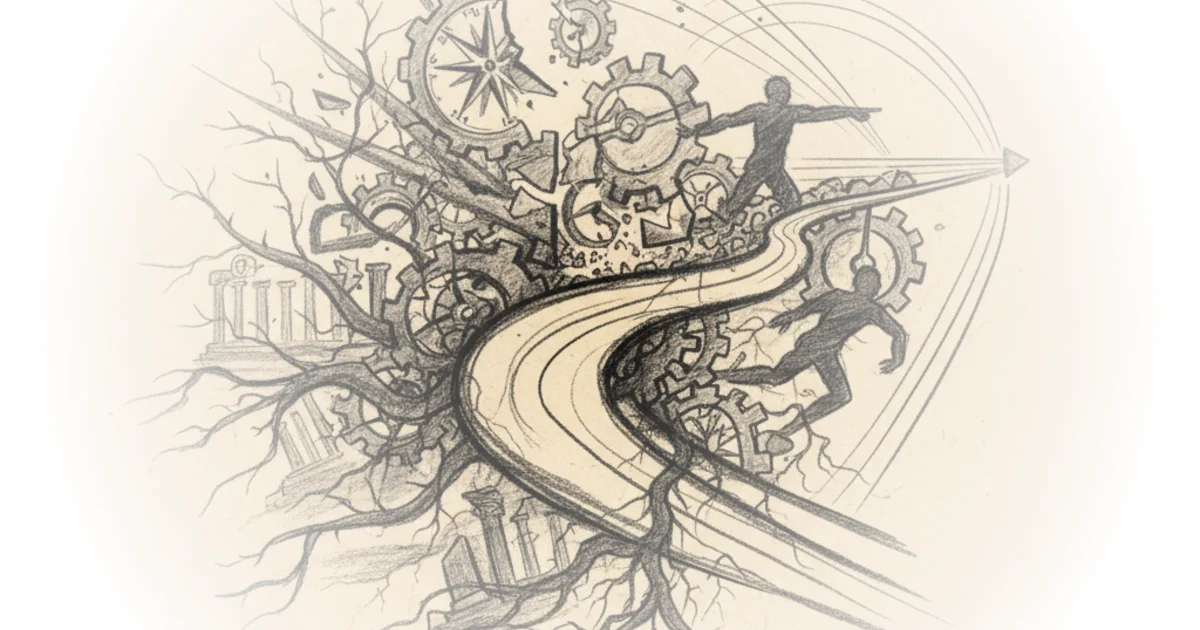
The author targets economist Deirdre McCloskey, who recently argued that past contributions to society—like public roads or education—should not influence current tax or redistribution debates. McCloskey asserts, "The past is the past. It's given, the place from which your decision in your factory should begin. Not finish." Hédoin finds this reasoning deeply flawed when moved from factory floors to the halls of justice. He points out that McCloskey commits a non sequitur by assuming that the rules for resource allocation must also govern the rules of fairness. "If we try to transpose the marginalist reasoning principle... to the domain of distributive ethics, we obtain something like James Buchanan's claim that the allocation of property rights should be made against a baseline corresponding to the current status quo," he explains.
This framing is powerful because it exposes a blind spot in liberal thought: the tendency to treat the current distribution of wealth as a neutral starting line. Hédoin suggests that by ignoring the path taken to reach that line, policymakers risk legitimizing outcomes born of coercion or historical injustice. A counterargument worth considering is that focusing too heavily on historical grievances can paralyze governance, making it impossible to reach any agreement. However, Hédoin's point is not to demand perfect restitution, but to insist that the starting point itself must be scrutinized.
Justice is path dependent. What is fair today partially depends on past decisions.
The Weight of History
The essay deepens by introducing philosophers David Gauthier and Robert Nozick, who reject the idea that the past is normatively irrelevant. Hédoin highlights Gauthier's insistence that a bargain is only just if the starting positions were not achieved through unfair means. "It is both rational and just for each individual to accept a certain constraint on natural interaction... as a condition of being voluntarily acceptable to his fellows," Hédoin quotes. This directly contradicts the marginalist view that any mutually beneficial deal is automatically fair, regardless of how the parties got there.
Hédoin argues that ignoring history doesn't simplify politics; it actually makes it messier. When we strip away the historical context, we lose the ability to understand why certain groups feel aggrieved. He draws on Raymond Aron to note that history is not just a list of facts, but a source of normative reasons. "History thus becomes a source of normative disagreement because it offers normative reasons to justify actions and institutions," he writes. Two people with different historical narratives will inevitably clash on what constitutes justice, not because one is irrational, but because their understanding of the present is rooted in different pasts.
The author warns that a society organized purely around "Pareto-expanding" interactions—where everyone just needs to be better off than before, regardless of how they got there—is a fragile illusion. "Reintroducing history makes things messier," Hédoin admits, but he insists this messiness is necessary for genuine justice. He clarifies that acknowledging history does not mean absolving individuals of responsibility, nor does it automatically mandate specific reparations. Instead, it demands a more nuanced approach than simply applying an economic formula to human relationships.
Bottom Line
Hédoin's strongest contribution is his dismantling of the idea that economic efficiency can serve as a proxy for moral justice. His argument is vulnerable only if one believes that political stability requires a willful amnesia about the past, a position that is increasingly difficult to sustain in a polarized world. The takeaway for leaders is clear: you cannot solve modern political conflicts by pretending the past doesn't exist; you must engage with the history that shaped the current disagreement.