This piece cuts through the moral panic surrounding autonomous vehicles to reveal a familiar, cynical truth: the fight in Congress isn't about saving lives, but about who gets to write the rules of the road. Reason argues that while both major bills claim to prioritize safety, they are actually driven by a classic economic dynamic where high-minded advocates provide cover for commercial interests seeking market dominance.
The Bootleggers and Baptists of the Road
The article opens with a stark comparison to ground the scale of the crisis. "America loses a baseball stadium's worth of lives to vehicular accidents every 12 months," Reason notes, pointing out that roughly 36,742 people die in traffic crashes annually. The piece suggests that self-driving technology offers a solution, yet the political response has been to create two conflicting legislative paths. The core of the argument relies on the "bootleggers and Baptists" framework, a concept coined by economist Bruce Yandle to describe unlikely coalitions where one group seeks moral legitimacy and another seeks economic gain. The editors explain that this dynamic is "familiar to anyone who has studied how high-stakes regulation often works," tracing it back to Prohibition-era alliances between religious reformers and illicit distillers.
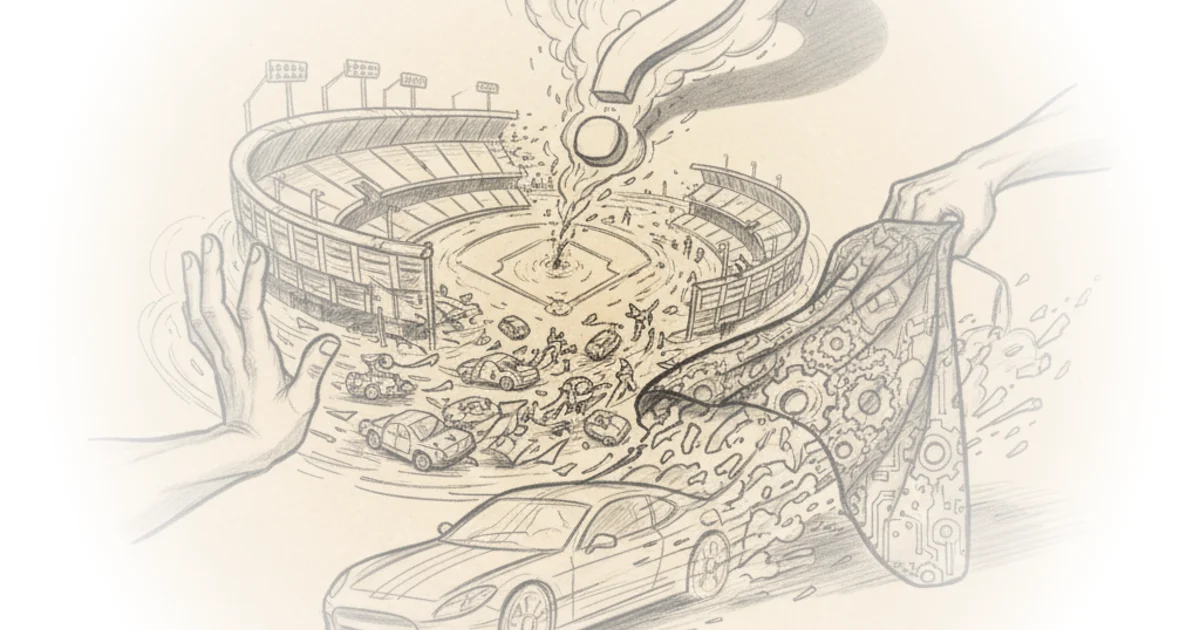
The first bill, the SELF DRIVE Act, is framed by its proponents as a safety measure to accelerate the deployment of life-saving technology. "The 'Baptist' case for the SELF DRIVE Act is simple enough: more self-driving cars, deployed more quickly, would save more lives," Reason reports. However, the article argues that the "bootleggers" here are the incumbent tech giants. The bill would allow manufacturers to self-certify their systems against a "safety case" standard, a process the piece describes as a "low bar in any product-safety context" because it relies on subjective language like "sufficient" and "appropriate." Furthermore, the legislation would raise the testing cap from 2,500 to 90,000 vehicles and allow companies to earn revenue during this testing phase. "If self-driving vehicles are in commercial service while being 'tested,' what one has is not a development stage but a business model," the editors argue. This structure benefits large firms like Waymo, Tesla, and Uber, who have the resources to navigate these subjective standards, while effectively locking out smaller competitors.
Critics might note that self-certification is a common regulatory tool in many industries, and that a federal framework is urgently needed to replace the current "patchwork of 34 different state laws." Yet the piece maintains that the specific design of this bill serves to lower the compliance bar for those already in the game.
The Asymmetric Cost of Regulation
The second bill, the Stay in Your Lane Act, takes a different approach by requiring manufacturers to define an "operational design domain" (ODD)—the specific conditions under which a vehicle is designed to operate safely. The article draws a sharp distinction between Level 2 systems, which assist human drivers but require constant supervision, and Level 4 systems, which are fully autonomous within a set domain. "The act correctly treats ADAS incidents as a problem, and requires that manufacturers define an ODD and prohibit operation outside it," Reason reports.
The commentary suggests that while this sounds like a universal safety rule, it functions as a targeted constraint. "The Stay in Your Lane Act is therefore largely costless to Waymo and constraining to Tesla," the piece argues. This is because Waymo already operates within geofenced areas as a matter of practice, whereas Tesla's advanced driver-assistance systems are permitted to operate on any road. The article notes that this asymmetry is "founded on the fact that Waymo has built a system disciplined enough to operate safely within defined limits, while Tesla hasn't." Here, the "bootleggers" are less visible, but the competitive effect is clear: the bill codifies as a requirement what one company already does voluntarily, while punishing another for a different operational model.
The best possible federal A.V. framework—one that would prevent state patchwork, mandate independent verification of safety cases, and write the Level 2/Level 4 distinction into statute—has no bootleggers behind it.
The Evidence Nobody Wants To Cite
Perhaps the most damning critique in the piece is the observation that neither side is engaging with the actual data. The article points out that consumer safety groups like Consumer Reports and Advocates for Highway and Auto Safety have demanded independent verification of safety claims, yet they have ignored existing peer-reviewed studies. Reason highlights a 2024 study by Kusano et al. which "found an 80 percent reduction in any-injury crashes and a 55 percent reduction in police-reported crashes against comparable human benchmarks" for Waymo. Despite this, the safety advocates have not cited or disputed the data. "They are demanding to be shown exactly the kind of evidence that already exists, which is a strange posture for organizations that describe themselves as evidence-driven," the editors note.
The piece suggests that engaging with this data would complicate the safety advocates' opposition to the SELF DRIVE Act, as it would force them to distinguish between the risks of Level 2 systems and the demonstrated safety of mature Level 4 technology. "The opposition from these safety advocates appears to be procedural and institutional, not empirical," Reason concludes.
Bottom Line
The strongest part of this argument is its unflinching application of the "bootleggers and Baptists" model to reveal how safety rhetoric is being used to cement the market position of incumbent tech giants. Its biggest vulnerability lies in its reliance on industry-funded studies to prove the safety of autonomous vehicles, a point that independent regulators would rightly scrutinize. Readers should watch for whether Congress can be pressured to adopt a framework that mandates independent verification rather than self-certification, or if the current legislative path will simply calcify a system that favors the largest players over public safety.