Kings and Generals transforms a familiar medieval narrative into a masterclass on logistical warfare, arguing that the Third Crusade was won not by the glory of knights, but by the silence of supply lines and the chaos of thirst. While history often fixates on the clash of steel, this documentary zeroes in on the brutal arithmetic of water, heat, and morale that turned a decisive Christian defeat into a total annihilation. It is a reminder that in the Levant, the terrain itself is often the most formidable commander.
The Anatomy of a Trap
The piece opens by dismantling the romanticized image of the Crusader army, presenting a force that was "halfhazard" and internally fractured. Kings and Generals writes, "Despite their undeniable talent in combat an army of knights had been humbled by the Muslims at Hattin almost 2 months earlier revealing their potential weakness around 4,000 other mounted troops supplemented the flower of Christian chivalry." This framing is crucial; it establishes that the Christian leadership was already operating from a position of strategic anxiety, not invincibility. The commentary effectively highlights the disconnect between the elite heavy cavalry and the ragtag infantry, a vulnerability that would prove fatal.
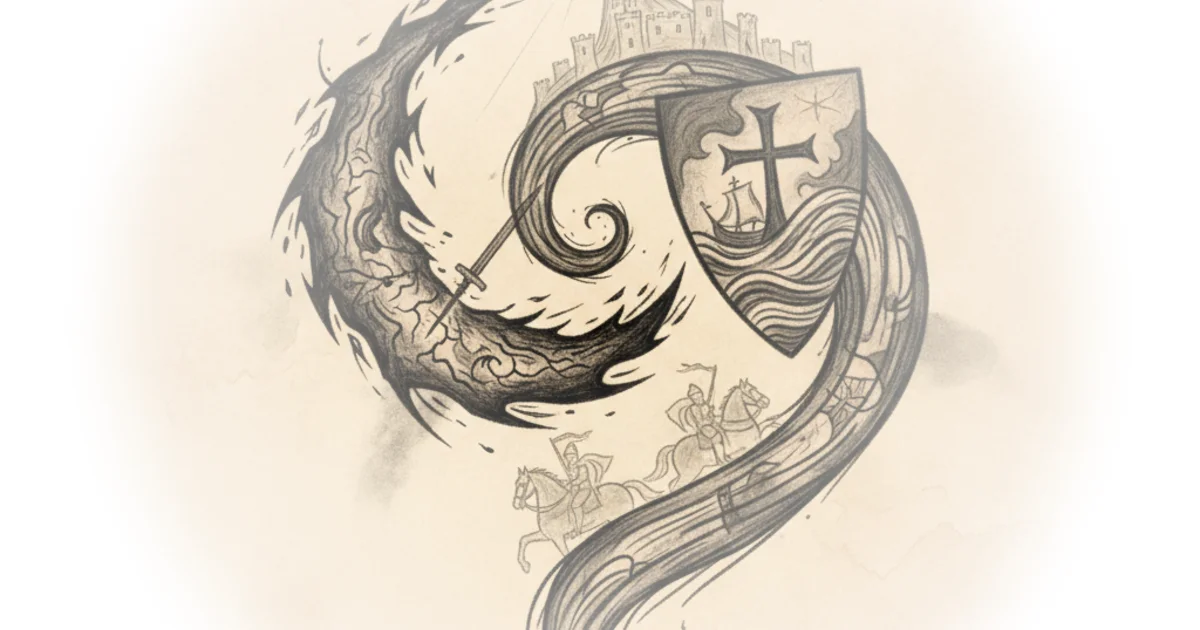
The narrative then shifts to the psychological maneuvering that preceded the battle. Saladin's decision to besiege Tiberias was not merely a territorial grab but a calculated trap. As Kings and Generals puts it, "Saladin's attack on Tiberius was as he saw it intended to draw them into an unfavorable situation and a battle on his terms." The documentary captures the intense internal conflict within the Crusader camp, where Count Raymond of Tripoli correctly identified the trap, only to be overruled by the Grand Master of the Templars. This moment of political infighting is presented as the catalyst for the military disaster, a point that resonates with modern readers who understand how organizational friction can doom even the most talented teams.
"The dire situation provoked the defection of some Knights to Saladin informing the sultan that their comrades were finished at this moment of Maximum opportunity Saladin ordered the bulk of his men in the center to charge down the hill and into the foe."
The account of the march itself is a study in environmental warfare. Kings and Generals details how Saladin used the landscape as a weapon, ordering "prepared piles of parched Brushwood to be set Al light blowing arid smoke from the Northwest Hills straight into the Christian ranks." This detail elevates the conflict from a simple skirmish to a siege of the senses. The commentary suggests that the smoke was as devastating as the arrows, disorienting and suffocating an army already dehydrated by the Galilean heat. Critics might note that the documentary leans heavily on the dramatic flair of the smoke tactic, potentially understating the sheer volume of arrow fire that decimated the unarmored horses, but the atmospheric description remains a powerful illustration of Saladin's tactical genius.
The Collapse of Morale
As the battle reaches its climax, the focus shifts from strategy to the raw psychology of defeat. The documentary paints a harrowing picture of the Christian forces trapped on the "Horns of Hattin," an extinct volcano where the terrain offered no escape. Kings and Generals writes, "Morale completely collapsed when King Guy who was still trying to fortify his Camp sent orders for the Infantry to come back down they refused stating we are not coming down because we're dying of thirst and we will not fight." This quote encapsulates the total breakdown of command; when the physical limits of the human body are reached, hierarchy dissolves. The refusal of the infantry to move is not framed as cowardice, but as a biological imperative that no amount of religious fervor could override.
The narrative also touches on the aftermath, where the fall of Jerusalem was a direct consequence of the army's destruction. The documentary notes that the city was "swollen by refugees from the countryside fleeing the war and was deprived of fighting Men by the annihilation at Hattin." This connects the tactical battle to the strategic loss of the Holy City, a chain of causality that is often glossed over in broader histories. The subsequent rise of the Third Crusade is framed not just as a religious reaction, but as a geopolitical necessity driven by the shock of the defeat. Kings and Generals observes that "deepening rivalries between and within the Western Powers exacerbated the problem that the previous Second Crusade which had been utterly defeated had discredited the notion of holy war." This adds a layer of political realism to the religious narrative, suggesting that the Crusade was as much about restoring prestige as it was about reclaiming land.
"Richard the prince who would later become known as the lionheart this young prince who was Waring against his father supported by the new French King Philip II Augustus was the first to take up the cross in November of 1187."
The introduction of Richard and Philip Augustus highlights the complex domestic politics that had to be resolved before the Crusade could launch. The documentary points out that "neither would displace their military forces unless the other did," illustrating the precarious balance of power in Europe. This context is vital; it shows that the Third Crusade was not a monolithic wave of piety, but a fragile alliance of competing monarchs. The commentary effectively argues that the success of the Crusade would depend as much on the ability of these kings to manage their own rivalries as on their ability to fight in the Holy Land.
Bottom Line
Kings and Generals delivers a compelling analysis that prioritizes logistics and morale over chivalric myth, offering a clear-eyed view of how the Third Crusade was shaped by the harsh realities of the Levant. The strongest element is the detailed breakdown of the Battle of Hattin as a failure of supply and command rather than a lack of courage. However, the piece occasionally sacrifices strategic nuance for dramatic effect, particularly in its portrayal of individual character motivations. For the busy listener, the takeaway is clear: in the theater of war, the most dangerous enemy is often the one you cannot see—the heat, the thirst, and the silence of a broken supply line.