This piece from Sinification does something rare: it articulates a specific, suffocating anxiety that many feel but few can name, framing it not as a policy failure but as a collective psychological shift. By weaving together the recent passing of former Premier Zhu Rongji with the personal memoir of economist Zhao Jian, the editors present a startling thesis: the loss of a certain kind of authoritative confidence in governance has left a vacuum that material wealth alone cannot fill.
The Architecture of Confidence
The article opens with a visceral description of the moment the news of Zhu's death broke, capturing the disorientation of a generation that assumed certain figures would always be present. "The man who once spoke on television with such powerful force of personality and such ringing conviction had already reached the age of ninety-eight," Sinification reports, noting how Zhao Jian felt "dazed" by the brevity of the official notice. This isn't just an obituary; it is a eulogy for an era where the state felt like a protective shield.
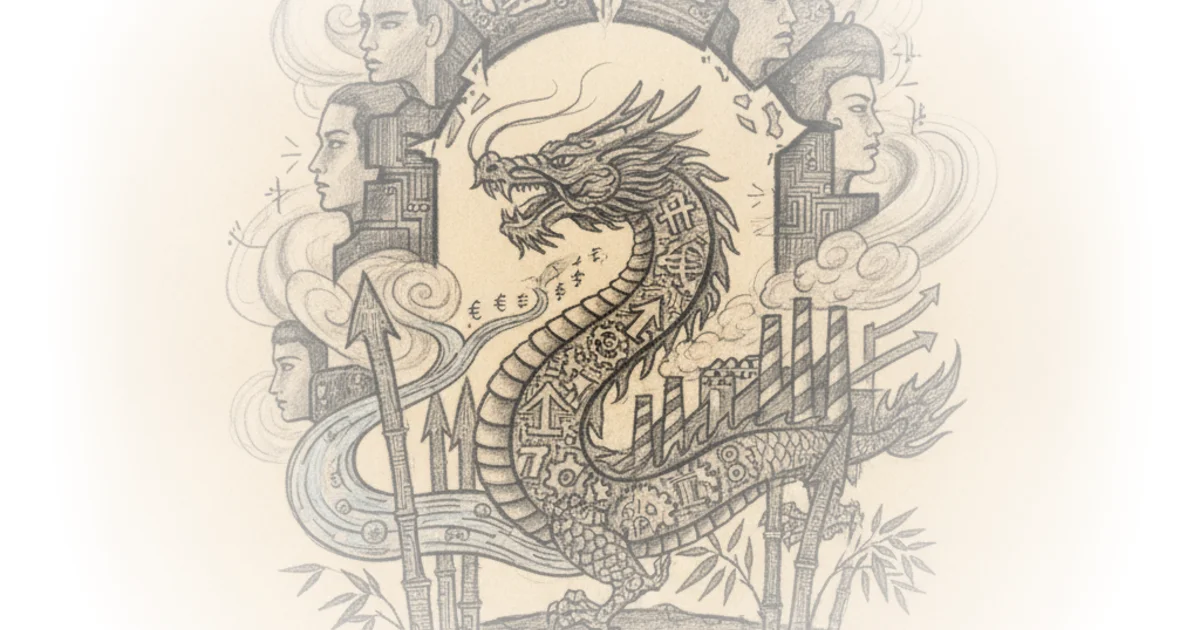
Zhao Jian, the piece's primary voice, contrasts the "properly poor" 1990s with the affluent but anxious present. He argues that while living standards have skyrocketed, the underlying social contract has fractured. "We believed then that hard work would be rewarded, that good things would come to good people and that things in this world could all be reasoned out," the article notes, recalling a time when citizens felt "someone was holding up the weight of this country." This sentiment echoes the era of the danwei (work unit), where the state provided not just employment but a comprehensive, albeit restrictive, sense of security and purpose. The piece suggests that the current leadership, despite having more resources, lacks the same perceived moral authority to "hold up the sky."
"If it hurts, that would prove this is not a dream. But if that is the case, why does everything feel so unreal?"
The argument gains traction by acknowledging the complexity of the current situation. Zhao does not dismiss the necessity of anti-corruption drives or the need to deflate the property bubble. "Fighting corruption? Absolutely correct, it was long overdue," the piece paraphrases, admitting that individual policies often make rational sense. However, the core critique is that the aggregate effect of these measures, combined with stricter information controls, has eroded trust. The editors highlight Zhao's observation that "our default setting has become 'human nature is bad'," replacing a society that assumed the best with one where "businesses must be cheating me, experts are duping me, policies are manipulating me."
The Cotton Wool of Governance
Perhaps the most striking metaphor in the piece is the description of the current political atmosphere as a form of "Dreamcore"—a hazy, nostalgic aesthetic that feels like a dream one cannot wake from. Zhao describes the frustration of trying to identify a specific cause for the nation's malaise. "It's as if all the trust has gone," the article argues, noting that while everyone is doing their job, the result is a "suffocating heaviness" that clings to society.
This feeling is captured in the phrase "throwing a punch only for it to land on cotton wool." Sinification reports that Zhao feels he "clearly perceives that something is wrong, but cannot identify a concrete enemy." This is a profound insight into the current institutional dynamics: the absence of a single villain makes the problem feel inescapable. The piece draws a parallel to the "stability maintenance" apparatus, suggesting that the very mechanisms designed to prevent chaos are now the source of a pervasive, low-grade dread.
Critics might argue that this nostalgia is selective, glossing over the genuine hardships and lack of agency that characterized the 1990s, particularly for those displaced by the massive state-owned enterprise reforms Zhu himself championed. The article admits that "living standards have significantly improved," yet insists that the emotional texture of life has degraded. It is a tension the piece acknowledges but ultimately resolves in favor of the emotional reality: "Maybe, our surroundings have not actually changed... Perhaps what has changed is simply our bodily functioning and our state of mind."
"Simply being able to focus on living a good life has itself become a wild hope."
The piece concludes with a resignation that feels heavy with unspoken political weight. Zhao reflects on the transition of his generation from the audience to the center of the stage, only to realize they are now "beginning to disappear behind that curtain." The final plea is not for revolution, but for a quiet, personal retreat: "Let go of those obsessions, abandon those illusions and lower expectations as far as they will go." The editors note the irony that even after "repeatedly cutting and revising," the author feels the piece cannot be published, a meta-commentary on the very censorship that fuels the essay's central argument.
Bottom Line
The strongest element of this commentary is its ability to diagnose a crisis of trust that transcends specific policy debates, framing the current malaise as a loss of faith in the system's ability to reason and protect. Its biggest vulnerability is the risk of romanticizing a past era that was, for many, far more precarious and less free, yet the emotional resonance of the "cotton wool" metaphor captures a genuine, widespread sentiment that official narratives often miss. Readers should watch for how this specific brand of "Dreamcore" nostalgia evolves as the generation that came of age in the 90s continues to age and assume more responsibility in the economy and society.