Cory Doctorow cuts through the noise of artificial intelligence hype by exposing a fundamental paradox: the same technology that empowers some workers to build better tools is simultaneously being weaponized to turn others into mere quality-control inspectors for defective code. This isn't just a technical debate about software architecture; it is a stark analysis of how capital seeks to recoup massive investments in AI by dismantling the very human expertise required to maintain reliable systems. For anyone navigating an economy increasingly defined by automation, understanding this distinction between "today's task" and work that actually builds for the future is critical.
The Centaur Divide
Doctorow begins by dissecting a confusing reality where experienced programmers report wildly different outcomes from using AI. He writes, "One thing I've learned about paradoxes: often the answer to the riddle of 'how can this one thing have such a contradictory set of features and effects?' is 'it's not one thing, it's two things.'" The author argues that we must stop viewing these workers as doing the same job. Instead, he identifies "centaurs"—workers who direct automation to enhance their craft—and "reverse centaurs," those conscripted to serve as peripherals for systems they cannot control.
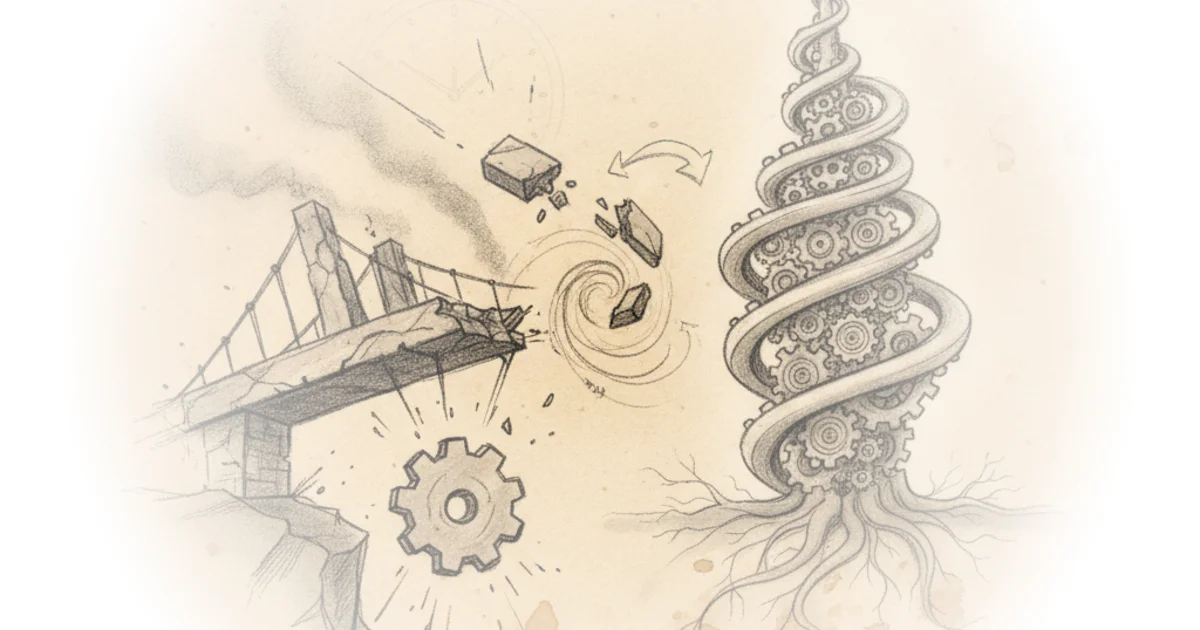
This framing is powerful because it shifts the blame from the tool to the economic structure surrounding it. As Doctorow notes regarding the aviation industry, some workers describe a nightmare of tech debt: "I work in aviation, and I just don't think anyone should ever fly again, those things now unsafe at any altitude, thanks to the code I had to sign off on." The danger here is not that AI writes bad code, but that the business model demands it. The executive branch's push for rapid deployment often ignores these safety implications, prioritizing speed over the "canonization" of reliable systems.
The AI bubble requires the production of reverse centaurs, to the exclusion of centaurs.
The Myth of Vibe Coding
The piece then tackles the seductive idea of "vibe coding," where users generate software through natural language prompts. Doctorow correctly identifies this as part of a long lineage of personal computing empowerment, tracing it back to tools like HyperCard and shell scripts that allowed novices to customize their own environments without asking for permission from a central IT department. He writes, "Vibe coding can be seen as part of a lineage that includes shell scripting, Applescript, Hypercard and Visual Basic: ways for technical novices to directly create personal software."
However, the author draws a sharp line between this personal utility and industrial application. While a script to manage your own calendar might work fine if it's "disposable," the stakes change entirely when that code becomes part of a critical infrastructure system. Doctorow argues that for a tech company, "code is a liability, not an asset." The industry's current trajectory involves firing skilled workers and replacing them with "terrorized survivors" who must mark the AI's homework at superhuman speed. This creates a feedback loop where the pressure to produce volume destroys quality.
Critics might argue that this view underestimates the potential for AI to eventually reach a point of genuine reliability, but Doctorow's evidence from the aviation sector suggests the current "vibe coding" model is actively degrading safety margins. The focus on immediate output over long-term maintainability is a strategic choice by management, not an inevitable technological limitation.
Canonization vs. Technical Debt
The most profound insight in the piece comes when Doctorow introduces Kellan Elliott-McCrea's concept of "canonization." This term describes the process of turning local, one-off solutions into general, reusable, and coherent libraries that others can build upon. As Doctorow explains, "Canonization is accretive. To canonize code is to make it 'legible to systems of humans and non-humans operating on it.'"
The distinction here is between code that simply gets a task done today versus code that allows the future to function. Doctorow writes, "Elliott-McCrea posits that making code that is 'socially constructed in a way that leaves the team prepared to operate on it, iterate it, and improve it' is the difference between 'I got it working' and something the future can build on.'" This argument resonates deeply with anyone who has inherited a legacy system built by someone who only cared about the immediate deadline.
The tragedy, as Doctorow points out, is that the AI industry is "consuming the canon without putting anything new back in it." Just as AI might be able to prove individual mathematical theorems, it struggles to create the "library mathematics" that forms the foundation of a robust ecosystem. The drive for short-term efficiency is devouring the seed corn required for long-term innovation.
The social production of knowledge is the seed corn, and the current industrial model is burning it down.
Bottom Line
Doctorow's most compelling contribution is reframing the AI crisis not as a technological inevitability but as a deliberate economic strategy that sacrifices system stability for short-term profit. While his focus on "reverse centaurs" effectively highlights the human cost of this transition, he perhaps underplays the potential for regulatory intervention to force companies to prioritize canonization over speed. The strongest takeaway is clear: if we allow the current model to continue unchecked, we risk filling our digital infrastructure with lethal technical debt that will take generations to dig out of.