Erik Hoel doesn't just curate links; he identifies the invisible fault lines cracking open in our collective consciousness. While others chase the daily news cycle, Hoel connects the carbonized scrolls of ancient Rome to the emerging threat of AI-generated hallucinations, arguing that we are standing at a "hinge of history" where the definition of human thought itself is under siege.
The New Axial Age and the Death of Slop
Hoel frames our current moment not merely as a technological shift, but as a potential "New Axial Age," a concept rooted in the historical pivot points where human philosophy and consciousness fundamentally reorganized. He posits that rapid technological development is forcing a "pivotal transformation of consciousness" with profound social and political consequences. To test this, he highlights a $50,000 contest inviting essays and fiction to explore whether we are truly at a point where "events that occur in this distinct point in time significantly influence the trajectory of the future."
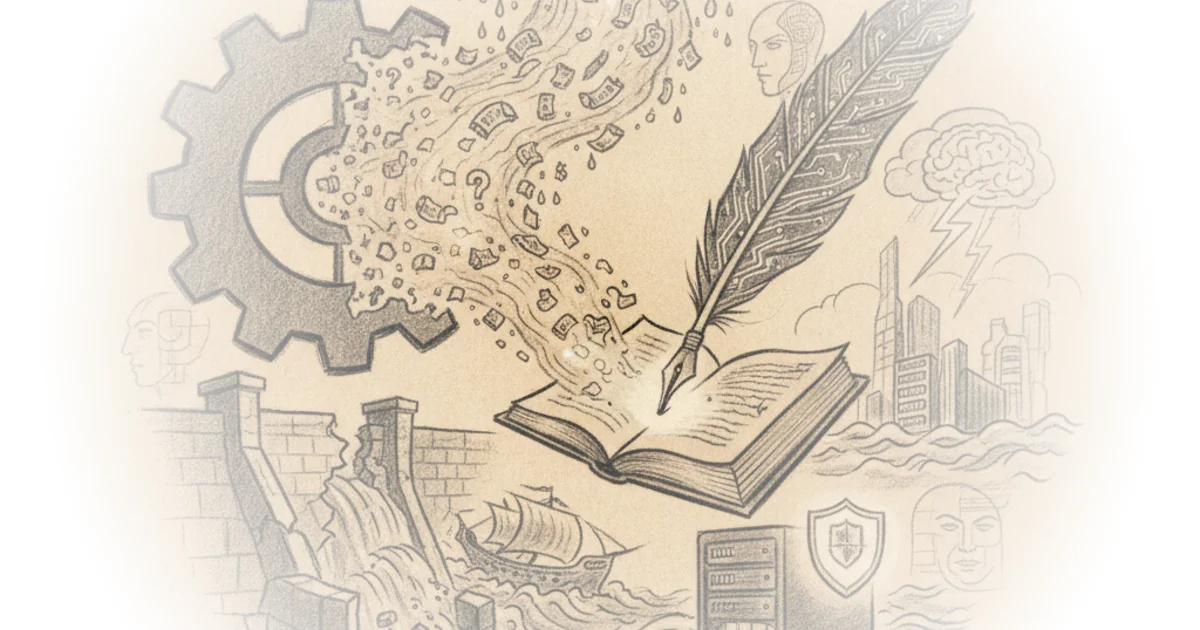
This is a bold framing. By elevating the discussion from mere "AI disruption" to a philosophical reorganization of civilization, Hoel forces the reader to consider the long-term trajectory rather than the immediate noise. However, critics might argue that labeling our current era an "Axial Age" risks overstating the coherence of our global crisis, which feels more fragmented than the unified philosophical shifts of the past.
"Are we undergoing a pivotal transformation of consciousness as a result of rapid technological development and its myriad social, economic, and political consequences?"
The most visceral part of Hoel's commentary addresses the degradation of digital discourse. He celebrates the integration of Pangram, an AI detection tool, into the Substack platform, declaring the end of "Slopstack." He writes, "Goodbye Slopstack! It was not a fun time. I won't miss you at all." This sentiment is shared by many, yet Hoel goes further, mocking the specific genres of AI-generated drivel that plagued the platform: "Here's An Idea I Won't Be Citing the Origin Of" and "An Elegiac Remembrance of Abstract Mush."
While the relief is palpable, the reliance on detection tools introduces a new tension. Hoel acknowledges the statistical rarity of false positives for long-form human writing but admits that "Pangram isn't super reliable for just a paragraph." This creates a precarious environment where a single paragraph of dense, complex prose could be mislabeled, potentially chilling the very human expression the platform aims to protect.
Unwrapping the Past to Save the Future
Hoel draws a striking parallel between the ancient and the futuristic, suggesting that the technology used to read the Herculaneum papyri—charred scrolls buried by the eruption of Mount Vesuvius in 79 AD—offers a surprising vindication for cryogenic preservation. He notes that researchers have finally decoded a Stoic philosophical treatise from these scrolls using CT-scan-like imaging, a process pioneered by scholar Seales who states, "Now it's only a matter of time until we read all the scrolls."
This historical context is not merely a trivia drop; it serves as an argument for the resilience of information. If we can recover words from "literal chunks of burned scrolls indistinguishable from what you leave behind in a used fire pit," Hoel argues, then the hope of restoring frozen brains in the distant future is not as absurd as it sounds. He writes, "If we can read the words on literal chunks of burned scrolls... maybe there'll be a contest in a thousand years to restore all those frozen brains everyone forgot about."
The connection is compelling because it shifts the narrative of cryonics from science fiction to a plausible engineering challenge. It suggests that the barrier to future resurrection isn't the preservation itself, but the decoding technology we haven't yet invented.
The Quiet Crisis of Attention and Climate
Beyond the digital and the ancient, Hoel identifies two converging crises: the physical environment and the human mind. He points to a statistical reality that many feel but few quantify: cloudbursts are increasing. He cites data showing that in New York City, "the four most extreme precipitation events have all happened in the last four years," a stark contrast to the pre-1990s era when such intensity was virtually unknown. The distinction he draws is critical: "Generally rain is talked about in terms of the total amount of precipitation—but it's the speed that determines its impact."
Simultaneously, he turns inward to the human experience, citing a study that reveals we are speaking 338 fewer words daily each year. The data is so counter-intuitive that researchers initially thought they had made a mistake, finding a 20% drop in daily word count over decades. This decline in speech mirrors the rise of passive consumption and the "adversarial consciousness tech" Hoel discusses next.
"We are entering an age of rapid scientific progress. People aren't prepared for the consequences and we don't know what's possible."
Hoel describes a disturbing trend where AI-generated imagery is being engineered to trigger specific, unwanted responses in the human brain, creating "liminal backrooms-style" videos that induce visceral dread. He compares this to an embryonic form of "adversarial consciousness tech," noting that while the research is currently just "computational modeling work," it represents a dangerous asymmetry. We lack a scientific theory of consciousness, yet we are already building tools to hack it.
The danger here is real, but the solution remains elusive. Hoel argues that "we might need defensive consciousness tech, but to do that, you need to figure out consciousness." Until neuroscience moves from a pre-paradigmatic state to a rigorous theory, humanity remains vulnerable to stimuli designed to exploit our neural architecture.
The Human Element: Love, Literature, and Loss
Amidst the high-tech and the historical, Hoel grounds the piece in the messy reality of human relationships. He critiques the literary trend of auto-fiction, using the rumored rivalry between writers and actors to illustrate the "vicious and jealous" nature of the artistic world. He invokes the parable of the scorpion and the frog to explain why a famous actress might foolishly befriend a writer known for turning private life into public art.
He also dismantles a long-held historical myth: that medieval people did not love their children. Citing Nicholas Orme's research, Hoel notes that the idea that medieval parents were cold is "nonsense." In reality, medieval families were small, with high child mortality rates that forced parents to make "immense sacrifices" and pay for apprenticeships, proving that "medieval people who emerge from Orme's book are quite unlike the strange and cold figures that we have been led to imagine."
"I believe they were ourselves, five hundred or a thousand years ago."
This historical correction serves a deeper purpose: it challenges the notion that modern alienation is the default human state. If medieval parents loved their children despite high mortality, then the current decline in speech and the rise of digital isolation are not inevitable features of humanity, but specific failures of our current moment.
Bottom Line
Hoel's strength lies in his ability to weave disparate threads—ancient scrolls, climate data, and AI ethics—into a single tapestry of existential risk and human resilience. His argument that we are at a "hinge of history" is most convincing when he connects the recovery of the past to the fragility of the future. However, the piece's reliance on the idea that a unified "New Axial Age" is emerging may overlook the chaotic, fragmented reality of our current geopolitical landscape. The reader should watch for how the proposed "defensive consciousness tech" evolves, as the gap between our ability to hack the mind and our understanding of it remains the most dangerous variable of all.