A Coordinated Strike With an Audacious Goal
On a Saturday morning in March 2026, sirens woke residents across Israel just after 8 a.m. -- not because missiles were inbound, but because the government had decided to use the alert system as a national alarm clock. Israel, in coordination with the United States, had launched its second major attack on Iran in nine months. Dan Perry, writing from his Tel Aviv bomb shelter, reports that the stated objective this time goes far beyond nuclear facilities.
We were awoken just after 8 a.m. by a siren, followed within minutes by the notification that there were in fact no incoming missiles. It appeared the Israeli government had decided to use the alert system as a kind of national alarm clock, to let the country know that the war had begun.
The piece is remarkable for its tonal control. Perry writes with the wry composure of a veteran correspondent who has spent too many hours in stairwells, and the detail work carries real weight -- the mathematics divorcee with her enormous dog, the elderly couple holding hands as though on a train platform, the French mother in her finest dress at nine in the morning. These are not decorative flourishes. They ground a geopolitical essay in the physical reality of what it means to be on the receiving end of retaliatory missile fire.
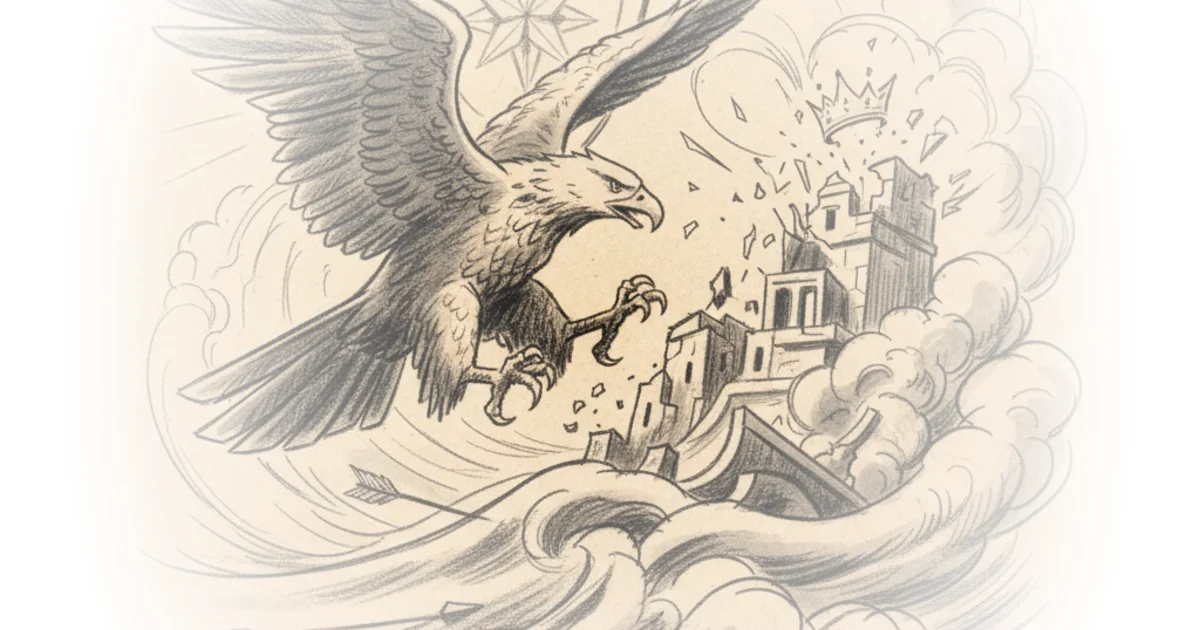
The Case for Regime Change -- and Its Troubled History
Perry lays out the logic driving the operation with unusual clarity. After the June war, both Benjamin Netanyahu and Donald Trump declared Iran's nuclear program crippled for years. Eight months later, they are back. Perry is skeptical of the official justification.
The arguments initially presented for this round are not, on the surface, overwhelming. After the 12-day war in June, Benjamin Netanyahu declared that Iran's nuclear and ballistic missile programs had been set back many years, that the major threat to Israel's existence had been removed "for generations." Eight months is a generation perhaps for hedgehogs.
The real catalyst, Perry argues, was political rather than nuclear. Protests erupted in Iran in January. The regime reportedly killed 32,000 people to suppress them. Trump had told Iranian protesters that "help is on its way," and when thousands were subsequently massacred, he looked foolish for having encouraged and then abandoned them.
Trump had boxed himself in last month when he told Iranian protesters that "help is on its way." After many thousands were then reportedly massacred, Trump rightly took heat for having encouraged and then abandoned them. He was made to look ridiculous, and -- to paraphrase The Godfather -- a man in his position cannot afford to look ridiculous.
Perry then makes the affirmative case for regime change -- something few mainstream commentators do with this degree of directness. The Islamic Republic's internal repression is ferocious. Its proxy network has destabilized the region for decades. Hamas, Hezbollah, the Houthis, Shiite militias in Iraq -- Perry traces the thread back to Tehran.
That idea has a grim history. It rarely works as intended. It is unpredictable, destabilizing, morally fraught. The record in the Middle East is not encouraging. The legal right to do it is debatable at best. But there are exceptions, and the Islamic Republic, in its 47 years, has made a compelling case for being one.
The Trust Deficit
The essay's most incisive section addresses the credibility problem. Perry does not shy away from the fact that the two leaders presiding over this operation are among the least trusted in the democratic world.
Trump, it need hardly even be said, has made dishonesty a kind of performance art. He is the most determined dissembler to hold the American presidency, as far as I can tell. It has become something of a joke, in America and across the world. In a moment like this, it is not a joke.
Netanyahu fares no better. On trial for bribery, trailing in polls ahead of elections that must come by October, he fits the profile of a leader who would start a war to survive politically. Perry does not accuse him directly, but the implication sits plainly on the page.
So these two men, each viewed by large portions of their publics as self-interested and manipulative, now preside over a conflict that could be ruinous.
This is where the argument deserves a sharper counterpoint than Perry provides. He acknowledges the trust deficit but ultimately lets the potential upside of regime change carry the weight. Yet the history of externally driven regime change -- Iraq in 2003, Libya in 2011 -- suggests that the aftermath is often worse than the status quo, regardless of how loathsome the existing regime may be. The Iranian state, with its deep institutional roots and complex factional politics, is not obviously more likely to produce a stable democratic successor than Iraq was. Perry calls this possibility "naive" in passing but does not dwell on it.
The Paradox of the Moment
Perry saves his most striking observation for the end. Trump -- who abandoned Ukraine, expressed admiration for Vladimir Putin, rattled NATO, and attempted to seize Greenland from Denmark -- may be on the verge of one of the most consequential geopolitical achievements in half a century.
If the Iranian regime were to fall with American assistance, it would rank among the most consequential geopolitical events of the past half-century, perhaps second only to the collapse of Soviet communism.
It is a genuinely disorienting thought, and Perry does not pretend otherwise. The essay ends with the kind of honesty that distinguishes real-time reporting from retrospective analysis.
It is possible to feel two contradictory things at once. This might be a reckless, perhaps even insane action launched by unworthy leaders. And it might, just possibly, change everything for the better.
There is a second weakness in the argument worth noting. Perry treats the Israeli consensus -- that a post-theocratic Iran would become a partner, even an ally -- as a "romantic notion" but does not examine why it might be wrong. Iran's strategic interests, its regional ambitions, and its sense of civilizational identity would not evaporate with a change of government. A democratic Iran might still compete with Israel for regional influence, still resist American hegemony, and still maintain relationships with actors that Jerusalem finds threatening. Regime change, even if successful, is not the same as alignment.
Bottom Line
Perry's dispatch is a rare thing: a piece written under actual fire that maintains analytical rigor. The shelter scenes lend the geopolitical argument a gravity that no think-tank paper can replicate. His case for regime change is the strongest version of that argument available -- honest about the risks, clear-eyed about the leaders pursuing it, and unblinking about the moral complexity. Where the essay is weakest is in its treatment of what comes after. The Islamic Republic may indeed deserve to fall. But the question Perry only gestures at -- whether external force can produce something better, or merely something different -- is the one that matters most.