This piece cuts through the diplomatic pleasantries of a high-stakes European energy tour to reveal a stark reality: the U.S. Department of Energy is effectively functioning as a sales arm for the very industry that created the climate crisis. Emily Atkin does not merely report on the itinerary of Energy Secretary Chris Wright; she dissects the institutional corrosion of a government agency led by a former fracking executive who is actively selling climate denial to allies while peddling American gas. The most jarring element is not just the policy shift, but the deliberate deployment of taxpayer funds to propagate a narrative that contradicts the overwhelming scientific consensus, all while the official's personal fortune hangs in the balance.
The Architecture of State-Sponsored Denial
Atkin frames the trip not as a diplomatic mission, but as a transparent conflict of interest where the regulator has become the salesman. She draws a sharp parallel to a hypothetical scenario involving the FDA and opioids to illustrate the absurdity of the current situation. "Imagine if Donald Trump had nominated a Purdue Pharma executive to lead the FDA, and that executive took a multi-day, taxpayer-funded international trip to tell world leaders that the opioid epidemic not a big deal and the best way to make citizens healthier is actually to buy more Oxycontin," Atkin writes. This analogy lands with force because it strips away the technical jargon of energy policy to reveal the core ethical failure: a public official prioritizing private industry interests over public health and safety.
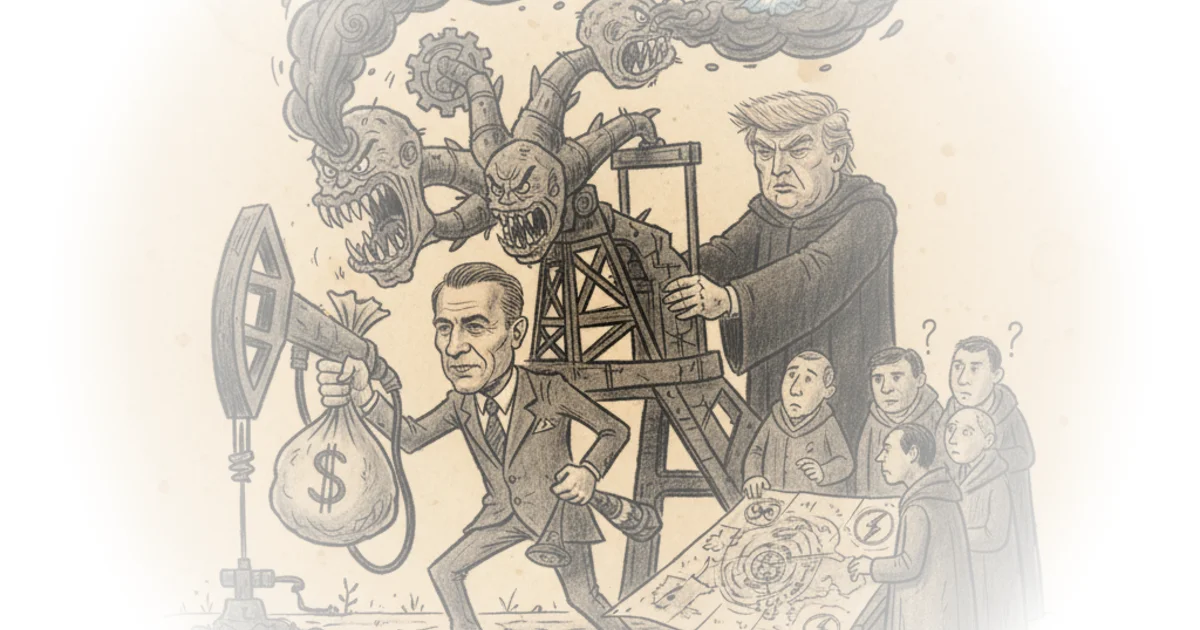
The article details how Wright, a former fracking magnate, has used his position to dismiss the urgency of the climate crisis. Atkin highlights a specific moment where Wright downplayed the existential threat, stating, "Climate change, for impacting the quality of your life, is not incredibly important... In fact, if it wasn't in the news and the media, you wouldn't know it." This claim is particularly dangerous because it is being made by the head of the nation's energy agency, lending a veneer of official legitimacy to what Atkin describes as "state-sponsored disinformation." The administration's strategy appears to be a deliberate attempt to reset the global conversation on climate, moving it from a crisis requiring immediate decarbonization to a manageable issue that can be solved with more fossil fuel extraction.
A fracking executive peddles climate denial in Europe, using taxpayer money to convince the world that the crisis is a media invention and the solution is more American gas.
Critics might argue that energy security and economic stability are legitimate concerns for European nations facing volatile markets. However, Atkin counters this by showing that the administration's solution—doubling down on liquefied natural gas exports—actually exacerbates the very economic instability it claims to solve. The argument that renewables are driving up prices is presented as a convenient falsehood. Atkin notes that Wright falsely blamed wind and solar for rising costs, ignoring data from the U.S. Energy Information Administration which states that "Higher natural gas prices in 2025 and 2026 are the result of strong export growth that persistently outpaces U.S. natural gas production." This reframing is crucial; it shifts the blame from green energy to the administration's own export policies, revealing a disconnect between the official narrative and economic reality.
Manufacturing Consensus and Cherry-Picking Science
The piece exposes the mechanics behind the administration's denialist stance, specifically the creation of a rogue scientific report designed to validate pre-existing biases. Atkin describes how Wright personally recruited five scientists with histories of questioning mainstream climate science to produce a 151-page report claiming climate change is a "net benefit" to U.S. agriculture. "The report was put together by five scientists with long histories of questioning mainstream climate science—including the former chief scientist of BP. Each scientist was personally recruited to write the report by Wright," she writes. This detail is vital because it reveals that the administration's scientific position is not the result of independent inquiry, but a curated product designed to serve a specific political and economic agenda.
The article further details how this manufactured consensus was met with immediate rejection by the broader scientific community. A group of 85 publishing climate scientists issued a 439-page rebuttal, arguing the report "exhibits pervasive problems" including misrepresentations and factual errors. Despite this, Wright continued to promote the report's findings in Europe, claiming that a "warmer, wetter world is more conducive to growing crops." Atkin dismantles this claim by pointing to the nuanced reality of climate impacts, noting that while some localized areas might see benefits, the global trend is toward reduced agricultural productivity. She cites Stanford researchers who estimate that every additional degree of warming will drag down global food production, directly contradicting the administration's optimistic narrative.
The financial stakes for Wright are impossible to ignore. Atkin points out that while Wright divested his holdings to become Energy Secretary, the long-term contracts he secures for American gas could lead to a lucrative return to the private sector. "Once Wright is finished with his role as Energy Secretary—once he's secured long-term contracts for the EU to buy American gas—there is nothing stopping him from returning to the fracking industry to cash in on the contracts he secured," she argues. This creates a powerful incentive structure where the official's future wealth is tied to the success of the very policies he is selling abroad. The administration's push to "displace all Russian gas" with American LNG is framed not just as a geopolitical strategy, but as a mechanism to lock in a permanent market for the industry that made Wright rich.
The Human Cost of Economic Denial
Beyond the economic and political maneuvering, Atkin addresses the dangerous minimization of climate impacts on human life and the environment. Wright's assertion that extreme weather events like hurricanes and floods are not getting worse is labeled as a direct lie. "One of the negative implications you hear all the time in the news is that tornadoes are getting worse, and hurricanes are worse, and floods and droughts and storms, they're more frequent and larger in magnitude. This is just simply untrue," Wright claimed. Atkin contrasts this with the findings of NASA and other major scientific bodies, which confirm the intensification of these events. By dismissing these realities, the administration is effectively telling the world that the growing threats to human safety and infrastructure are not a priority.
The article also tackles the economic arguments used to justify inaction. Wright suggested that the economic impact of climate change would be negligible, estimating a loss of only "0.2% to 0.3% or 0.4%" in per capita GDP. Atkin refutes this by citing more rigorous estimates from institutions like Swiss Re, which predict a potential global GDP loss of 11 to 14 percent by 2050. This discrepancy highlights a deliberate strategy to downplay the severity of the crisis to avoid the political cost of taking meaningful action. The administration's narrative relies on the idea that climate change is a "great exciting story" in the media, rather than a genuine threat, allowing them to frame climate regulations as unnecessary government overreach.
The entire life's wealth, purpose, and identity of the Energy Secretary depends on climate change not being a big deal, creating a conflict of interest that no amount of divestment can fully erase.
Bottom Line
The strongest element of Atkin's coverage is its unflinching exposure of the personal and institutional conflicts driving the administration's energy policy, moving beyond surface-level political disputes to reveal a systemic capture of the regulatory state. The piece's greatest vulnerability lies in its reliance on the assumption that the audience is already aware of the scientific consensus, potentially alienating readers who have been fed a steady diet of administration propaganda. Ultimately, the reader must watch for how these long-term gas contracts, once signed, will lock the United States and Europe into a fossil-fuel dependent future, regardless of the shifting political winds or the mounting scientific evidence of harm.