Matt Stoller delivers a jarring reality check on the entertainment industry, arguing that the proposed $83 billion merger between Netflix and Warner Bros. Discovery isn't just a business transaction—it's a potential death sentence for the movie theater experience and a stark example of unchecked corporate greed. While the business press often treats consolidation as inevitable, Stoller exposes a rare moment where the public, critics, and even rival executives are united in opposition, driven by a simple fact: streaming prices have soared 125% since 2014, far outpacing inflation.
The Economics of Greed
Stoller anchors his argument in the tangible anger of the consumer. He notes that the public is no longer charmed by the convenience of streaming but is instead reacting to a company that has "exploited its market power to raise prices." The author points out a critical detail: Netflix eliminated its lowest-cost tier in 2024, a move that signals a shift from mass accessibility to premium extraction. As Stoller writes, "Americans think Netflix is greedy, and that it has exploited its market power to raise prices."
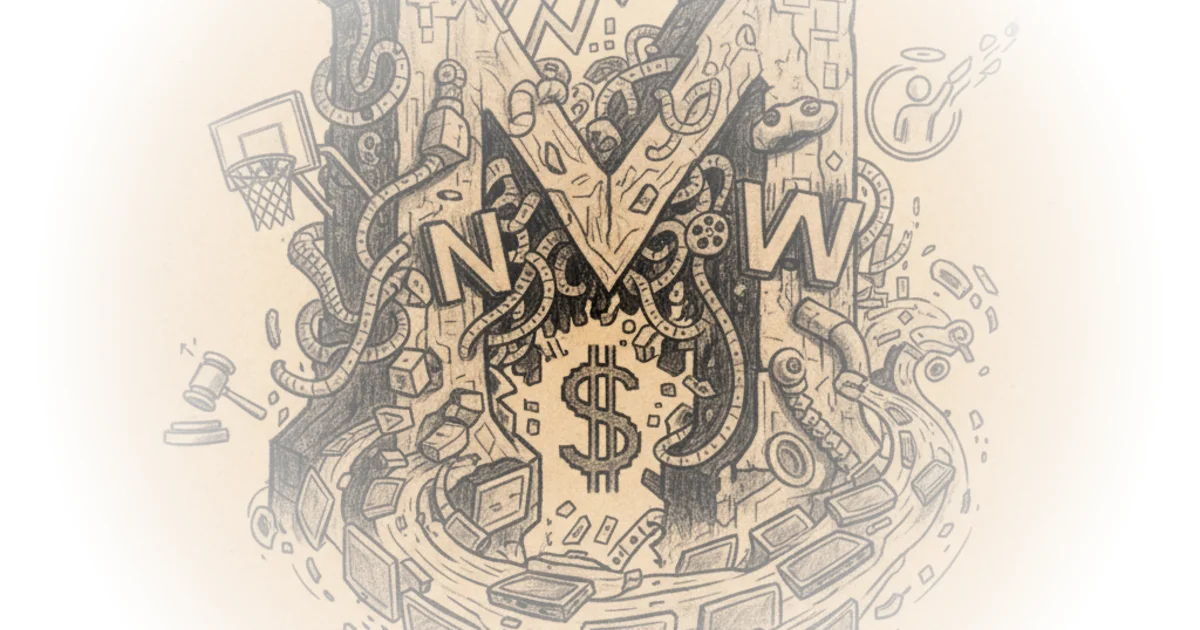
This framing is powerful because it connects abstract market share to the daily wallet of the average American. The author argues that the merger is financially motivated by a desperate need to generate cash flow, citing an industry analyst who notes the deal "needs to boost Netflix's cash flow by $8 billion per year for the next 20 years to justify itself." Stoller's logic follows a clear, terrifying trajectory: if the acquisition requires such massive returns, the only lever left to pull is further price hikes.
Critics might argue that the streaming market is still fiercely competitive with rivals like Amazon and Disney+, suggesting that price hikes are limited by consumer churn. However, Stoller counters this by highlighting the unique position of these two giants as both the top and third-largest streamers, creating a duopoly that reduces the realistic options for consumers.
"If Netflix does buy Warner and limits theatrical releases the way people expect, it will be game over."
The Strategic Freeze
Perhaps the most insidious aspect of the deal Stoller uncovers is the strategic advantage of the merger process itself, regardless of the outcome. He argues that the mere announcement of the bid serves to paralyze the target company, Warner Bros. Discovery, effectively freezing its ability to compete or innovate for the next two years. "Controversial mergers take between 18-24 months to close, and in that time period, the company being bought is paralyzed," Stoller explains.
This period of uncertainty allows Netflix to block rival bidders like Paramount and gain access to competitively sensitive information about its biggest rival, HBO Max. Stoller draws a sharp parallel to the Clayton Antitrust Act of 1914, which was designed specifically to prevent such combinations that "may substantially lessen competition or tend to create a monopoly." The author suggests that the current administration's approach to antitrust enforcement is the only variable that might stop this, noting that the Department of Justice has historically been independent, though political pressures are mounting.
The argument here is that the merger is a weapon of attrition. Even if the deal never closes, Netflix has already won by damaging its competitor's strategic agility. Stoller writes, "Netflix may not care that much if it is actually able to finalize the deal," because the damage is done during the waiting period.
The Death of the Movie Theater
Stoller shifts from economic analysis to cultural preservation, arguing that this merger threatens the very existence of the theatrical experience. He challenges the narrative that movie theaters are dying, pointing out that youth-oriented films are actually drawing audiences back. The danger lies in a merged entity that has no incentive to support a distribution model that competes with its own streaming platform.
"I spoke with a major executive in theatrical exhibition," Stoller reports, quoting a prediction that "North America to lose 5 thousand screens under a Netflix controlled WB within 5 years." This potential loss of screens would devastate smaller studios and independent filmmakers who rely on theatrical windows to build audiences. The author cites a New York Times op-ed by a former Amazon Studios head who warned that this combination "will be the end of Hollywood."
This section of the commentary is particularly effective because it moves beyond the balance sheet to the cultural cost. Stoller notes that Hollywood is our "cultural lingua franca," and the consolidation of content creation and distribution into one entity risks homogenizing the stories we tell. The public's reaction has been unusually vocal, with figures ranging from actor Ben Stiller to Senator Bernie Sanders condemning the deal. As former FTC Commissioner Alvaro Bedoya puts it, "The Netflix-Warner deal is a horror movie."
The Legal and Political Battlefield
The final piece of Stoller's puzzle examines the legal viability of blocking the deal. He outlines how the proposed acquisition violates nearly every guideline in the 2023 merger rules from the Antitrust Division and the Federal Trade Commission. The deal creates a supplier-customer relationship where the merged giant could cut off rivals from essential content, a classic vertical integration antitrust violation.
However, Stoller acknowledges the political reality: the Department of Justice's ability to litigate has been compromised by a lack of talent and political interference. He notes that the Antitrust Division has been "bleeding litigation talent" because the focus has shifted from public interest to serving the President's personal interests. Despite this, he suggests that state attorneys general, particularly in California and New York, might step in to fill the void.
The author also highlights the absurdity of the current bidding war, where Comcast, Paramount, and Netflix all made offers that would likely violate antitrust laws. "That's fundamentally a toxic way of thinking about the problem," Stoller writes, quoting Senator Chris Murphy, "forcing us to imagine which deal is relatively less corrupt."
"Consolidation, in other words, is not inevitable, and it's not even legal."
Bottom Line
Stoller's strongest argument is his ability to reframe a corporate merger as a direct threat to the cultural fabric of the nation, moving the debate from Wall Street to the living room and the movie theater. The piece's greatest vulnerability lies in its reliance on the assumption that state-level enforcers or a politically compromised federal agency will have the will and capacity to fight an $83 billion behemoth. The reader should watch closely to see if the unprecedented public outrage translates into a legal blockade that can withstand the immense pressure of the executive branch.