Scot McKnight's "Meanderings, 9 May 2026" is a masterclass in connecting disparate threads of American life—from the gritty resilience of public education to the bureaucratic absurdity of the Vatican and the soaring costs of global spectacle. Rather than offering a standard news roundup, McKnight constructs a narrative about the friction between institutional rigidity and human potential, revealing how ordinary people navigate systems that often seem designed to exclude them. This is essential listening for anyone trying to understand the current American psyche, where triumph and trauma frequently share the same zip code.
The Architecture of Resilience
McKnight opens by spotlighting the human element behind graduation season, moving beyond the cliché of cap and gown to the messy reality of how students actually succeed. He highlights the story of Kayla McClellan, a Missouri teacher who was once expelled in middle school, to illustrate that potential is often dormant rather than absent. McKnight writes, "I struggled through education and not because I was not adequate, not because I wasn't smart or anything like that, but because that wasn't always my focus, and I didn't always know my potential." This framing is crucial; it shifts the blame from the individual's intellect to the lack of early intervention and mentorship.
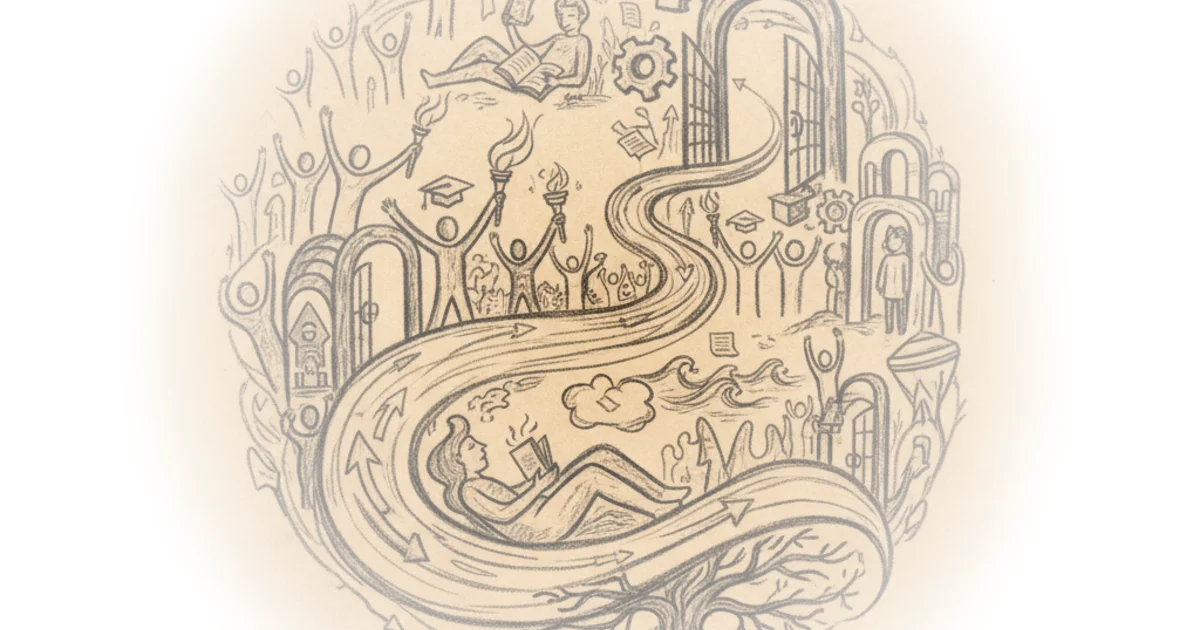
The author notes that McClellan's turnaround came not from a sudden change in ability, but from adults who refused to let her fail. "Along the way, I had some teachers and some professors at college that really snatched me up and [were] like, 'You're going to get yourself together, and you are going to do this,'" McKnight recounts. This mirrors the historical mission of organizations like Teach for America, which was founded in 1990 specifically to address the gap between student potential and educational opportunity by placing high-achieving graduates in underserved schools. McKnight's choice to lead with McClellan's journey underscores a vital truth: the system often works only when individuals within it decide to break protocol and invest personally in a student's future.
Potential is rarely a fixed trait; it is a relationship forged by someone who refuses to let you quit.
The narrative then pivots to Lamont Newell, a valedictorian from South Los Angeles who secured 65 college acceptances. McKnight emphasizes the significance of Newell's location for his interview: a recreation center in South Park where he learned to code and, tragically, where his family sought refuge during homelessness. "There were times where we didn't have a roof over our head, but we had a car. We didn't have a place to stay so we would come and sleep in this parking lot," Newell's mother told the press, a detail McKnight includes to ground the achievement in stark reality. This connects to the legacy of institutions like the Armed Forces Recreation Centers, which have long served as critical community hubs, providing stability and resources when family structures are under extreme strain.
McKnight captures the emotional weight of Newell's drive, quoting the student's realization: "I realized if I didn't try hard enough, who would for him?" Here, the author argues that success in these contexts is often a communal act, fueled by the desire to protect the next generation. While critics might argue that focusing on individual "rags-to-riches" stories can obscure the need for systemic policy changes in housing and education, McKnight balances this by showing how Newell's mother actively navigated the system to find resources, proving that agency and structural support are not mutually exclusive.
The Absurdity of Bureaucracy
Shifting gears with characteristic wit, McKnight turns to the Vatican, dissecting the mundane hurdles faced by Pope Leo XIV (Robert Prevost) just two months into his pontificate. The story of the Pope being unable to update his bank phone number because he couldn't appear in person with a photo ID is a perfect microcosm of institutional inertia. McKnight writes, "Then her screen flagged his file: any further changes had to be made in person, at the branch, with a photo ID. Coming in person would not be possible, he told her, in the polite tone of a man who knew the answer before he asked the question." The humor lies in the clash between the highest spiritual office and the lowest level of customer service bureaucracy.
The resolution of the story—where the bank president only acts after intermediaries threaten to move the account—reveals a cynical truth about power dynamics. McKnight notes, "The bank did not want to lose the account of the pope. They changed the number. He asked them not to share it. (Editor's note: Someone definitely shared it.)" This anecdote serves as a sharp commentary on how institutions often respond to authority not out of respect, but out of fear of losing revenue. It is a reminder that even the most sacred offices are subject to the same transactional logic as a local checking account.
The Cost of Spectacle
The commentary then tackles the economic reality of the upcoming World Cup in the United States, where the promise of global unity is being tested by exorbitant costs. McKnight points out that parking can exceed $200 and hotel rooms nearly $700, prompting fans to question the value proposition. "A FIFA spokesperson, in a statement to ESPN, said revenue generated from tickets is reinvested into the 'global development of football,'" McKnight reports, immediately juxtaposing this with the reality that fans are facing a "maze of ticketing tiers, multipart transportation directives and head-spinning logistics."
The author highlights the disconnect between the official narrative and the fan experience, noting that while the White House's World Cup task force compares the event to "78 Super Bowls in 39 days," the logistical burden on international visitors is immense. Visa delays and travel restrictions are compounding the financial strain, creating a barrier to entry that contradicts the spirit of a global festival. McKnight's inclusion of the $11 billion revenue forecast for FIFA serves as a stark counterpoint to the "extortionate" costs cited by fan groups, suggesting that the "not-for-profit" defense may be a convenient shield for profit-driven behavior.
The Mechanics of Power
In a more serious turn, McKnight incorporates analysis from historian Ruth Ben-Ghiat regarding the psychology of autocrats and the dangers of succession planning. The text explains that autocrats are "particularly paranoid people, prone to purging any government official who is amassing too much power for their tastes." McKnight uses this to explain why leaders often resist discussing who comes next, viewing succession as an existential threat rather than a democratic necessity.
The author details how these leaders employ "divide and rule" tactics and transform judicial institutions into tools of self-protection. "They alone can guide the nation to greatness. TINA (There is No Alternative) is their mantra," McKnight writes, capturing the ideological rigidity that defines such regimes. The piece notes that while some autocrats rely on dynastic succession, like the "dictatobrats" in various nations, the transition is rarely smooth. "Thirty-six years went by between dictator Ferdinand Marcos's exit and the entry of his son Ferdinand 'Bongbong' Marcos Jr. in the Philippines," illustrating the long shadow these regimes cast over their nations' political evolution. This section serves as a sobering reminder that the stability of democratic institutions is not guaranteed and requires constant vigilance against the consolidation of power.
Indigenous Theology and the Medicine Wheel
Finally, McKnight engages with a deep theological conversation between Joel Green and Dr. T. Christopher Hoklotubbe regarding Indigenous interpretation of Scripture. The discussion centers on the tension between the non-hierarchical nature of the medicine wheel and the traditional Christian view of Scripture as the supreme authority. McKnight summarizes the core question: "How do you adjudicate, in practice, when these four sources genuinely conflict?" The four sources being Scripture, cultural traditions, creation, and the communal heart/mind.
The authors of the book being discussed, Reading the Bible on Turtle Island, argue for an asset-based theology rooted in Genesis 1, contrasting it with the deficit-based theology of the Fall that has historically underwritten colonial attitudes. McKnight notes the book's argument that "Western theology's overemphasis on 'the fall' has underwritten colonial attitudes toward Indigenous peoples." However, he also raises the critical question of whether this approach risks romanticizing the precolonial past by treating sin primarily as an external imposition rather than an internal condition. "Doesn't a purely asset-based anthropology risk its own kind of theological imbalance," McKnight asks, urging readers to consider how a purely positive view of human nature might fail to account for the universal human capacity for error and harm.
Bottom Line
McKnight's piece succeeds by refusing to categorize these stories into neat silos; instead, he reveals the common thread of human agency struggling against rigid systems, whether they are schools, banks, international sporting bodies, or theological frameworks. The strongest element is the juxtaposition of the mundane (a bank teller hanging up on the Pope) with the profound (a homeless student reaching for an Ivy League degree), forcing the reader to see the absurdity and the beauty of the human condition simultaneously. The biggest vulnerability lies in the brevity of the theological section, which raises complex questions about sin and grace that deserve a longer, more nuanced exploration, but as a snapshot of contemporary thought, it is both provocative and necessary.