Timothy Snyder does not merely analyze a conflict; he diagnoses a structural failure of the American state itself. His most startling claim is that the current war with Iran lacks any genuine American origin story, existing instead as a product of a private "oligarchical corridor" where foreign interests and domestic wealth bypass public institutions entirely. For a listener trying to make sense of sudden military escalation without a clear national threat, this reframing offers a crucial, if unsettling, key to understanding the chaos.
The Absence of an American Origin Story
Snyder begins by dismantling the conventional assumption that American wars stem from national security threats or public consensus. He writes, "In all of these historical instances, however, there was some American component, some American process. That American input is missing here." This observation is the piece's analytical anchor. By contrasting the current conflict with the clear, albeit flawed, domestic debates that preceded the Vietnam or Gulf Wars, Snyder forces the reader to confront the anomaly of a war launched without a public mandate or a government-wide threat assessment.
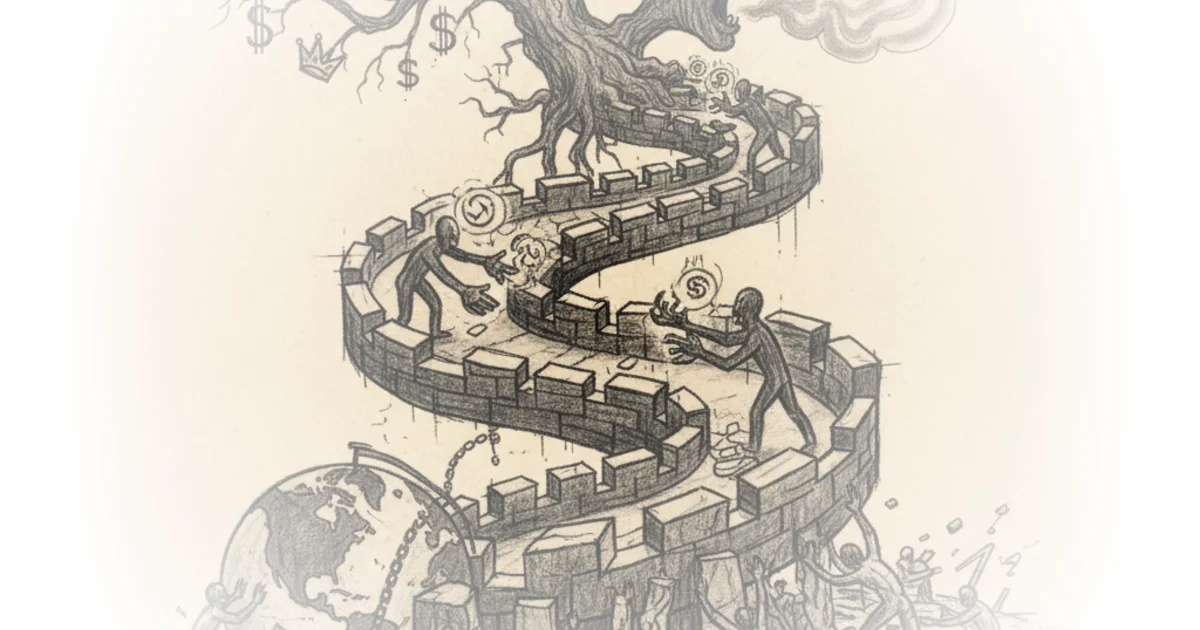
The author argues that while the executive branch holds the formal authority to order troops, the motivation for this specific action cannot be traced to the President's own convictions or public opinion. Instead, he suggests the decision emerged from a closed loop of private emissaries. "The pathway to Trump's mind seems to be an oligarchical corridor," Snyder posits, noting that the usual channels of government analysis and propaganda are conspicuously absent. This is a bold assertion, one that shifts the blame from a single leader's whims to a systemic bypass of democratic accountability. Critics might argue that attributing complex geopolitical decisions solely to private networks underestimates the role of traditional intelligence agencies or bureaucratic inertia, yet the lack of public debate Snyder highlights remains a glaring fact.
"The American state is allowed to decay and falter, while oligarchs use the bits that remain to pursue private interests and private fortunes."
The Mechanics of the Corridor
To support his thesis, Snyder identifies specific individuals who operate outside the formal diplomatic apparatus, creating a shadow channel of influence. He points to the involvement of Jared Kushner and Steve Witkoff, noting that their "impatient" negotiation styles have consistently tilted toward the interests of Israel, Saudi Arabia, and Russia. This connects directly to the broader context of the "Deep State" debates, but flips the script: rather than a bureaucratic resistance, Snyder sees a private network that has successfully captured the executive function.
Snyder highlights the financial and emotional connections within this group, stating, "Kushner has a plan to turn Gaza into a giant resort... In the case of the Gulf States, the two men benefit from (known and documented) financial transactions of unusual flexibility and generosity." The argument here is that these private actors are not just advisors but stakeholders with their own economic incentives, effectively turning foreign policy into a vehicle for personal and allied profit. This echoes the dynamics seen in the "Project for the New American Century," where ideological goals were advanced by a specific network of elites, but Snyder suggests the current iteration is even more detached from national interest, driven instead by the "cozy passage" of the oligarchical corridor.
The evidence presented relies heavily on the pattern of behavior rather than a "smoking gun" document, which Snyder admits: "We don't know nearly enough to be confident about what is in that corridor." However, the consistency of the outcomes—policies that align with foreign adversaries and allies alike while ignoring American vulnerabilities—lends weight to his circumstantial case.
Strategic Blunders and Foreign Beneficiaries
The commentary then shifts to the tangible consequences of this private influence, arguing that the war actively harms American strategic interests while benefiting foreign powers. Snyder points out the absurdity of the United States burning through expensive Patriot missile stockpiles to intercept cheap drones, a tactical error that leaves Ukraine vulnerable. "If the United States wastes the stock of Patriots in its Iran adventure, then it will be hard to protect Ukrainian cities," he warns. This is a devastating critique of the war's operational logic, suggesting that the "oligarchical corridor" is indifferent to the long-term security of American allies.
Furthermore, Snyder notes that the conflict inadvertently aids Russia by driving up oil prices and reducing the supply of Iranian weapons to the Kremlin, despite the immediate disruption. "On balance, the war exposes a Ukrainian vulnerability, and addresses a Russian one," he concludes, highlighting the irony that the administration's actions align with the strategic goals of a geopolitical rival. The author also dismantles the administration's propaganda, which blames Ukraine for the conflict, noting that "Trump and Leavitt are repeating a Russian cliché." This repetition of foreign talking points serves as a powerful indicator that the "American" narrative has been hijacked.
"The violence that Americans wreak around the world will affect, among other people, Americans as well; the killing and dying is done in their name, though without their input or any thought to their well-being."
Bottom Line
Snyder's most compelling contribution is his diagnosis of a "stateless" war, where the machinery of the American government is used to execute the private desires of a transnational elite rather than the will of the people. While the argument relies on inference regarding the private conversations of the "corridor," the observable outcomes—strategic blunders, alignment with foreign adversaries, and the total absence of domestic debate—make the case difficult to dismiss. The reader is left with a stark warning: the greatest threat to American democracy may not be an external enemy, but the internal decay of its own institutions into a vehicle for oligarchical ambition.