Philip Goff, a philosopher long known for championing the radical idea that consciousness is fundamental to the universe, has done the unthinkable for a skeptic: he has become a Christian. But not the kind you expect. In a candid conversation with Alex O'Connor of Cosmic Skeptic, Goff reveals a journey that bypasses traditional conversion narratives, arguing instead that the scientific puzzles of fine-tuning and consciousness point toward a "heretical" faith that rejects an all-powerful, interventionist God in favor of a self-designing, conscious universe.
The Heretical Turn
O'Connor opens by acknowledging the strangeness of Goff's new position, noting that Goff himself admits, "I never thought I'd be religious. It's kind of bizarre." This admission sets the tone for a discussion that is less about divine revelation and more about intellectual necessity. Goff explains that his shift wasn't a sudden epiphany but a slow erosion of the rigid dichotomy between atheism and theism. He argues that both sides have hit a wall: theists cannot satisfactorily explain the problem of evil, while atheists struggle to account for the precise "fine-tuning" of physical constants required for life.
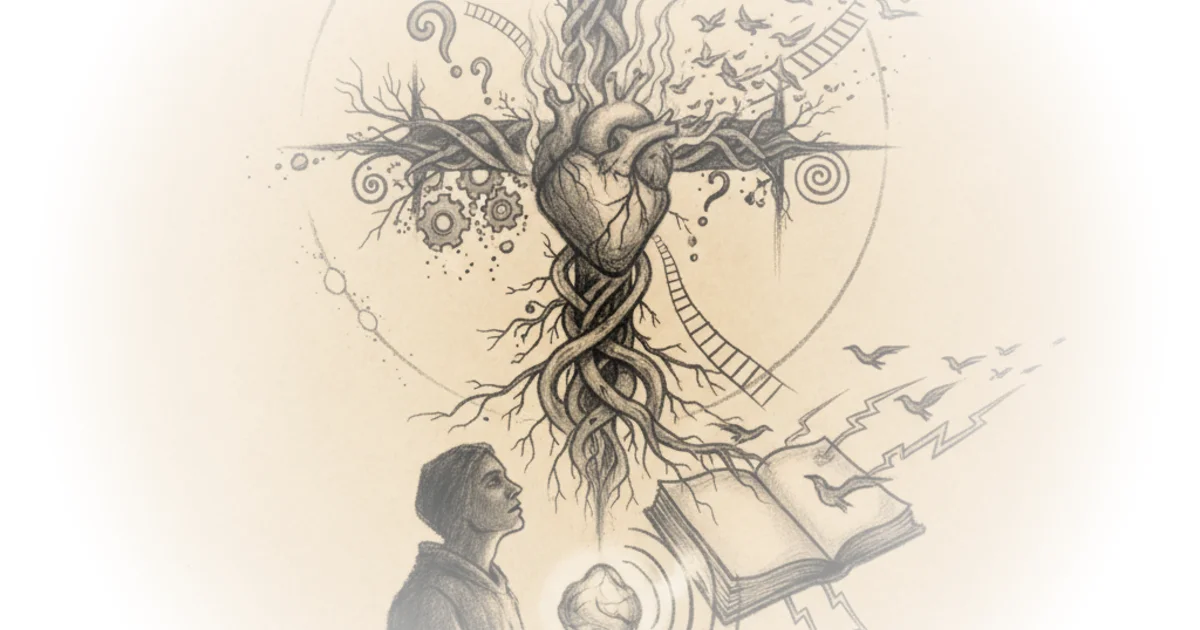
Goff's solution is a middle path. He suggests that the standard debate forces a false choice. "I think both sides have things they can't explain," Goff states, noting that theists "tie themselves up in knots trying to explain suffering" while atheists do the same with fine-tuning. This framing is compelling because it validates the doubts of secular listeners while refusing to dismiss the data that suggests design. However, critics might argue that finding a "middle way" often results in a position that satisfies neither the rigorous demands of science nor the spiritual needs of traditional faith, potentially leaving Goff in a theological no-man's-land.
"The theists tie themselves up in knots trying to explain suffering. The atheists try tie themselves up in knots trying to explain fine-tuning."
Panpsychism as the Bridge
The core of Goff's argument rests on his decades-long work in panpsychism—the view that consciousness is a fundamental feature of all matter, not just a byproduct of complex brains. O'Connor helps clarify this for the audience, noting that if gravity were slightly different, the universe would collapse or fly apart, making life impossible. Traditionally, this leads to three options: blind chance, a multiverse, or a supernatural designer. Goff rejects the first two and modifies the third.
Instead of a supernatural God outside the universe, Goff proposes that the universe itself is the conscious agent. "If you're a panpsychist and you think the universe is conscious... maybe the universe has goals of its own," Goff argues. This allows for a self-designing cosmos that avoids the need for a "supernatural designer outside the universe." This is a bold move, effectively naturalizing the concept of God by internalizing consciousness within the fabric of reality. It is an elegant solution on paper, but it relies heavily on the acceptance of panpsychism, a theory that remains controversial and unproven in mainstream physics.
As O'Connor points out, this argument can feel circular to a materialist: "In order to get that conscious agent there had to have been finely tuned constants... so it can't have been that conscious agent that did the tuning." Goff's response is to borrow from multiverse theory, suggesting that in the earliest moments of the universe, the constants were not fixed but flexible, determined by the universe's own conscious nature rather than random chance. "We don't need loads of other universes," Goff says. "We just need the universe itself designing itself." While this avoids the infinite regress of the multiverse, it still requires the listener to accept that the universe possessed agency before it possessed matter—a leap that many scientists will find difficult to swallow.
A Non-Standard Faith
Perhaps the most striking aspect of Goff's new identity is how far it deviates from orthodoxy. He is not embracing the Bible or traditional dogma. "I don't believe in the virgin birth. I don't believe in an all-powerful God. I think the Bible's wrong about loads of stuff," Goff admits with characteristic candor. This "heretical" stance is crucial to his argument; it allows him to keep the intellectual benefits of theism (a purposeful universe) without the baggage of supernatural miracles that conflict with science.
O'Connor captures the tension well, noting that Goff is "still processing what's going on actually." This honesty is refreshing in a field often dominated by dogmatic certainty. Goff's journey suggests that one can be religious without being fundamentalist, a nuance that is often lost in public debates. Yet, the question remains whether a Christianity stripped of the virgin birth, an omnipotent God, and biblical inerrancy can sustain itself as a coherent faith, or if it is merely a philosophical metaphor for a conscious universe.
"I think there's also secular bias... I feel silly talking in front of my peers about fine-tuning and the purpose of the universe and that's a very powerful group think."
Bottom Line
Alex O'Connor's coverage of Philip Goff's evolution offers a rare glimpse into how a rigorous materialist can arrive at a form of theism without abandoning scientific integrity. The argument's greatest strength is its refusal to accept the false choice between a cruel, all-powerful God and a meaningless, accidental universe. However, its biggest vulnerability lies in its heavy reliance on panpsychism; if the premise that the universe is fundamentally conscious is rejected, the entire "self-designing" edifice collapses. For the busy thinker, this piece is a vital reminder that the most interesting ideas often live in the uncomfortable space between established camps.