Most discussions about the origins of life treat Earth as a closed laboratory, but Matt O'Dowd reframes our entire biological history as an interstellar inheritance. By anchoring the argument in the fresh data from NASA's OSIRIS-REx mission, he moves beyond theoretical speculation to present a tangible case that the very code of our DNA may have been written in the cold dark of deep space long before our planet cooled.
The Cosmic Head Start
O'Dowd begins by dismantling the assumption that life's complexity required a slow, exclusive evolution on Earth. He notes that "life got started so quickly on Earth that some have argued that natural selection just didn't have the time to take raw elements all the way to the first single cell life form." This temporal pressure is the crux of his argument: if life emerged almost immediately after the planet became habitable, the building blocks must have arrived pre-assembled. He introduces the concept of "pseudo panspermia," a middle ground between life traveling on rocks and life starting from scratch on Earth.
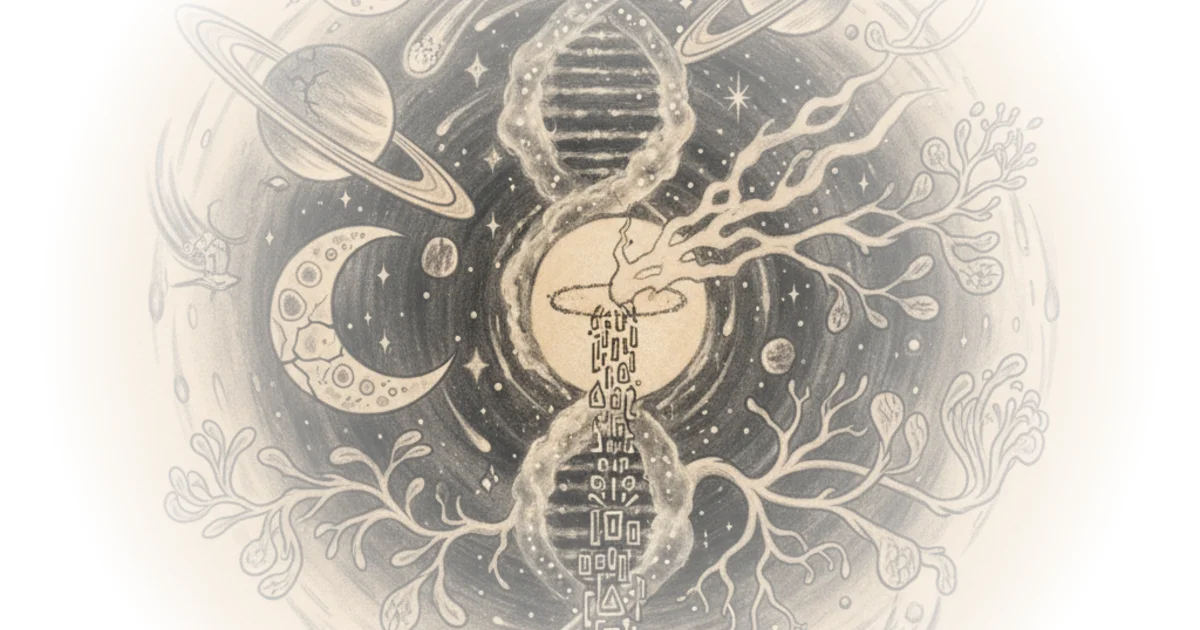
The author's framing is particularly effective because it shifts the focus from the miracle of life's emergence to the ubiquity of its ingredients. He writes, "perhaps life didn't start in space but maybe its building blocks did." This distinction is crucial; it suggests that while the spark of life might be rare, the fuel is everywhere. Critics might note that finding amino acids does not equate to finding life, and the leap from organic molecules to a self-replicating cell remains a massive, unexplained gap. However, O'Dowd sidesteps this by focusing on the chemical head start rather than the final ignition.
Evidence from the Asteroid Belt
The commentary gains its strongest momentum when O'Dowd turns to the physical evidence returned from the asteroid Bennu. He details how the OSIRIS-REx mission, despite a chaotic landing and a parachute failure, successfully delivered pristine samples that have rewritten our understanding of prebiotic chemistry. "Among the most exciting discoveries in the sample are all five of the nuclear bases that serve as the code for DNA and RNA," he states, highlighting a first-of-its-kind finding on a single space rock.
This evidence is compelling because it bypasses the contamination issues that plagued earlier meteorite studies, such as the famous Murchison meteorite. O'Dowd explains that while the Murchison sample showed both left and right-handed amino acids—a sign of abiotic origin—the Bennu samples were collected in a vacuum and sealed in nitrogen. "Because benu samples were stored in pure nitrogen they maintained a pristine Suite of salts for analysis," he notes. This methodological rigor allows for a much stronger claim about the asteroid's history.
The presence of sodium-rich salts and ammonia in the sample forces a reconstruction of Bennu's origin that is far more complex than a simple rocky body. O'Dowd reconstructs a narrative where Bennu is a fragment of a destroyed, water-rich protoplanet that once existed beyond Jupiter. "This protoplanet however is doomed before it can grow to full planethood a catastrophic Collision perhaps with a similar body scatters its fragments into space," he writes. This storytelling approach transforms a dry geological report into a cosmic tragedy that directly seeded Earth.
"Maybe the system that codes Earth life including your own DNA was set by extraterrestrial biochemistry."
The Implications for a Cosmic Biology
The final section of the piece elevates the scientific findings into a philosophical inquiry about the nature of life in the universe. O'Dowd argues that if the chemical cocktail for life is standard across the solar system, then the path to life itself might be narrow and inevitable. He posits, "if all planets start with a similar chemical cocktail maybe there's a pretty narrow path to life everywhere one that involves DNA like molecules." This suggests that the genetic code we use is not a random accident of Earth, but a universal standard imposed by the chemistry of the cosmos.
While this is a provocative conclusion, it relies on the assumption that the specific nucleobases found on Bennu are the only viable path to life. A counterargument worth considering is that alternative biochemistries could exist that do not rely on DNA or RNA at all. O'Dowd acknowledges the difficulty of proving life elsewhere but uses the ubiquity of these specific molecules to suggest that Earth is not an outlier, but a participant in a broader, pre-solar chemical process. He concludes by noting that the mission continues, with the spacecraft renamed OSIRIS-APEX, now tasked with studying the asteroid Apophis to help prevent future impacts, linking our understanding of origins to our survival.
Bottom Line
O'Dowd's strongest move is using the pristine Bennu samples to validate the "pseudo panspermia" hypothesis, effectively arguing that Earth's biology is an interstellar import rather than a local invention. The piece's biggest vulnerability lies in the leap from finding the ingredients of life to confirming the inevitability of life, a gap that remains the central mystery of astrobiology. Readers should watch for the next phase of the OSIRIS-APEX mission, as the distinction between a universal chemical code and a universal biological outcome will likely define the next decade of space exploration.