Kahlil Greene dismantles a pervasive statistical myth with a historical sledgehammer: the assumption that Black religiosity is an innate cultural trait rather than a strategic adaptation to systemic exclusion. While recent data suggests Black Americans hold Christian nationalist beliefs at rates higher than white Americans, Greene argues this is not a reflection of inherent spirituality, but the lingering scar of an institution built when white churches barred Black worshippers at the altar. This piece is essential listening because it forces us to confront how the very structures of American freedom were forged in the fires of religious control, turning the church into the only available fortress for a people denied all other civic spaces.
The Architecture of Exclusion
The core of Greene's argument rests on the idea that Black religious identity was not chosen in a vacuum but constructed under duress. He writes, "Slaveholders and colonial legislators built the conditions that attached Christianity to Black life in America." This framing is crucial because it shifts the blame from the community to the architects of slavery. The administration of the time, through colonial legislatures, actively weaponized theology to maintain the labor force. By 1706, laws in at least six colonies declared that baptism did not alter an enslaved person's legal status, effectively neutering the spiritual promise of liberation that missionaries might have offered.
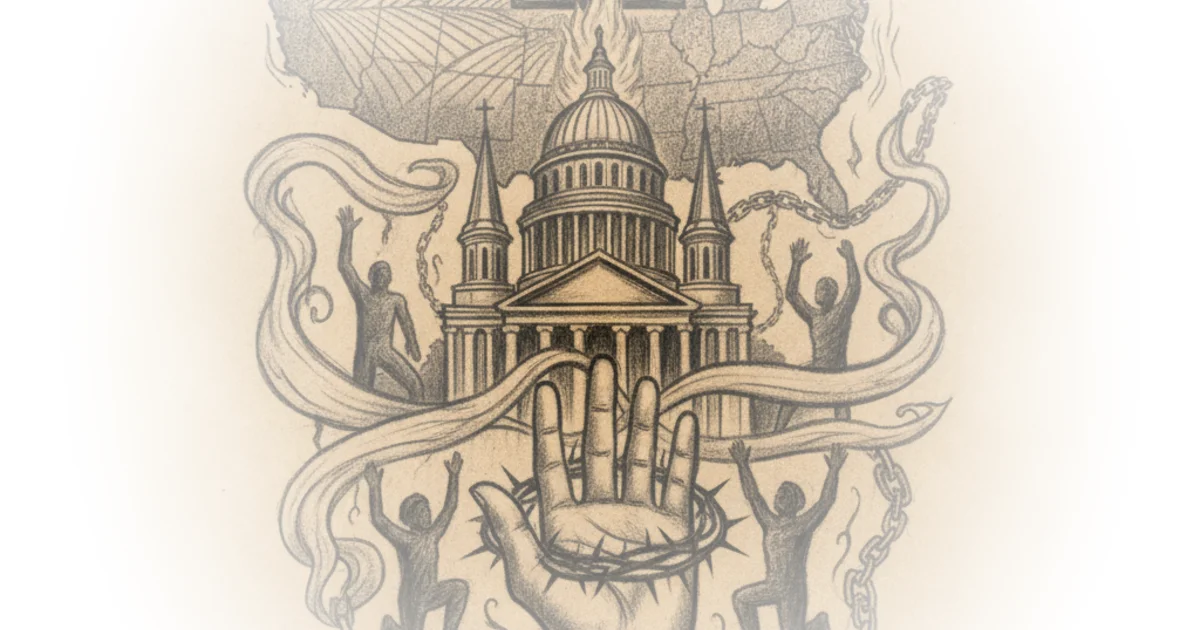
Greene highlights the brutality used to enforce this theological control, noting that "slaveholders punished worship they did not control." He cites the harrowing account of Charlotte Martin, whose brother was "whipped to death for taking part in a religious service," and Silas Jackson, who described a slaveholder killing a man named Zeek simply for praying. These are not abstract statistics; they are the human cost of a system that sought to monopolize the soul. Critics might argue that focusing on coercion ignores the genuine spiritual agency enslaved people found in Christianity, but Greene's point is precisely that this agency was exercised within a cage of their own making, necessitated by the violence of the outside world.
"Black Americans built churches because white institutions shut them out, and the Black Americans who rejected religion have often been left out of the histories."
This observation is the piece's most potent insight. It explains why the "invisible institution"—worship in woods and ravines—was so vital. It was a survival mechanism, not just a spiritual one. The historical record shows that when white churches like St. George's Methodist Episcopal Church in Philadelphia physically dragged Richard Allen and Absalom Jones from their knees in 1787, the response was not just a new denomination, but the creation of a parallel society. This mirrors the dynamics seen in the Roman Catechism era, where religious instruction was often a tool of social control rather than spiritual liberation, a pattern that persisted well into the 19th century.
The Myth of Monolithic Belief
Greene's most daring move is to challenge the narrative that Black America is a monolith of faith. He points to figures like A. Philip Randolph, who "reached a different answer" than the church founders. Randolph, a key architect of the 1963 March on Washington, famously stated that "prayer was not one of its remedies," insisting instead on "scientific education" and "sound methods." Greene notes that Randolph accepted the American Humanist Association's Humanist of the Year award in 1970, a fact often erased from the popular imagination.
The author also brings literary giants into the fold, noting that James Baldwin, after his teenage stint as a preacher, concluded in The Fire Next Time that "a God who does not make people larger and freer is a God worth discarding." Similarly, Zora Neale Hurston described organized creeds as "collections of words arranged around a wish," while James Weldon Johnson, despite writing the Black national anthem, admitted in his autobiography that he did not know if a personal God existed. By weaving these voices together, Greene demonstrates that the "religious" label often applied to Black intellectuals is a projection by outsiders who cannot conceive of Black life without the church.
"Anyone who explains those rates by pointing to something inherent in Black people has to leave out Randolph, Hurston, Baldwin, and Johnson."
This sentence cuts through the noise of modern polling. When the Public Religion Research Institute found that 34 percent of Black Americans hold Christian nationalist beliefs, the immediate reaction is often to assume a theological shift. Greene reframes this as a continuation of historical institutional dynamics. The high rates of attendance and belief are less about theology and more about the fact that, for centuries, the church was the only institution Black Americans could fully control. As Greene puts it, "Weekly attendance measured participation in one of the few major institutions Black Americans controlled themselves."
The Future of Disbelief
The piece concludes by looking at the generational shift, noting that the gap between Black and white religious affiliation is closing. Greene cites Anthony Pinn, who argues that "humanist organizations now need to offer Black nonbelievers the community that the church offered." This is a forward-looking call to action that acknowledges the church's historical role as a social safety net while recognizing its limits in a modern, pluralistic society. The decline in attendance among Gen Z—down to 64 percent from 83 percent in the Silent Generation—suggests that the necessity of the church as the sole pillar of community is eroding.
However, a counterargument worth considering is whether secular humanist organizations can truly replicate the deep, multi-generational cultural roots of the Black church. The church provided not just spiritual comfort but also job training, insurance, and political organization, as seen in the rapid growth of the AME Church from 20,000 members before the Civil War to 400,000 by 1884. Replacing that infrastructure with something new is a monumental task. Yet, Greene's documentation of the "Black Practice of Disbelief" suggests that the seeds are already there, waiting for the right soil to grow.
"The rates PRRI measured in 2024 followed from what white Americans did to Black Americans over three centuries and from what Black Americans built in response."
This final synthesis is the article's masterstroke. It refuses to let the data stand alone as a measure of piety and instead reads it as a measure of resilience and adaptation. It forces the reader to see the statistics not as a snapshot of belief, but as a map of history.
Bottom Line
Kahlil Greene's analysis is a vital correction to the lazy assumption that Black religiosity is natural or inevitable; it is instead a testament to the ingenuity of a people who built their own institutions when the world tried to destroy them. The argument's greatest strength is its refusal to separate faith from the brutal history of exclusion that necessitated it, though it leaves open the difficult question of how to build new communities for a generation that no longer needs the church to survive. Readers should watch for how secular movements adapt to fill the void left by declining church attendance, a shift that will redefine Black civic life in the coming decades.