In an era where medicine increasingly relies on digital scans and algorithmic diagnostics, Rohin Francis makes a provocative case that the most profound medical tool remains the one invented in 1816: the stethoscope. He argues that the rhythm we hear in a patient's chest is not just a biological signal, but a fundamental thread connecting human evolution, music, and the very art of clinical care.
The Lost Art of Listening
Francis, a cardiologist and educator in the UK, frames the physical examination as the ultimate discriminator in medical training. He notes that while modern technology offers precision, the ability to listen to heart sounds remains the skill that "often makes or breaks a candidate" in high-stakes exams. He contrasts this with the historical shift from placing an ear directly against a patient's chest to the invention of the stethoscope by René Laennec, describing the device as a "telescope to see into the chest." This historical context is vital; it reminds us that the tool was born from necessity and social propriety, yet it fundamentally changed how we perceive the human body.
The author then demystifies the sounds of the heart, explaining that the "lub-dub" is actually the closing of valves, a mechanical rhythm that can be faked or altered to reveal pathology. He describes how a third heart sound, normal in the young, becomes a "gallop rhythm" in the elderly, signaling heart failure. Francis captures the urgency of this finding vividly, noting that a gallop rhythm sounds like a "steam train... hurtling towards Clayton ravine unless the patient can be saved by all of our magical potions." This metaphor transforms a clinical sign into a narrative of impending crisis, emphasizing that listening is an act of witnessing a patient's struggle.
Medicine blends together art and science, humanities and social studies, and the physical exam is the very essence of medicine.
Critics might argue that Francis romanticizes auscultation in the face of overwhelming evidence that imaging is more accurate. He anticipates this, conceding that "the ultrasound probe is more accurate than the stethoscope" but insisting that relying solely on it risks converting doctors into mere "technicians" who never touch their patients. This distinction is the core of his argument: accuracy is not the sole metric of care; the human connection forged through the "laying on of hands" is equally critical.
The Biological Metronome
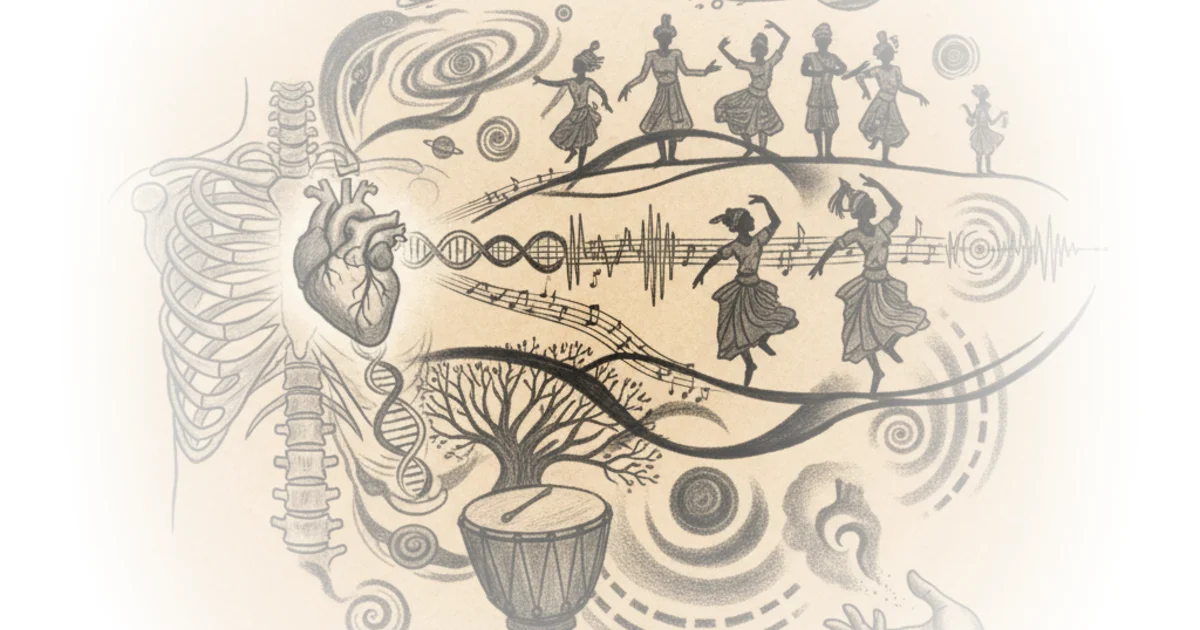
Francis expands his scope from the clinic to the cradle, positing that our love for rhythm is hardwired by our first auditory experience: the maternal heartbeat. He writes that the "first metronome is our mother's heart," and that the tempo of our lives mirrors the acceleration of that heart during gestation, which culminates in birth. He connects this biological reality to musical preference, suggesting that our "musical tastes tend to mirror the frequencies of our heartbeats."
He takes this connection further by linking speech cadence to the heartbeat, using Shakespeare's iambic pentameter as a prime example. Francis points out that scholars often refer to the alternating accents in Shakespeare's verse as a "heartbeat at the very center of it," arguing that this rhythm reflects natural speech and strong emotion. He playfully admits that venturing into literary analysis feels like a departure from science, joking that "you either die an unsullied hero of science or you live long enough to see yourself get infected by social sciences." Yet, this interdisciplinary approach is his strongest asset, illustrating that the boundaries between biology and culture are far more porous than we assume.
We've already lost the skills of the previous generation... doctors should treasure and maintain their traditions. This is our history, this is our art.
A counterargument worth considering is that Francis may overstate the universality of these connections. While the maternal heartbeat is a shared experience, the claim that musical preferences are strictly dictated by heart rate ignores the vast influence of culture, geography, and individual exposure. However, his broader point—that our bodies provide a rhythmic baseline for our cognition—remains a compelling hypothesis that bridges the gap between the physical and the abstract.
Bottom Line
Francis's argument succeeds not because it proves that the stethoscope is superior to the MRI, but because it reclaims the human element in a field increasingly dominated by data. The piece's greatest strength is its refusal to treat medicine as a purely technical exercise, insisting instead that the "art of auscultation" is a tradition worth preserving. The vulnerability lies in the difficulty of quantifying this "art" in an era obsessed with metrics, yet Francis makes a persuasive case that losing the rhythm of the physical exam would mean losing a vital part of the healing process.