This piece from Sinification offers a startlingly candid window into how a segment of China's establishment views the current American trajectory: not as a rival to be defeated in a hot war, but as a distressed asset to be acquired. The central thesis is provocative, suggesting that the United States is involuntarily liquidating its "imperial assets"—from military bases to industrial rights—to preserve its core military and financial strength, creating a unique window for Beijing to "harvest" these concessions. It moves beyond standard diplomatic platitudes about "multipolarity" to outline a specific, transactional strategy for capitalizing on American fiscal and industrial strain.
The Logic of Forced Liquidation
The article's most striking contribution is its reframing of US policy shifts not as ideological choices, but as desperate financial maneuvers. Sinification reports that the underlying logic is that "debt, de-industrialisation and the pursuit of strategic autonomy by allies have flipped the calculus for US hegemony, which has now become a drain on its resources rather than a source of strength." This perspective suggests that the American empire is no longer a profit center but a liability that requires "selling off some of its non-core hegemonic privileges" to maintain liquidity for its military and technology sectors.
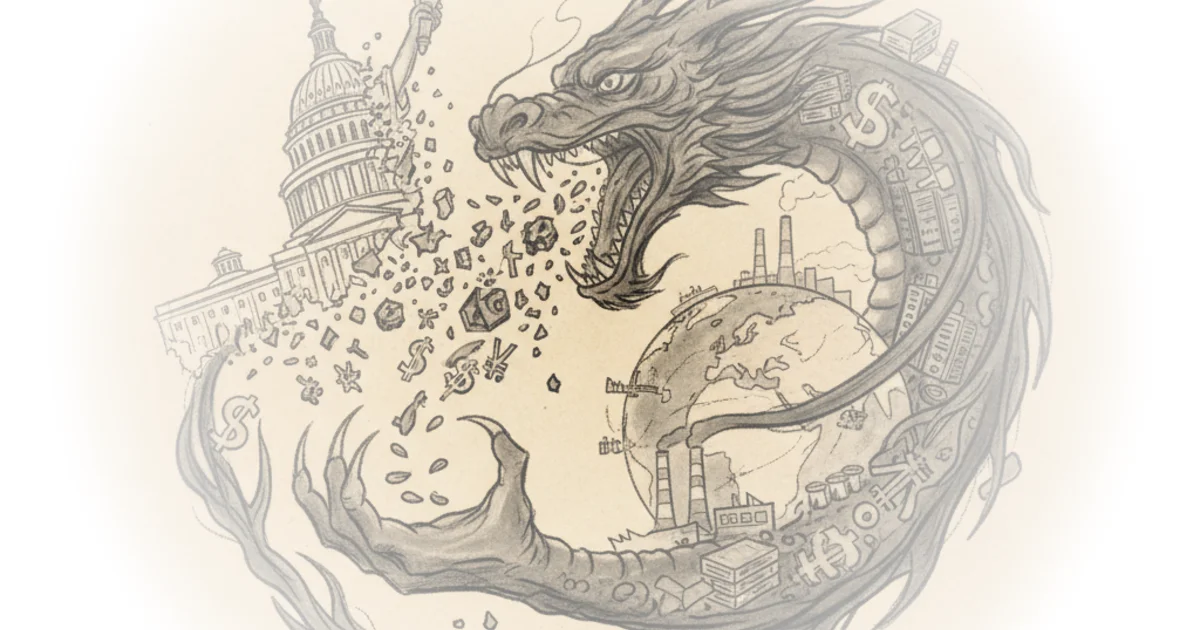
The piece argues that this is not a voluntary retreat but a forced sale driven by three interlocking crises: a fiscal crisis where debt consumes a massive portion of GDP, an industrial crisis leaving manufacturing at under 12% of GDP, and a hegemonic crisis where allies are increasingly seeking "strategic autonomy" and refusing to fully obey US direction. The editors note that this dynamic forces the US to "expend tomorrow's hegemonic credit for liquidity in the present," effectively monetizing its future influence to solve immediate cash flow problems.
"The US 'selling off its imperial assets' is not a simple matter of 'needing money and so selling things' but rather the concentrated manifestation of its hegemonic system's unsustainability."
This framing is compelling because it treats the global order like a balance sheet, where the US is forced to divest non-core holdings to save its crown jewels. However, this analysis glosses over the political agency of the executive branch. Critics might note that characterizing these shifts as purely structural inevitabilities ignores the role of specific policy decisions and political rhetoric that actively drive these outcomes. The argument assumes a level of passive inevitability that may not account for the volatility of domestic American politics.
The Catalog of Assets for Sale
Sinification details exactly what is being put on the market, ranging from financial instruments to physical resources. The piece suggests that the US is "loosening restrictions on foreign investment in critical minerals, strategic industry and infrastructure" to attract the capital needed for survival. It points to specific examples, such as the approval of Chinese equity in US lithium mining and participation in port operations, as evidence of this "hidden transfer" of industrial rights.
The argument extends to technology and intellectual property, positing that the US is forced to engage in a "hidden transfer of non-core technologies" to solve its de-industrialization crisis. The editors highlight a shift in global discursive power, noting that the US has been "forced to recognise as a fait accompli the growing rule-shaping and agenda-setting power of institutions such as the BRICS New Development Bank and the Asian Infrastructure Investment Bank." This mirrors the historical shift seen after the Nixon shock, where the US was forced to abandon the gold standard to manage its balance of payments, fundamentally altering the structure of global finance.
"For example, the United States has recently approved a Chinese company to acquire partial equity in a certain US lithium mining enterprise... These are all important opportunities for China to obtain strategic resources and optimise its global supply chain."
While the identification of these sectors is astute, the piece's optimism regarding the US openness to Chinese foreign direct investment is questionable. The narrative of "regulatory loosening" in sectors like biotech and renewable energy contradicts recent legislative trends in Washington, such as the BIOSECURE Act, which aims to tighten, not loosen, restrictions on foreign entities in sensitive industries. The argument seems to rely on a selective reading of isolated deals while ignoring the broader, tightening regulatory environment.
The Strategy for Harvesting
The core of the commentary lies in how China should respond to this perceived opportunity. The piece outlines a strategy of "strategic give and take," where China uses its absorption of US government debt as a bargaining chip. The goal is to trade debt purchases for "substantial strategic concessions such as lifting technology sanctions or granting resource extraction rights."
Sinification advises that China should "strike" precisely when the target's dependence on external capital is at its peak, such as during credit crises or budget shutdowns. The strategy involves employing multilateral cooperation with third-party capital to dilute political risk and building support among US state governments. The editors warn that China must maintain "defensive vigilance to avoid 'asset, patent and rule traps' that Washington may set," while retaining retaliatory capabilities in rare earths and finance.
"China's core strategic challenge is how to 'harvest' these relinquishing assets at minimal cost and friction while avoiding the trigger of systemic conflict."
This approach reflects a cold, calculated view of international relations where diplomacy is merely a mechanism for asset transfer. It echoes the logic of the "G2" diplomacy concept, suggesting a grand bargain between the two superpowers. However, the assumption that the US would willingly trade technology sanctions for debt purchases overlooks the deep-seated bipartisan consensus in Washington against transferring advanced technology to China. The strategy relies on a level of cooperation that may no longer exist in the current geopolitical climate.
"The US is 'expending tomorrow's hegemonic credit for liquidity in the present'."
Bottom Line
The strongest part of this analysis is its unflinching diagnosis of the US as a system under financial and structural stress, forced to monetize its global privileges to survive. It provides a rare glimpse into the transactional mindset of Chinese strategists who view American decline not as a threat, but as a market opportunity. However, its biggest vulnerability is the assumption that the US will act as a rational, unified seller in this "auction," ignoring the intense political friction and regulatory barriers that make such "harvesting" far more difficult than the piece suggests. Readers should watch for whether these theoretical "soft landing" deals materialize in practice, or if they remain a fantasy of a specific school of thought within the Shanghai policy ecosystem.