Most histories of the American Revolution focus on the battles of Lexington and Concord or the signing of the Declaration. This piece from Reason does something far more unsettling and fascinating: it argues that for a critical two-year window, the United States didn't just lack a government—it had no government at all, yet somehow functioned. It forces a busy reader to confront a radical idea: that order can emerge not from the top down, but from the voluntary withdrawal of consent by the governed.
The Vacuum of Power
The article opens by dismantling the romantic notion of a seamless transition to republicanism. Instead, it paints a picture of a chaotic interregnum where old structures collapsed before new ones could be built. Quoting Thomas Paine, Reason notes that "for upwards of two years from the commencement of the American War... there were no established forms of government." Yet, as the piece points out, "order and harmony were preserved as inviolate as in any country in Europe."
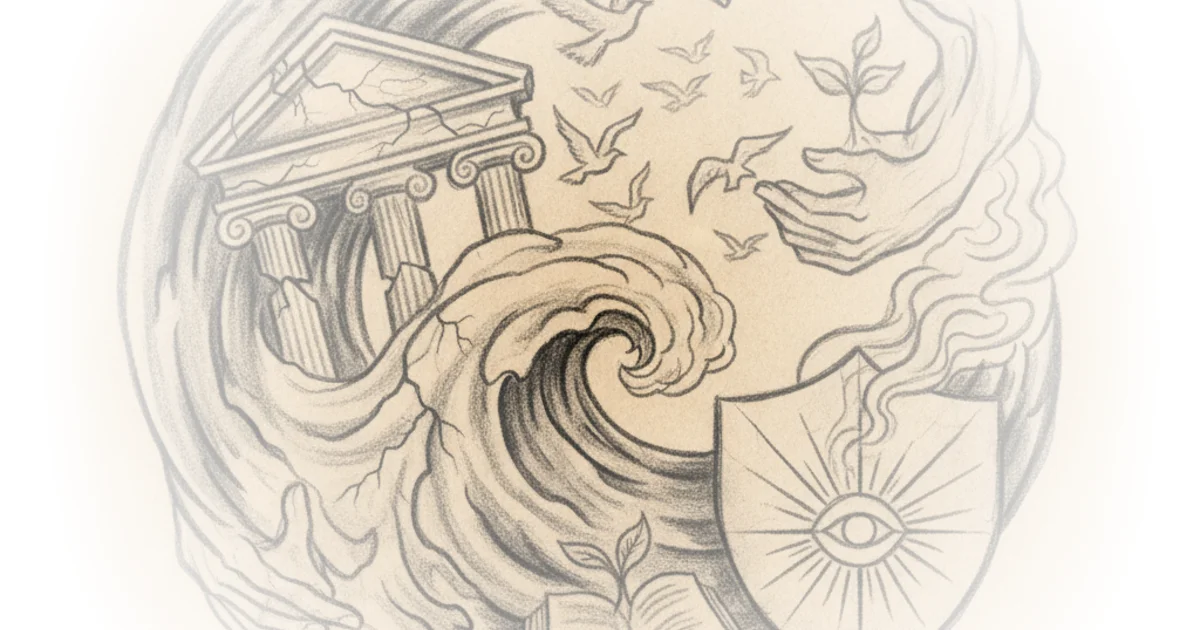
This is the central paradox the editors want us to sit with. How did society hold together without a state? The answer lies not in a vacuum, but in a competitive marketplace of authority. The old colonial regimes didn't vanish overnight; they "shriveled away" as grassroots associations, committees, and councils rushed to fill the void. The piece highlights a striking example from Georgia in 1775, where rebels surrounded a royal fort, compelled the king's rangers to surrender, and then immediately asked them to return to their posts—this time working for the revolutionary Council of Safety. It was a moment of pure improvisation, where loyalty was fluid and authority was negotiated in real-time.
"Government totally Annihilated," a royal governor reported, only to watch "Congresses, Councils and Committees" assume the old Leviathan's functions.
This framing is powerful because it shifts the focus from the Founding Fathers in Philadelphia to the thousands of unnamed citizens in county seats who actually kept the lights on. It suggests that the revolution was less a sudden coup and more a slow-motion collapse of legitimacy, where the "voluntary withdrawal of authority" from the old regime was the true engine of change.
The Mechanics of Voluntary Compliance
Without a standing army or a police force, how did these new bodies enforce their will? The article argues that the Continental Association, a boycott of British goods, succeeded not through legal coercion but through social pressure. "The Continental Association lacked the machinery of a state and therefore the capacity to enforce laws as a state does, by jail, fines, and the like," the piece reports, citing sociologist Ronald McCarthy. Instead, advocates relied on the threat of ostracism, denunciation, and, in extreme cases, the "tar pot and some feathers."
This reliance on social capital is the most compelling part of the argument. The First Continental Congress didn't build a bureaucracy; it simply asked qualified voters to form local groups. Hundreds of councils sprang up, each with its own shape, burrowing into the British edifice of authority. The piece notes that these groups "quickly started burrowing into Britain's edifice of authority," effectively creating a parallel government before the war had even truly begun.
Critics might argue that this romanticizes a system that was deeply messy and often arbitrary. The article acknowledges this tension, noting that while the system was more open to popular participation, it also cracked down on Loyalists, neutralists, and pacifists. The "voluntary" nature of this governance had a dark side: it could be coercive for those who didn't fit the consensus.
The Double-Edged Sword of Grassroots Power
The commentary does not shy away from the violence and repression that accompanied this power vacuum. As the committees shifted from economic boycotts to running a war effort, they became "engines of a crackdown" on anyone deemed a British sympathizer. The piece details how these councils opened mail, confiscated property, and demanded loyalty oaths. Yet, it offers a crucial distinction when comparing this to the French Revolution that would follow decades later. "Instead of executing enemies wholesale," historian T.H. Breen is quoted, "the committees tried to shame them into giving public confessions. These proceedings took on a ritual quality in which terror and humiliation were aimed at converting dissenters. The bark was generally worse than the bite."
This comparison is vital. While the American committees were certainly repressive, the article argues they were "much milder" than their European counterparts. In North Carolina, for instance, the revolutionary congress explicitly instructed committees not to inflict physical punishments, rejecting the stocks and whipping posts of the old regime. The result was that while thousands of Tories fled, "barely a handful were killed."
"Never before in history," libertarian theorist Murray Rothbard argued, "had so much reliance been placed on such nonviolent methods of mass struggle as the boycott..." yet he regretted that the committees' zeal eventually took them "beyond the bounds of libertarian principle."
The piece uses this tension to explore the limits of stateless governance. It was a system that could mobilize a nation without a central command, but it also struggled to protect minority rights when the majority turned hostile. The human cost of this "voluntary" order is real; the humiliation and social death inflicted on Loyalists were severe, even if they didn't result in the guillotine.
Bottom Line
Reason's analysis offers a necessary corrective to the myth of a smooth, orderly birth of the American nation. The strongest part of this argument is its demonstration that legitimacy is not granted by laws or decrees, but by the daily, voluntary cooperation of the governed. Its biggest vulnerability, however, is the tendency to underplay the fear and coercion that sustained this "voluntary" order, particularly for those on the losing side of the revolution. For the modern reader, the lesson is clear: institutions are fragile, and when they collapse, the people will fill the void—but the result is rarely a utopia, and often a messy, dangerous experiment in self-rule.