In a field often obsessed with the immediate noise of the latest poll, G. Elliott Morris offers a rare, data-driven excavation of what actually drives American elections: the difference between who says they will vote and who actually shows up. This piece cuts through the noise of partisan punditry to reveal a startling truth about the 2024 electorate—that the millions of non-voters who stayed home were not a Democratic reservoir waiting to be tapped, but a Republican-leaning bloc that has fundamentally shifted since the Obama era.
The Myth of the Latent Democratic Majority
Morris dismantles the comforting narrative that the 2024 election result was merely a turnout failure for Democrats. He leans heavily on fresh data to challenge the idea that a higher turnout would have flipped the outcome. "My answer is that had everyone voted in 2024, Trump likely still would have won," Morris writes, grounding his assertion in a stark finding from the Pew Research Center. According to the data, non-voters in 2024 favored the Republican candidate by four points, a dramatic reversal from 2016 when Hillary Clinton held a significant lead among this group.
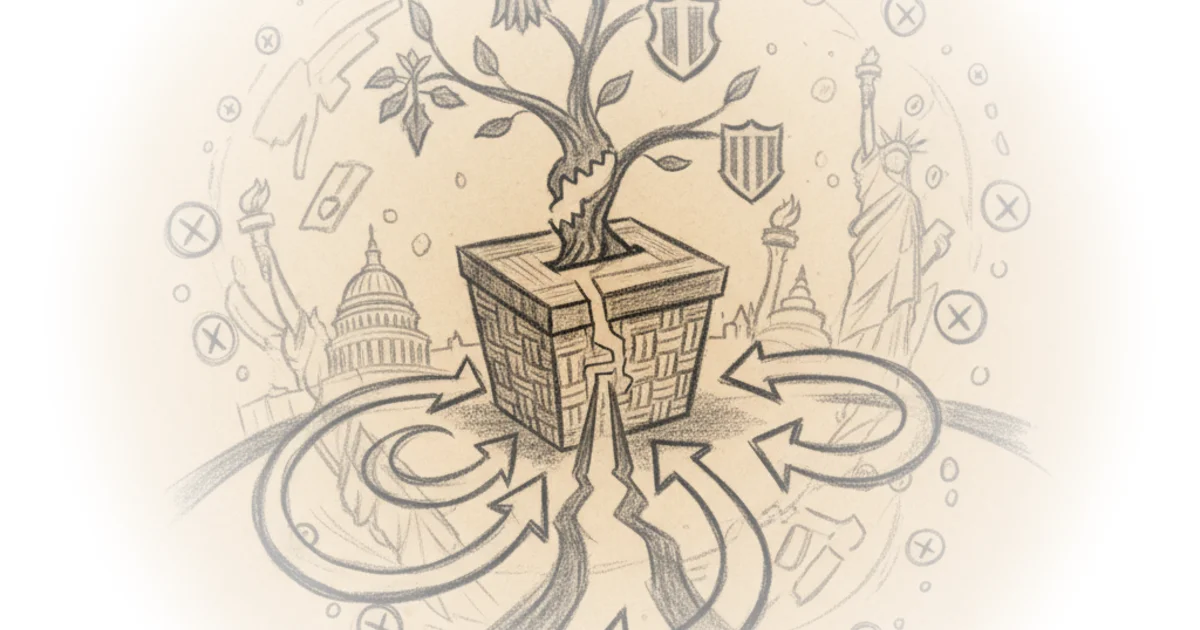
The author's analysis of this shift is particularly sharp. He notes that while non-voters used to be a Democratic stronghold, "opinion has shifted since 2024," with the former non-voter bloc now showing a distinct preference for the incumbent administration's direction. This isn't just a statistical blip; it represents a realignment that invalidates the old playbook. Morris points out that even in the 2025 elections in Virginia and New Jersey, non-voters who finally turned out favored Democrats by 25 points, suggesting the group is fluid, not a monolith. "This is a good reminder that nothing is forever in politics," he observes, a line that serves as a sobering check on both Democratic optimism and Republican triumphalism.
Critics might argue that focusing on non-voters ignores the structural barriers that keep them from the polls, but Morris's point remains: the preferences of those who stay home have changed, regardless of the barriers. The data suggests that the "Emerging Democratic Majority" was a historical artifact, not a permanent feature of the American landscape.
Nothing is forever in politics. That goes for the authors of the 2002 book The Emerging Democratic Majority and the Republicans who alleged the 2024 election showed voters had fundamentally realigned to the right.
The Methodology of Trust
Beyond the raw numbers, Morris tackles the often-opaque world of polling aggregation, specifically addressing why his model, FiftyPlusOne, diverges from the New York Times' average. The distinction lies in the reference population. While the Times averages polls as they are reported, Morris adjusts the data back to the population of "all adults." He explains that registered voters are "much more likely to have an opinion about politics" and slightly more favorable toward the current administration than the general adult population.
This methodological choice is not about partisan spin; it is about historical consistency. Morris argues that because historical benchmarks from Gallup and Pew use the "all adults" metric, failing to adjust creates a bias in long-term trend analysis. He uses a vivid analogy to illustrate the danger of mixing datasets: "If we did not make this adjustment, then in our historical analyses... the predictions could be biased up or down in ways the model didn't know about." He compares it to predicting the free-throw rate of a basketball league of short players and then suddenly adding a seven-foot-four French player—Victor Wembanyama—into the mix without recalibrating the model. The outlier distorts the prediction, just as the specific demographics of "likely voters" distort historical comparisons if not adjusted.
The author is equally rigorous when discussing election predictions versus general opinion. For predicting who wins, he insists on using "likely voter" polls because "persuasion and turnout are correlated." This nuance is often lost in broader media coverage, where a single approval number is treated as a universal truth. Morris clarifies that for characterizing the average American, "all adults" is the correct metric, but for predicting elections, the "likely voter" model is superior.
The Illusion of Reform
The piece takes a turn toward the structural when addressing a reader's question about ranked-choice voting (RCV) in presidential primaries. Morris revisits his own 2020 work, which simulated how a nationwide RCV primary might have altered the Democratic nomination. The simulation showed that left-leaning voters, who often fail to rank enough candidates, would have exhausted their ballots early, ultimately handing the nomination to Joe Biden over Elizabeth Warren in a 53-47 split.
However, Morris is quick to temper the excitement around RCV as a silver bullet. He argues that the chaos of the primary system is not just about the voting method, but the federalist structure itself. "The state-by-state nature of presidential primaries creates a chaotic path dependency that increases the importance of otherwise rare and seemingly inconsequential decisions," he writes. In a state-by-state system, a local leader's endorsement can be the difference between viability and obscurity, a dynamic that a nationwide RCV system would flatten but not necessarily fix.
Furthermore, the political hurdles to such a change are immense. Morris notes that for the Democratic National Committee to adopt RCV, it would require a majority of the 450-member national committee and changes to state election laws, many of which explicitly prohibit ranked ballots. The takeaway is pragmatic: "RCV probably doesn't fundamentally alter the chaos inherent in modern primary systems." The focus should remain on understanding the ideological lanes of the electorate rather than hoping for a procedural fix.
The Human Element in Data
Finally, Morris addresses the inevitable question of bias, a topic that has recently drawn criticism from figures like Nate Silver. Rather than offering a sterile defense, Morris provides a personal history that contextualizes his worldview. He describes growing up in rural Texas, the son of a teacher and a fishing boat captain who worked on the Deepwater Horizon cleanup. "I was born into a working-class family as one of four siblings," he writes, grounding his political priors in a life that has seen both government assistance and the generosity of local business leaders.
He admits to being "anti-oligarch" and "pro education and science," but frames these not as partisan weapons but as the result of lived experience. He challenges the notion that objectivity requires the absence of values, arguing instead that transparency about one's priors is the true mark of integrity. "It's very convenient for him to paint his competitors as ideological and throw mud without engaging in honest criticism," Morris says of Silver, suggesting that the real failure in the industry is a lack of substantive engagement with methodological disputes.
Bottom Line
G. Elliott Morris's Q&A is a masterclass in separating signal from noise, using rigorous data to debunk the myth of the latent Democratic majority while clarifying the nuances of polling methodology. The piece's greatest strength is its refusal to let political narratives override empirical reality, particularly in its assessment of non-voter sentiment. Its only vulnerability lies in the sheer complexity of its methodological adjustments, which may alienate casual readers, but for those willing to engage, it offers a far more accurate map of the American political terrain than the standard punditry. The real story isn't who the non-voters are, but how quickly their preferences can shift when the political winds change.