In an era obsessed with speed and efficiency, L. M. Sacasas makes a startlingly radical claim: that the most revolutionary act available to us is to walk at three miles an hour. This piece is not merely a celebration of exercise; it is a profound critique of how modern technology and urban design have severed the connection between our bodies and our minds, leaving us unable to think deeply or perceive the world in its fullness. For the busy professional who feels perpetually rushed, Sacasas offers a compelling argument that slowing down is not a luxury, but a prerequisite for human competence.
The Pace of Thought
Sacasas anchors his argument in a historical and scientific lineage that suggests walking is not just physical movement, but a cognitive necessity. He begins by invoking the philosopher Søren Kierkegaard, who advised, "Above all, do not lose your desire to walk," noting that the philosopher walked himself into his best thoughts and could walk away from any burden. This is not romantic fluff; Sacasas points to a 2014 study in the Journal of Experimental Psychology by Marily Oppezzo and Daniel L. Schwartz which confirmed that "walking substantially enhanced creativity." The author uses this to challenge the modern educational and corporate tendency to prioritize seated, static work, observing that "the neglect of the body in favor of the mind ignores their tight interdependence."
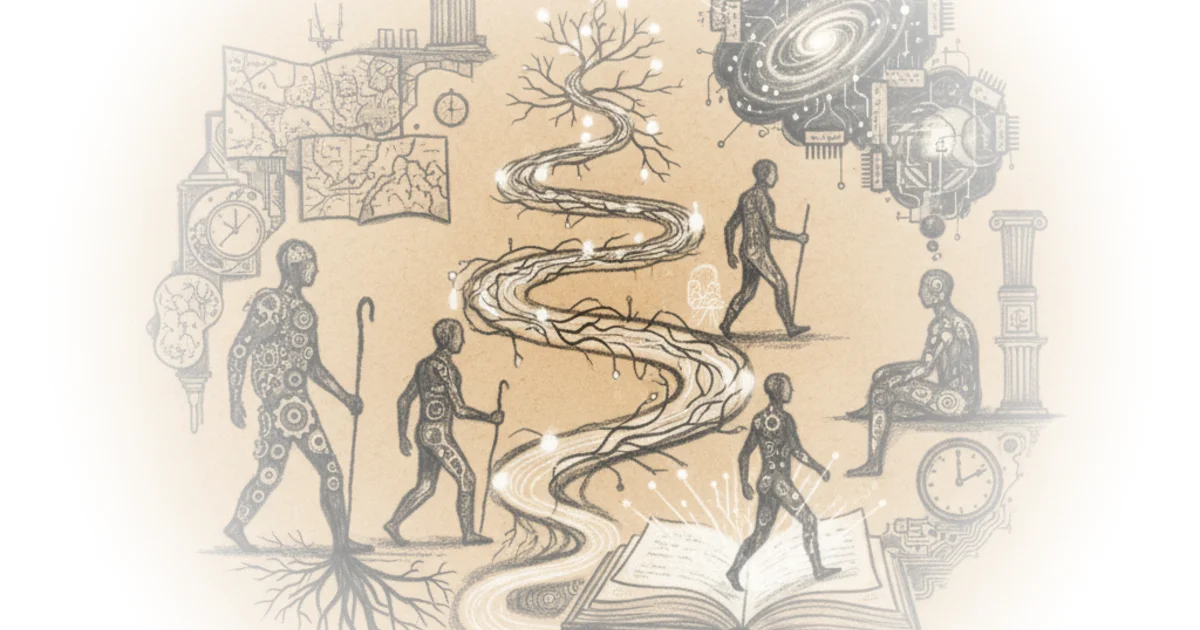
The core of Sacasas's thesis is that our mental tempo is biologically tethered to our physical stride. He draws on Rebecca Solnit's observation that "the mind, like the feet, works at about three miles an hour. If this is so, then modern life is moving faster than the speed of thought." This framing is powerful because it reframes our feeling of mental exhaustion not as a failure of willpower, but as a mismatch between our biology and our environment. When we move too fast, we lose the ability to process reality. As Sacasas puts it, "Past a certain speed, we simply cannot perceive the world in depth."
The world reveals itself to those who walk.
The Architecture of Inaccessibility
Beyond the internal mechanics of thought, Sacasas expands his critique to the external structures that make walking difficult. He cites the philosopher Ivan Illich, who argued that modern technology has "disabled very simple native abilities" and made people "dependent on objects." Sacasas highlights Illich's specific critique of the automobile, which "cuts out the use value from your feet," rendering the world inaccessible to anyone without a car. This is a crucial point: the problem is not just our personal habits, but the fact that "many of the places we live have been built for cars rather than for people."
The author suggests that by accepting this car-centric design, we have accepted a world where we are "hapless consumers of goods and service who no longer recalled what we were capable of doing for ourselves." This is a sharp, necessary indictment of urban planning that prioritizes throughput over human experience. A counterargument worth considering is that in many sprawling American cities, walking is not just inconvenient but dangerous or impossible due to a lack of infrastructure, making Sacasas's call to "walk whenever reasonable" a privilege not everyone possesses. However, the underlying principle remains: the tools we build to save time often cost us our autonomy.
The Virtue of Slowness
Sacasas elevates the act of walking from a mere mode of transport to a form of pilgrimage and a practice of attention. He references travel writer Nick Hunt, who notes that at walking speed, "the world is a continuum" where borders and cultures blend into one another, rather than appearing as sharp, artificial divisions. This perspective challenges the fragmented way we experience the world through screens and high-speed transit. Sacasas argues that walking allows us to "read the world" in a way that mirrors the deliberative process of reading a book. As Audrey Watters is quoted, "Walking lets you read the world — and much like the slow, contemplative mental processes involved in reading a book, the pace with which one moves through the world while walking allows for a different, deliberative kind of seeing."
The author draws a parallel to Ray Bradbury's Fahrenheit 451, where being a pedestrian was illegal because it allowed for too much thought. Sacasas writes, "In a fictional yet all-too-familiar society... thoughtlessness is abetted by enforced speed." This comparison serves as a stark warning: the pressure to move faster is not neutral; it is a mechanism that suppresses critical thinking. He argues that almost everything in the modern economic and technological world is "bent on pushing us past a human scale and speed," leading to "exhaustion and alienation." Against this, he posits that walking is a way to reclaim a "fitting scale" where the body and the world are in harmony.
Bottom Line
L. M. Sacasas's strongest argument is the biological and philosophical link between the rhythm of walking and the capacity for deep thought, a connection that modern efficiency culture actively destroys. The piece's greatest vulnerability lies in its potential to overlook the structural barriers—unsafe streets, lack of sidewalks, and car-dependent zoning—that make walking impossible for many, not just a matter of personal choice. Readers should watch for how this philosophy of "human scale" translates into tangible demands for urban reform, rather than remaining a purely individual spiritual practice.