More Perfect Union cuts through the noise of cultural panic to reveal a stark, material reality: young men aren't drifting toward the right because of a sudden ideological conversion, but because they feel economically stranded and culturally invisible. The piece's most distinctive move is bypassing the usual "toxic masculinity" lecture to sit down with five working-class men who articulate a profound sense of betrayal by both major parties. This isn't a story about a "testosterone podcast election"; it is a forensic look at how the collapse of the male breadwinner script has left a generation without a political home.
The Economic Anchor
The author grounds the entire discussion in hard data before introducing the human element, noting that while the top 20% of earners are flourishing, "men, on the other hand, are working less, often for worse pay." This framing is crucial because it shifts the debate from identity to economics. More Perfect Union writes, "Labor force participation for men has dropped 7% in the last 50 years. A third of men with only a high school education are not working today." This statistic is the silent engine driving the political realignment. The commentary effectively argues that the loss of a well-paying job isn't just a financial hit; it is a blow to the traditional "script" men were taught for how to be in the world.
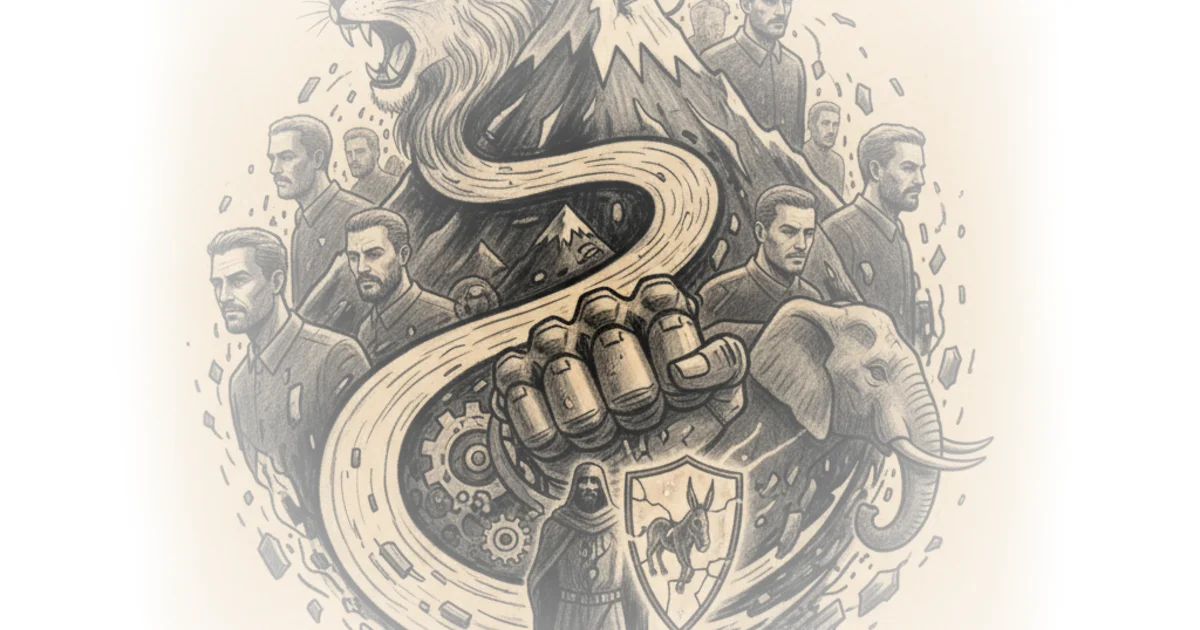
The piece highlights a painful disconnect: the economy has changed, but the social expectations have not. As one interviewee notes, "We're being cast in a modern-day HBO drama with a screenplay from Leave It to Beaver." This metaphor lands with force because it captures the absurdity of expecting men to fulfill the provider role of the 1950s in an economy where that role is increasingly unattainable. The author suggests that the Democratic party's failure to address this specific economic erosion has created a vacuum that the right is filling with cultural resentment.
"The left turns its back on boys and men, and the right turns back the clock on women and girls."
Critics might argue that focusing on male decline risks minimizing the ongoing struggles women face in the workplace. However, the author navigates this by showing that these issues are not mutually exclusive; the decline of manufacturing and the rise of automation have disproportionately hurt men, while women have made gains in education and white-collar sectors. The piece acknowledges that "both sides need to confront their problem with young men or a large share of the population is not going to have a political home."
The Cultural Vacuum
The commentary then pivots to the cultural dimension, where the interviewees express a deep sense of alienation from progressive discourse. One young man, a union organizer, bluntly states, "The Democratic party has abandoned men. They kicked them under the curb and spit on them." While the language is visceral, the sentiment reflects a genuine perception that progressive culture often frames male interests as inherently oppressive. More Perfect Union captures this by noting the tension where "men are into fighting. That's why Trump is there, you know, because Trump isn't abandoned us."
This section is particularly sharp because it doesn't shy away from the uncomfortable fact that the administration and its allies have successfully co-opted masculinity. The author observes that the executive branch and its surrogates have "politicized" masculinity, offering a sense of belonging that the left has failed to provide. Yet, the piece also delivers a stinging critique of the right's solution. One interviewee, identifying as transgender, points out the hypocrisy of the culture war: "Trans people are not hiking my credit card interest rates. They did not keep my wages stagnant. You're focusing on the wrong 1%."
This insight is the piece's intellectual anchor. It suggests that the political stalemate is a distraction from the real issue: class. The author paraphrases the consensus among the group that "the divide in America really should be class. You know, work versus the elite." This reframing is powerful because it exposes how the current political dynamic serves the interests of the wealthy by keeping working-class men and women fighting over culture rather than economics.
The Systemic Failure
Perhaps the most harrowing part of the coverage is the discussion of the legal system's failure to protect men in domestic violence situations. The author shares the story of Darren, who was assaulted by a partner and denied a protective order because the judge mocked his injuries. More Perfect Union writes, "I walked in with blood on my arm and got one for one day." This anecdote illustrates a broader institutional blindness where male victims are not taken seriously.
The commentary uses this to argue that the current political discourse is failing to address the full spectrum of gender issues. The author notes that "Liberals refuse to accept that gender gaps can now run both ways, and they're too quick to label male problems as individual failings." This is a bold claim, but the evidence provided—ranging from economic stagnation to legal bias—supports the idea that a rigid ideological framework is preventing a nuanced solution. The piece suggests that until the political establishment acknowledges these specific struggles, the alienation of young men will only deepen.
"You're focusing on the wrong 1%."
Bottom Line
The strongest part of this argument is its refusal to treat the rise in male support for the right as a purely cultural phenomenon, instead rooting it in the tangible collapse of the working-class male economy. Its biggest vulnerability is the difficulty of translating this class-based insight into a political coalition that doesn't alienate the very women the left seeks to protect. The reader should watch for whether the administration can pivot from culture-war signaling to concrete economic policies that address the specific labor market failures affecting young men, or if the current stalemate will continue to drive this demographic toward more extreme ideologies.