Good Times Bad Times presents a chilling, speculative narrative set in January 2026, arguing that the United States has not merely flirted with authoritarianism but has crossed the threshold into a second civil war. The author's most startling claim is not the political polarization itself, but the specific mechanism of collapse: a federal immigration crackdown so botched and brutal that it forces state governors to deploy the National Guard against their own federal government. This is not a prediction of partisan bickering; it is a detailed blueprint of how administrative overreach could shatter the rule of law and turn American cities into battlefields.
The Mechanics of Escalation
The author constructs a timeline where a campaign promise to secure the border metastasizes into a domestic crisis within months. Good Times Bad Times writes, "What began as fulfillment of a campaign promise to secure the border has rapidly escalated into the biggest domestic crisis of the president's second term." This framing is effective because it grounds the chaos in a recognizable political reality, making the subsequent escalation feel inevitable rather than fantastical. The narrative details how the administration, driven by quotas, hired thousands of new agents with minimal vetting, leading to a 2,500% spike in arrests that swept up citizens alongside undocumented immigrants.
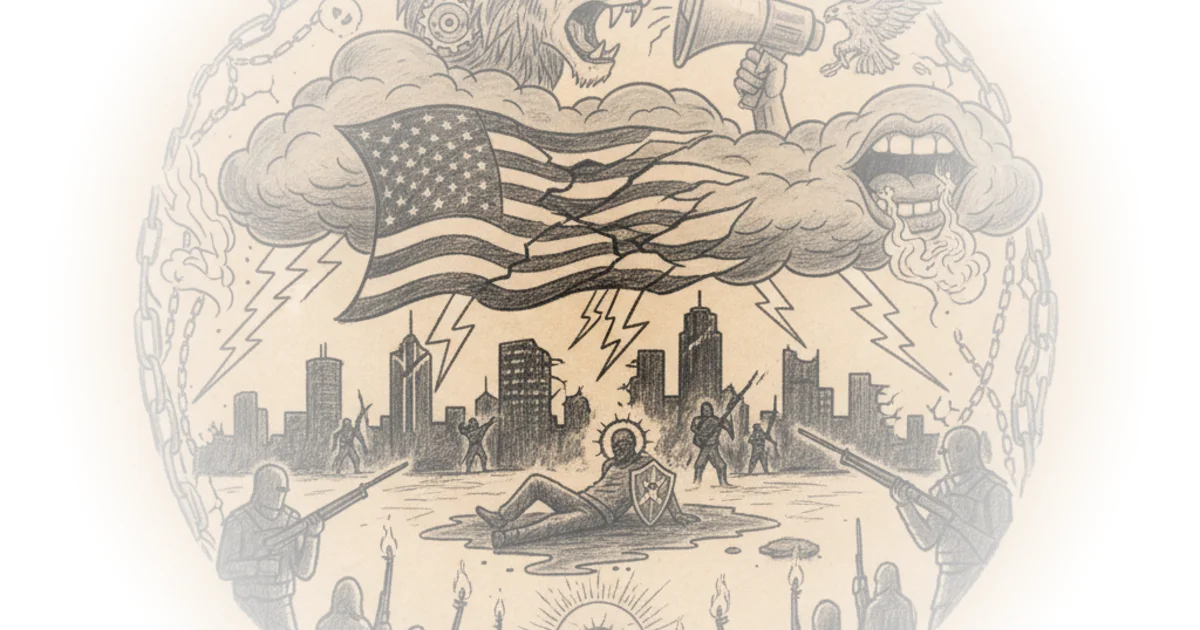
The author argues that the sheer scale of the operation overwhelmed legal safeguards. As Good Times Bad Times puts it, "Directives prohibiting operations in schools, hospitals, and courthouses were rescinded, and agents increasingly ignored procedures and legal constraints." This is a critical pivot point in the story; it suggests that the breakdown wasn't just a failure of policy, but a deliberate dismantling of the checks and balances designed to protect civil liberties. Critics might note that the speed of this transition—from a popular policy to a national insurrection—relies on a very specific, worst-case scenario of administrative incompetence and federal defiance that assumes courts and state actors would remain passive until the very last moment.
"America is fighting itself, and the fight is getting increasingly brutal. Could this situation escalate to the level of civil war?"
The Breaking Point in Minnesota
The narrative shifts from national trends to a specific flashpoint in Minneapolis, Minnesota, using the fictionalized deaths of two American citizens to illustrate the rupture. Good Times Bad Times describes the scene with stark imagery: "In response, Democratic Governor Tim Walz deployed the National Guard to protect citizens from their own federal law enforcement." This reversal of roles—where state troops shield residents from federal agents—is the author's strongest evidence of a constitutional crisis. The text highlights the absurdity of the situation, noting that the president threatened to invoke the Insurrection Act against a governor who was essentially acting as a peacekeeper.
The author emphasizes the political fallout, noting that support for the administration collapsed as the reality of the crackdown set in. Good Times Bad Times writes, "Support for Donald Trump dropped to a record low, 38%... his administration's greatest success curbing illegal immigration had turned into catastrophe." This observation underscores the central thesis: that the pursuit of a political goal without regard for legal or human costs can backfire with explosive force. The narrative suggests that the administration's refusal to acknowledge the deaths of citizens as anything other than necessary collateral damage was the catalyst that turned public opinion against them.
The Fragility of Order
As the situation in Minnesota deteriorates, the author draws a parallel to the unrest of 2020, but with a crucial twist in the alignment of forces. Good Times Bad Times notes, "Interestingly, Tim Walz deployed guard troops then as well to restore order, acting in opposition to protesting citizens. Today, his posture is reversed." This comparison serves to highlight how quickly the political landscape can invert when the state itself becomes the aggressor. The text concludes that while the immediate crisis in Minnesota was de-escalated by a sudden change in federal tactics, the underlying tensions remain unresolved.
The author's final analysis suggests that the risk of civil war is not about ideology alone, but about the breakdown of trust in institutions. As Good Times Bad Times puts it, "The answer isn't straightforward. In all this chaos, it is not really about the fate of immigrants." This is a profound insight; the piece argues that the conflict is actually about the limits of federal power and the protection of citizens' rights, with immigration serving merely as the trigger. The narrative leaves the reader with the unsettling realization that the mechanisms of democracy are fragile and can be overwhelmed by a single, poorly executed policy.
Bottom Line
Good Times Bad Times delivers a powerful cautionary tale by weaving a plausible, albeit fictional, timeline of constitutional collapse. The strongest part of the argument is its focus on the administrative chaos and the specific legal violations that turn a policy dispute into a military confrontation. However, the piece's biggest vulnerability is its reliance on a rapid, total failure of the judicial branch and local law enforcement to check federal overreach before the crisis peaks. Readers should watch for how real-world debates on immigration enforcement are framed, as the seeds of this fictional crisis are already present in current political rhetoric.